In the 1930s, the West seeded crested wheatgrass to restore damaged land and feed livestock; the introduced grass now dominates roughly 20 million acres
Discover how crested wheatgrass was introduced in the 1930s to restore damaged rangelands and its ongoing influence on native plant diversity across 20 million acres in the American West.
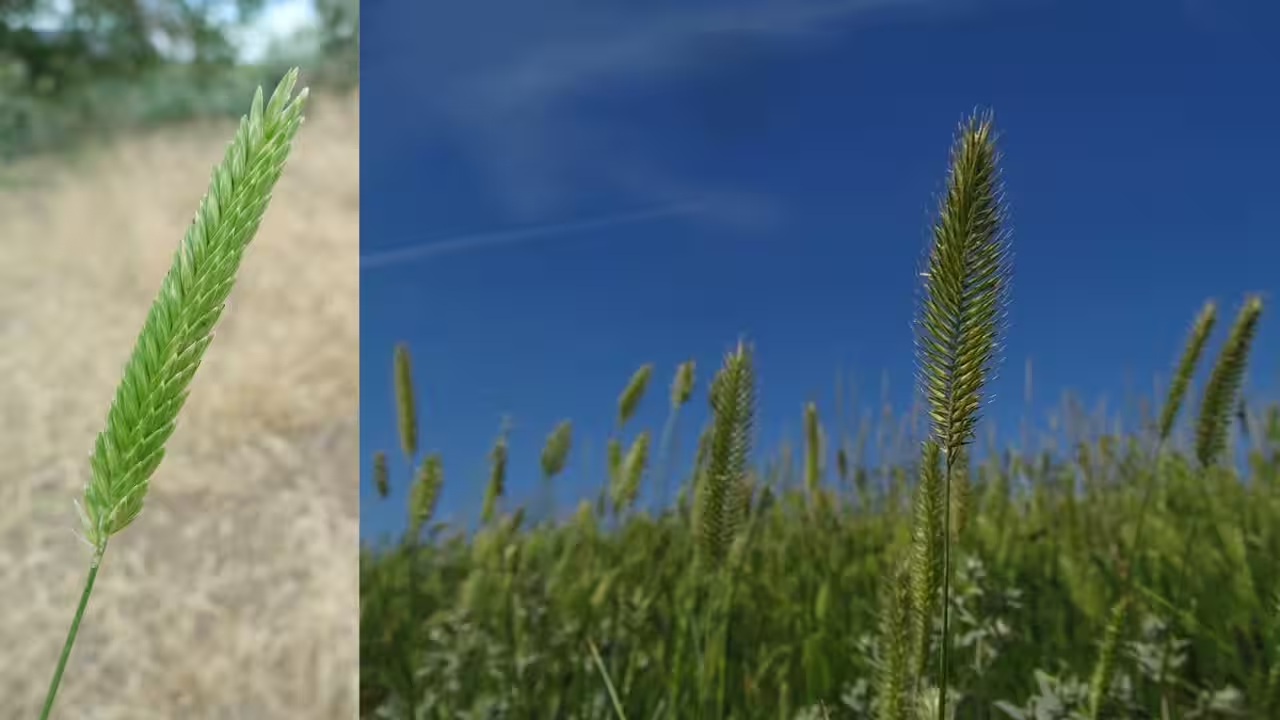
Land managers were seeking ways to restore degraded rangelands and provide forage for livestock, so they planted crested wheatgrass in large areas of the American West during the 1930s. The grass is native to the steppes of Russia and Siberia, and was established readily in cold and dry conditions, with an ecological-site assessment from the US Department of Agriculture estimating that about 20 million acres of crested wheatgrass have been planted in the western United States. That figure is an estimate of planting and not a measurement of how many acres are still dominated by the grass today, and it also warns that crested wheatgrass can spread into neighbouring native grasslands and compete with local vegetation.A grass that was chosen for damaged rangelandsCrested wheatgrass (Agropyron cristatum) was introduced to the United States in the early 20th century, and the US Forest Service records its first successful establishment in the country between 1907 and 1913, with its use expanding during the 1930s. The grass was practically advantageous for ranchers and land managers, as it tolerates cold and dry conditions, establishes relatively easily, and can remain productive for decades. Those characteristics made it useful in semi-arid regions where native vegetation had been damaged by cultivation, grazing, or other disturbance.The USDA's Agricultural Research Service explains how drought and economic hardship during the 1930s increased pressure to conserve soil and restore damaged rangelands, with New Deal-era conservation programmes expanding seed production and restoration work. Crested wheatgrass was among the introduced perennial grasses that were developed and distributed for these plantings, and the first known range seedings in the Intermountain West took place in 1932 near American Falls, Idaho, and at a USDA sheep experiment station in the state.Why is grass so difficult to replace?The same characteristics that made crested wheatgrass particularly useful for restoration can also create problems when managers want native plant communities to return after some time. The species is a long-lived perennial that has vigorous seedlings and a well-developed root system, and the Forest Service says that it can remain productive for more than 30 years and form stands that are dominated by the introduced grass. Crested wheatgrass greens up earlier in spring than many native bunchgrasses, which allows it to use soil moisture early in the growing season. It produces abundant seed, and established stands can persist even after the original planting objective has changed.The USDA ecological-site assessment identifies crested wheatgrass as a concern in areas where seeded pastures are at the border of native grasslands, since its seeds can dominate the seed bank in invaded areas, while established plants start competing with native grasses. The assessment links these altered plant communities with reduced plant diversity and simpler vegetation structure, but these effects vary by site, and the presence of crested wheatgrass does not mean that every native species will disappear.The acreage estimate needs contextThe estimated 20 million acres is widely cited in USDA ecological-site descriptions, but it traces back to research published in 1981, and should therefore be treated as a historical estimate of how extensively the grass was planted, instead of a current survey of its distribution. The US Forest Service's species review gives a wider range for crested and desert wheatgrass seedings combined, and reports that these grasses were established on 10 million acres and, by some accounts, as much as 26 million acres across North America. The review notes that the two species have very frequently been treated together in planting records, which complicates comparisons between estimates.Restoration goals have changedCrested wheatgrass remains useful as livestock forage and for establishing vegetation on some disturbed sites, and the management challenge only arises where older plantings occupy areas that are now targeted for restoration of native grassland or sagebrush-steppe ecosystems. It would require intensive management to return those sites to native vegetation, especially where the introduced grass has formed persistent stands, and restoration plans may need to control existing vegetation, introduce native seed and monitor the site over several growing seasons.The history of crested wheatgrass creates a practical conflict in rangeland management, since a species that is selected to solve one problem can complicate a later restoration goal. The original plantings addressed problems such as erosion, degraded land and livestock-feed needs, but where conservation priorities now call for greater native plant diversity, land managers must account for the grass's long persistence and competitive growth.You use AI every day. Now get your AI Quotient. Take the AIQ test.
Topics in this story
Gathered from external sources. Rights to this text belong to whoever originally published it.