Ex-Royal Marine from Dorset completes Pacific and Indian Ocean row
Dave "Dinger" Bell arrives in Kenya after setting off from Peru nearly 11 months ago.
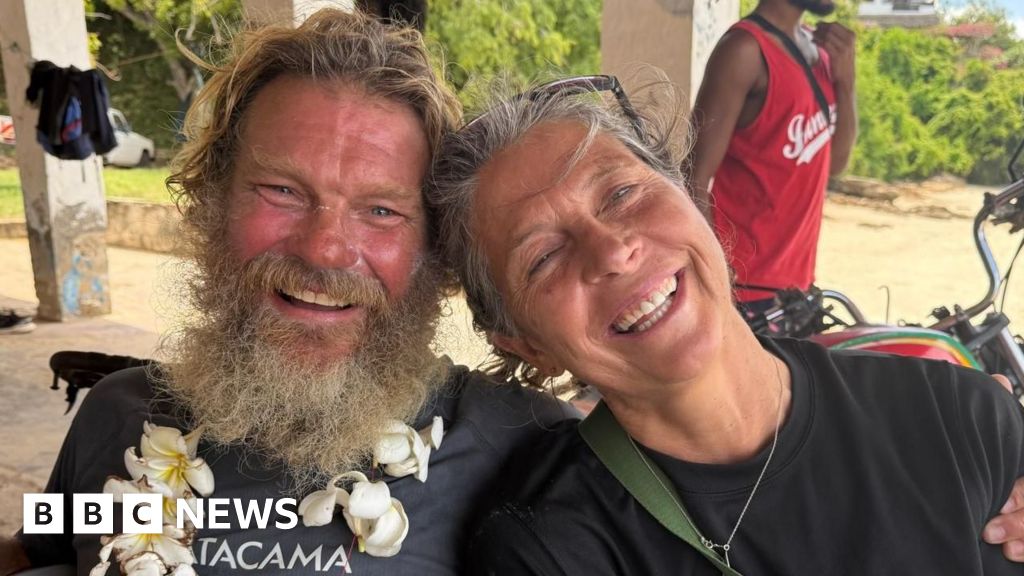
A former Royal Marine has completed a solo and unsupported row across the Pacific and Indian Ocean, having not set foot on land for 327 days.
Dave "Dinger" Bell, from Bere Regis, Dorset, set off from the west coast of Peru on 9 November last year with 350 days worth of food and equipment on board his carbon-fibre boat.
He stepped ashore in Kilifi, north of Mombasa, Kenya, at 10:15 BST (12:15 local time) after rowing more than 15,000 nautical miles (28,000km).
He is using the trip to raise money for Rock2Recovery, a charity helping veterans and blue light workers suffering from PTSD.
On arrival in Kilifi, Bell stooped to touch the sand and was supported by his partner, Georgie, as he walked unsteadily up the beach where he was handed a beer.
Speaking to journalists in front of a waiting crowd, he said: "The last week has been so amazing. I've been the calmest I've ever been in my life.
"I've not stepped off that boat since the ninth of November. This is the first time I've touched land."
Bell, who arrived earlier than expected, said he still had enough food on board to last another 20 days.
When asked if he had seen any sharks, he said: "Yes, the most enjoyable part was the wildlife encounters I had.
"I was followed for weeks - one whitetip on one side and one on the other - and I would row for days like that."
In a video update on Monday, Bell said his head was just "monkey-braining around" between looking forward to being home and the practicality and logistics of being ashore.
He said: "The plan is for me to step off... go back to the hotel to clean up, sleep and rest and socialise with the people that are coming to see me, then come back to the boat - when I've got rid of my land legs hopefully, so I can walk by myself.
"I'm trying to second guess what it's going to feel like, trying to sensitise myself because It's going to be bewildering to step off and step on dry land - total sensory overload.
"I'm looking forward to it, it'll be a novelty to feel like that and it'll eventually wear off."
In 2021, Bell rowed across the Atlantic, from New York to Newlyn, Cornwall, and vowed never to do anything like it again.
But advances in technology, such as lighter boats, improved solar panels and autopilot systems made him curious about what else he could achieve.
He said he had avoided "clockwatching" by listening to podcasts and audiobooks, as well as by sending and receiving voicenotes.
In one, sent to BBC Radio Solent and recorded in the Indian Ocean, he said he had embarked on the challenge due to an "overwhelming sense of curiosity", adding: "The idea struck me it might be achievable and I couldn't let that go."
Bell's record-breaking journey took him in a westerly direction across the Pacific, the Coral Sea, Great Barrier Reef, Torres Straight and the north coast of Australia, before crossing the Indian Ocean.
He said his biggest challenge during almost 11 months at sea had been to "stop rowing" for eight weeks while crossing the South Pacific to avoid arriving in the Coral Sea during cyclone season.
"I was too quick so I had to slow down," he said.
"To sit, mid-ocean, knowing you've still got seven, eight, nine months at sea but not be rowing was one of the hardest things, psychologically, that I've ever had to deal with."
Among those congratulating Bell on his achievement on social media was TV adventurer Jason Fox who said: "He's done. Two oceans on his own. It is incredible. What he's done is insane and it's all for Rock 2 Recovery."
In a video post, former footballer and pundit Graeme Souness said: "Dave, I can't get my head around 15,500 miles. Truly, truly incredible. Well done you."
Bell's challenge has so far raised more than £110,000 for Rock2Recovery.
After 323 days adventurer nears end of epic oceans row
Former marine completes unsupported Atlantic row
Topics in this story
Gathered from external sources. Rights to this text belong to whoever originally published it.