In 1988, diver Todd Barber watched a Cayman reef die, then invented hand-launched Reef Balls; his foundation’s modules now create habitat in over 70 countries
Rest of World News: Todd Barber was diving around Grand Cayman when Hurricane Gilbert damaged the coral reef he had known since childhood. The experience led Barber and h.
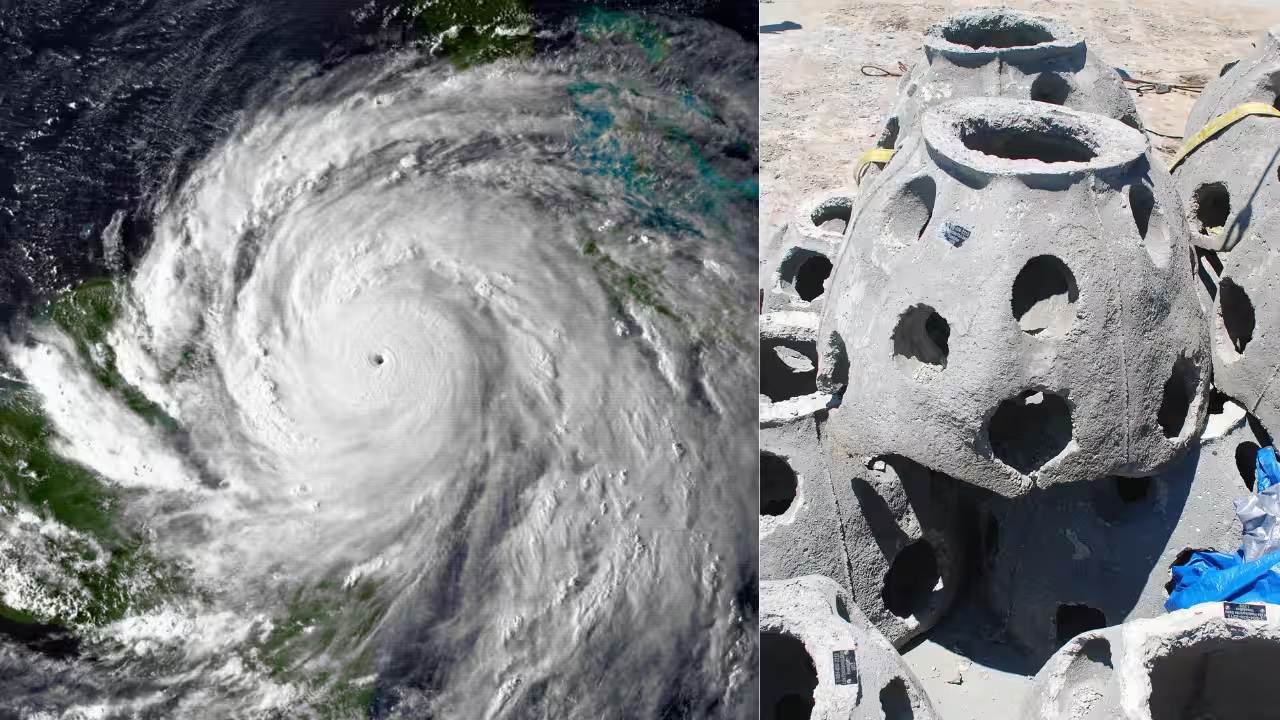
Todd Barber was diving around Grand Cayman when Hurricane Gilbert damaged the coral reef he had known since childhood. The experience led Barber and his father, Jerry, to look for a way to create artificial reef structures that could be transported and deployed without the heavy equipment that is generally used for large underwater installations.Their answer was the Reef Ball, which is a hollow concrete module with openings that provide shelter for marine organisms. The Reef Ball Foundation's history says the Barbers developed and patented the design after seeing the condition of the Cayman reef.Barber founded the Reef Ball Development Group in 1993, and that August the group's first ocean test reef, which consisted of three Reef Balls, was deployed south of Peanut Island in Florida's Intracoastal Waterway.A concrete sphere designed to move without cranesThe modules were built around inflatable objects, initially beach balls and later a central inflatable bladder. The hollow structure could be floated to a site by a small boat and then sunk by deflating the interior once the concrete hardened, which made the system different from artificial reefs created by sinking ships, vehicles or other heavy objects.The Reef Ball Foundation says the Barbers worked with researchers and colleagues from the University of Georgia, the Nationwide Artificial Reef Coordinators and the Florida Institute of Technology while refining the design. The foundation says a pH-neutral, hardened microsilica concrete was selected, while rough surface treatments were used to encourage organisms such as corals, algae and sponges to settle on the modules.The first tests came in 1993The first Reef Ball ocean test was modest, wherein three modules were placed in the water in August 1993. A contemporary September 1993 report from Waterfront News described the Barbers as the inventors of the inflatable concrete structures and said that the modules were intended to be inexpensive enough for local dive clubs and other groups to build and deploy.The early design was built around a four-foot-diameter inflatable structure, and the concrete shell contained openings that created protected spaces for juvenile fish and other marine organisms. Reef Ball's first test reef was expanded with newer designs in 1994 and later dedicated as a memorial reef.By 1997, the Reef Ball Foundation had been established as a nonprofit organization, which expanded the work beyond the original artificial-reef concept.From one reef to an international systemThe foundation says Reef Balls became internationally established after 300 modules were deployed in Cancun, Mexico, in 1994. Projects later spread across the United States and into Europe, the Arabian Gulf, Canada, Brazil, the Caribbean, Indonesia and Africa. The foundation now says Reef Balls have been used in 59 or more countries, while its projects have a global reach of more than 70 countries, and also reports more than 6,500 projects and more than half a million Reef Balls deployed.Those figures cover a much broader organization than the original 1993 development group, since the foundation's work now includes coral rescue and propagation, oyster and kelp reefs, mangrove restoration, living shorelines and other habitat projects.The modules became habitatThe basic principle has remained the same, which was to place a stable structure on the seabed and give marine organisms surfaces and protected spaces on which to settle. The foundation says Reef Balls are designed to resemble natural reef formations, with cavities that provide shelter for fish and other organisms.Results depend on location, water conditions, species present, and the ecological goals of an individual project, but the system that began with Barber's response to a damaged Cayman reef developed into a global artificial-reef program. The foundation now lists projects involving coral transplantation, fish habitat, oyster restoration, mangroves and shoreline protection.The original motivation remained tied to what Barber had seen underwater after Hurricane Gilbert, which began as an attempt to recreate damaged reef structure and eventually became a standardized module that could be built, transported and placed underwater without the cranes and barges required for much larger artificial-reef objects.Catch the latest World News and Live updates. Download the TOI app.
Topics in this story
Gathered from external sources. Rights to this text belong to whoever originally published it.