Leonardo DiCaprio helped protect Indonesia’s Leuser Ecosystem, a rare rainforest where elephants, tigers and orangutans still live together
US News: Long before climate campaigns became a fixture of celebrity activism, Leonardo DiCaprio travelled deep into one of the last places on Earth where oran.
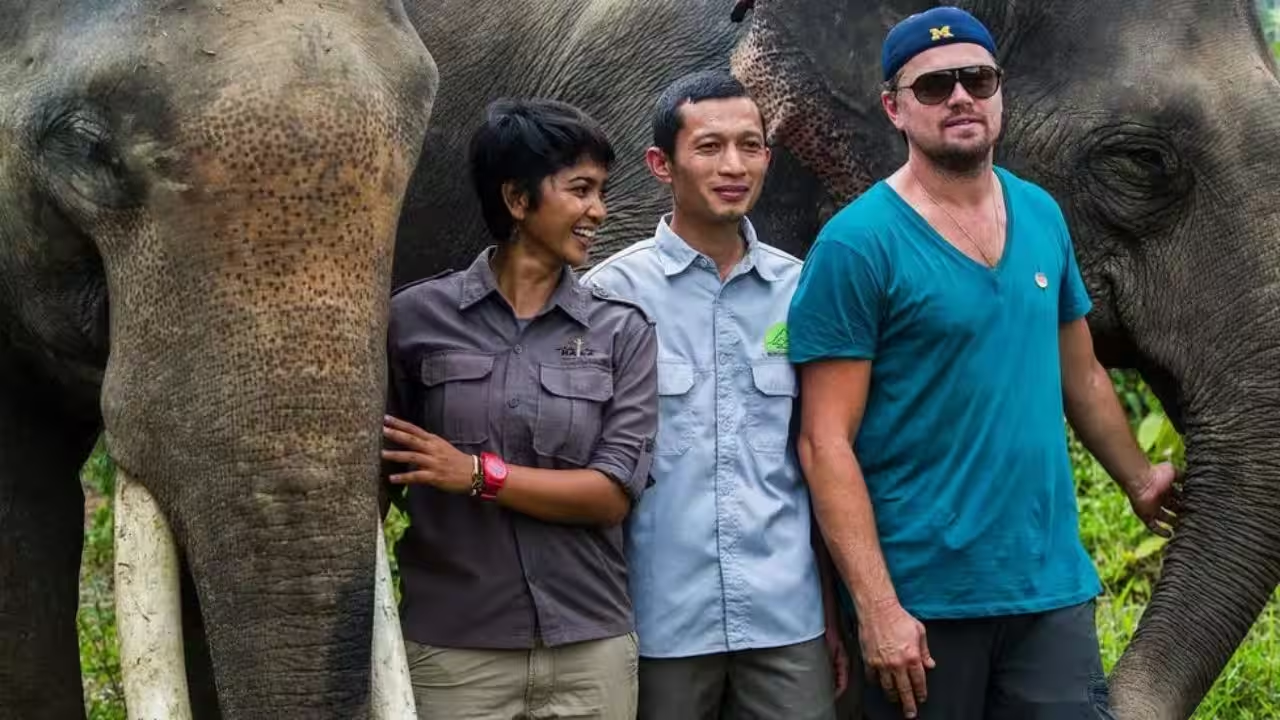
Long before climate campaigns became a fixture of celebrity activism, Leonardo DiCaprio travelled deep into one of the last places on Earth where orangutans, elephants, tigers and rhinos can still be found within the same connected landscape. His 2016 visit to Indonesia's Leuser Ecosystem lasted only a matter of days, yet it quickly turned a remote stretch of rainforest into an international talking point. He shared an Instagram post, showcasing conservationists and observing endangered wildlife that spread widely online, drawing fresh attention to a forest that scientists and environmental groups had been trying to protect for years. What followed was a debate that reached far beyond wildlife tourism. DiCaprio's warnings about palm oil expansion and habitat loss amplified concerns already being raised by conservation organisations, while Indonesian officials pushed back against parts of his criticism. This highlighted both the global importance of Leuser and the competing pressures shaping its future.Leonardo DiCaprio visited a fragile refuge for Sumatra’s threatened wildlifeThe Leuser Ecosystem covers about 6.5 million acres across the Indonesian island of Sumatra. It is unusual not simply because of its size, but because of the animals that still occupy parts of it.Sumatran orangutans, tigers, rhinos and elephants can all be found within the wider landscape. For conservationists, keeping those species in the same connected habitat matters because each depends on increasingly limited areas of suitable forest.According to Rainforest Action Network (RAN), he said, “The Leonardo DiCaprio Foundation is supporting local partners to establish a mega-fauna sanctuary in the Leuser Ecosystem, the last place on Earth where Sumatran orangutans, tigers, rhinos and elephants coexist in the wild.”DiCaprio's visit brought him into contact with some of that wildlife. Photographs from the trip showed him alongside elephants, while images shared on social media also drew attention to the Sumatran orangutan.The forest itself is under pressure. Agricultural expansion, particularly for palm oil, has altered parts of the landscape, while roads, mining and logging have added other forms of development. Fragmentation can be especially problematic for animals such as elephants, which need room to move between different parts of their range.ID@undefined Caption not available.Palm oil expansion puts Leuser forests under pressurePalm oil was at the heart of DiCaprio's public comments after the trip. The crop is widely used in food and other consumer products, and Indonesia is one of the world's major producers.For conservation organisations working in the Leuser region, the concern was not simply the existence of palm oil production but where plantations were being established and what happened to forests and peatlands as land was cleared.DiCaprio used his social media accounts to argue that expanding plantations were breaking up forest and interfering with elephant movement. He also described the Leuser landscape as a major biodiversity area facing pressure from development.His comments came shortly after he had announced at the World Economic Forum in Davos that the Leonardo DiCaprio Foundation would support organisations working to protect the ecosystem.ID@undefined Caption not available.Why Leuser's forests matter to millions of peopleThe Leuser Ecosystem is important for reasons that extend well beyond its wildlife. Its lowland forests and peatlands hold large quantities of carbon, while the wider watershed provides water and other resources for communities living in the region.Forested catchments also help reduce the impact of floods, landslides and other environmental hazards. Millions of people depend directly on the ecosystem in different ways, making its condition a local issue as well as an international conservation concern.That wider role formed part of the argument made by conservation groups supporting stronger protection. Losing forest in the region would not only reduce habitat for endangered species; it could also affect water supplies, carbon storage and the stability of surrounding landscapes.Government response adds a new twist to the Leuser debateThe reaction from the Indonesian government was more complicated than the supportive response from conservation organisations.As reported by the BBC, Environment and forestry minister Siti Nurbaya said, "My view is that DiCaprio's concerns are both sincere and substantial, and he has certainly acted in good faith," she said.She said the government was addressing problems inherited from previous years, including taking action against companies that breached environmental regulations.The disagreement did not mean the government rejected the importance of the Leuser Ecosystem. Officials said they supported efforts to protect it, even as they objected to some of DiCaprio's public statements.The issue became more pointed when Indonesian immigration authorities suggested that the actor could potentially be prevented from returning to the country if his social media posts were considered provocative or damaging to the government's interests. His tourist visa, officials noted, restricted what he could do while in Indonesia.A short trip became an international conservation storyDiCaprio's two days in the Leuser Ecosystem therefore produced two separate conversations. Conservation organisations saw an opportunity to bring international attention to a landscape containing some of Sumatra's most threatened wildlife. Indonesian authorities, while acknowledging the value of raising awareness, challenged aspects of the picture being presented abroad.The episode also illustrated the difficulty of protecting a large, inhabited landscape where conservation, agriculture and economic development overlap.For the species living there, the issue was much less about the controversy surrounding one visitor. Their survival remained tied to whether enough connected habitat could be retained. In the Leuser Ecosystem, that meant forests, peatlands and wildlife corridors continuing to function as part of one landscape rather than becoming increasingly isolated pieces.Catch the latest World News and Live updates. Download the TOI app.
Topics in this story
Gathered from external sources. Rights to this text belong to whoever originally published it.