California construction workers uncover 40-million-year-old fossils; they could belong to extinct 'thunder beast' or 'swamp rhino'
Workers on a routine infrastructure project in Oceanside, California, recently uncovered the fossilised remains of a large, hoofed mammal that lived tens
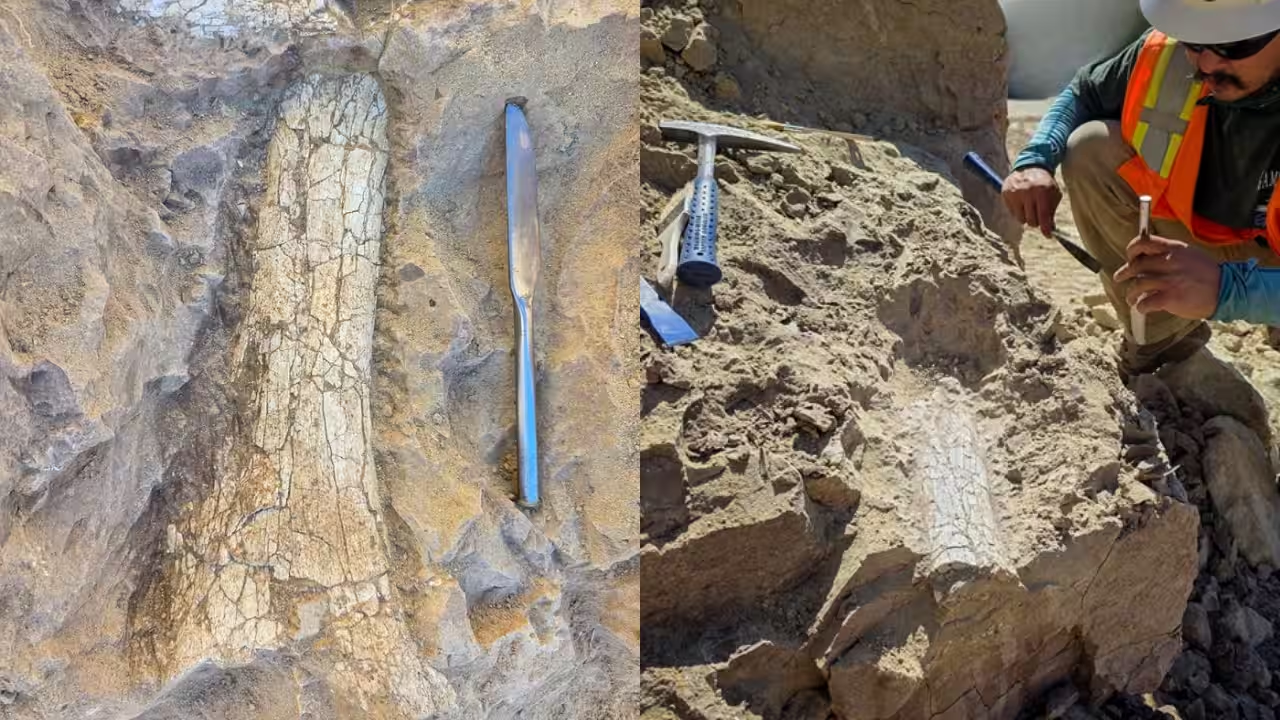
Workers on a routine infrastructure project in Oceanside, California, recently uncovered the fossilised remains of a large, hoofed mammal that lived tens of millions of years ago. The significant find, which included several limb bones, ribs and numerous other bones and fragments, was uncovered approximately 12 feet below the surface during routine excavation for a city infrastructure project, according to the City of Oceanside. A palaeontologist now believes the bones belong to one of two extinct, rhino-sized mammals that roamed North America during the Eocene Epoch.Why the fossils were unearthed during routine monitoring of a construction projectJoseph El Adli, PhD, the city's principal palaeontologist, discovered the site during routine monitoring and immediately secured the area to begin additional excavation. The city has kept the exact location under wraps; other outlets that covered the release reported this is meant to protect the site from unauthorised digging that could damage further fossils still in the ground.His team worked over a period of seven days to expose the fossil bones from beneath several tons of hardened mudstone and sandstone before encasing them in a plaster field jacket for safe transport to an off-site laboratory for eventual preparation.Could the bones belong to a rhino-sized 'thunder beast'Based on the size and shape of the bones uncovered during the excavation, Dr El Adli believes they likely belonged to an animal from one of two extinct mammal families that once roamed North America, both of which belong within the order Perissodactyla, the odd-toed hoofed mammals.The first possibility is a brontothere, sometimes called a titanothere or "thunder beast." A brontothere is a massive, hoofed mammal with a deep chest, a pronounced hump at the shoulder and a distinctive Y-shaped bony horn on the nose. They were land-dwelling creatures that fed on soft leaves and vegetation in forested habitats. The particular species known from this rock formation was roughly the size of a modern black rhino.The second possibility is an amynodont, historically referred to as a "swamp rhino." Amynodon had hornless faces and squat, hippopotamus-like bodies, with low, barrel-shaped torsos, short sturdy legs, a broad flat skull, and tusk-like canine teeth rather than a horn. Some amynodons were semi-aquatic, spending much of their time wallowing in rivers, ponds, and lakes and grazing on coarse aquatic and streamside vegetation, while others were more lightly built and lived on land.What Member C of the Santiago Formation reveals about the fossils' Eocene-era ageThe bones were recovered from Member C of the Santiago Formation, a thick sequence of sedimentary rocks exposed across parts of northwestern San Diego County. The formation dates to the Eocene Epoch and has previously yielded fossils from that time period within the city, as well as elsewhere in the region. Based on the surrounding rock and known organisms from the formation, palaeontologists estimate the specimen lived roughly 40 to 45 million years ago.What happens next for the newly discovered Oceanside fossilsThe fossils, now encased in plaster field jackets, have been transported off-site for lab preparation. Other outlets that reviewed the city's release reported that technicians will eventually free the bones from their plaster jackets and the surrounding hardened mudstone, then stabilise them with glues and resins so they can be preserved, to eventually place them in a museum collection where scientists and the public can study them.You use AI every day. Now get your AI Quotient. Take the AIQ test.
Topics in this story
Gathered from external sources. Rights to this text belong to whoever originally published it.