From 1968 to 1977, retired North Carolina tobacco farmer Henry Warren built a 27-building miniature stone village around a large metal water tower
Explore the captivating story of Henry Warren, a retired tobacco farmer who, in 1968, initiated the construction of a whimsical stone village called Shangri-La in North Carolina. Discover the village's unique buildings, materials, and the legacy it left behind after Warren's passing in 1977.
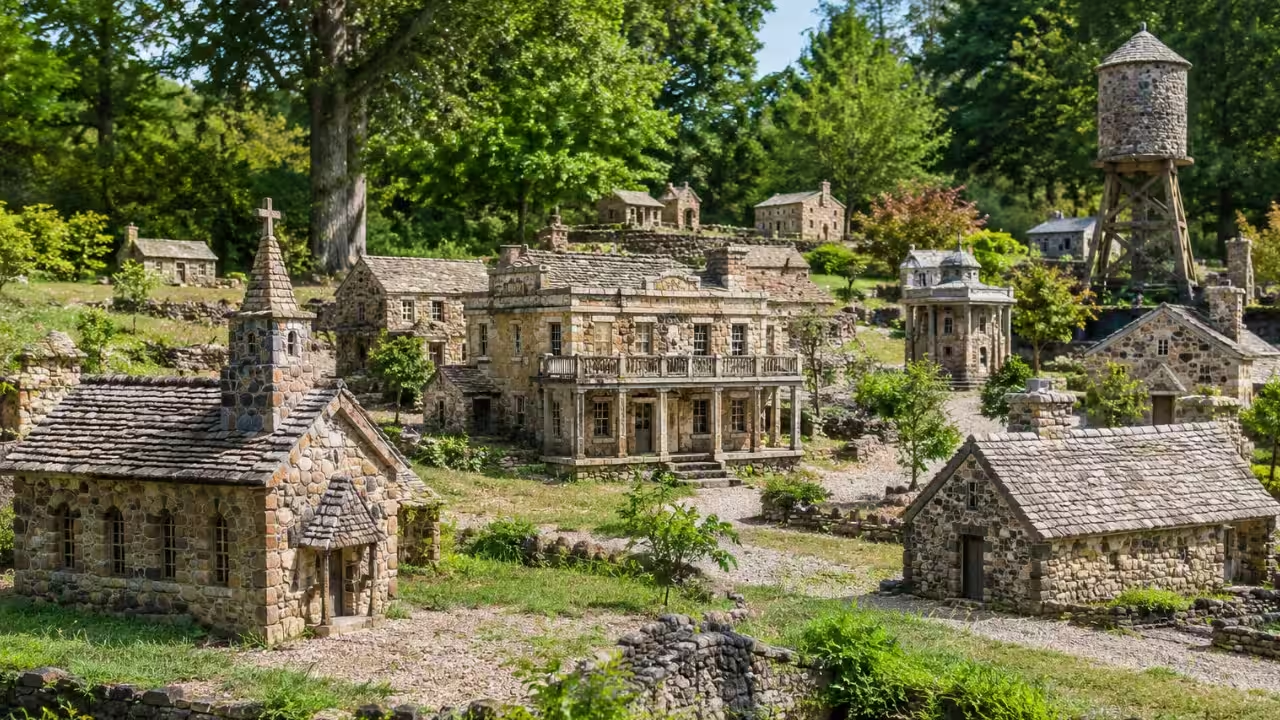
Caswell County lies along the northern edge of North Carolina’s Piedmont, in a region where tobacco was a major cash crop for generations. State Highway 86 runs through the county and passes near the unincorporated community of Prospect Hill. Hidden off the road, next to a volunteer fire station, is a grouping of little houses constructed from white rocks, quartz, bricks and cement, about as tall as a person. The little town does not have a fee or even a ticket booth for entrance; entry is free to all who visit. It was constructed by hand by a retired farmer on his property. The information provided herein deals with the man’s background, motivations, creations and post-death situation.Henry Warren’s retirement from farming Henry L. Warren was a Caswell County native who farmed tobacco until he retired. Our State magazine reports that he began the village in 1968 at age 75 and spent the last nine years of his life on it. The age of 75 fits a death at 84 in 1977, as Roadside America records, whereas VisitNC’s figure of 72 would make him 81 at his death and does not match that record. The Carrboro Citizen column Just Down the Road in Shangri-La describes the village as a hobby that developed over nine years and records that Warren died in 1977. The column references a story from The State magazine from 1979, titled “The Little Stone Village of Prospect Hill,” about a small village made of rocks and mortar and containing over 20 structures. Quoting from Our State, this project came about for the simple reason that farmers were accustomed to working with their hands and needed to have something to do after retirement.A miniature waterwheel from a Hillsborough antiques shopOur State also ties the village to a miniature waterwheel that Warren spotted at an antiques shop in Hillsborough. The magazine notes, “Some of his neighbors referred to it as White Rock Village, but he preferred the name Shangri-La.” The wheel was part of Warren’s completed village, which ABC11 describes as a collection of buildings surrounding a large metal water tower and pond.White flint rock blasted from the family property Roadside America describes how Warren quarried solid rock from his own property and worked on the village from dawn until dusk. Our State mentions white flint rock, quartz, red brick and cement as some of the materials that were used, while the steeple of the church is described as an inverted table leg painted white.According to Atlas Obscura, the stone pathway through the village is one of his inventions. Roadside America states that the total number of arrowheads embedded in the pathways is 11,000, while Atlas Obscura just mentions that there are thousands. ABC11 describes the winding pathway made of quartz, stones and arrowheads passing through tall bushes. Warren’s wife told Roadside America that as long as he had a cigarette and a Coke, he kept building.27 buildings standing at Warren’s death in 1977ABC11 and Roadside America both count 27 buildings in the village at the time of Warren’s death. Our State lists a church, hospital, mill, motel, movie theater, general store, jail, library, city hall and even a liquor store and Atlas Obscura adds a gym and a hotel. A bank and a gas station round out the list in Roadside America’s account and the Carrboro Citizen also places a fire station among them. The buildings stand about five feet tall, as ABC11 and VisitNC measure them. Visitors can also rest on carved thrones and feel like kings or queens of the village, a detail ABC11 highlights.The 1972 plaque and the hospital Warren was working on in 1977In 1972, Warren engraved his motto on a stone slab, ABC11 reports, reading: “Let me live in the house by the side of the road and be a friend to man.” Roadside America notes that a sign bearing the same inscription is found at the front of his house. The same source reports that Warren died of cancer in 1977 while still at work on the village’s miniature hospital. Whether that hospital was ever finished is unclear, since WRAL and Atlas Obscura both count 27 completed structures at the time of his death.Warren’s wife and daughter and the village’s upkeep As summarized in the North Carolina Periodicals Index entry for the 1979 magazine article, his wife eventually gave free tours of the village to visitors, with children and older people coming most often. According to ABC11, currently, Warren’s daughter and her family preserve Shangri-La. In addition, the journal of visitors, which is located on a grass-covered hill above the village, contains decades of thank-you messages to the Warren family. The stone/concrete construction has contributed to the durability of the buildings, as noted by Atlas Obscura and visitors can still use the trail from the house to the village.You use AI every day. Now get your AI Quotient. Take the AIQ test.
Topics in this story
- North Carolina stone village
- Henry Warren
- retired tobacco farmer
- Shangri-La Prospect Hill
- little houses construction
- Prospect Hill stone village
- Henry L. Warren
- Shangri-La little stone village
- North Carolina tobacco farming
- tourist attractions in North Carolina
- Caswell County attractions
- free attractions North Carolina
Gathered from external sources. Rights to this text belong to whoever originally published it.