Rwanda planted dozens of exotic tree species in an experimental forest in 1933; 90 years later scientists found eucalyptus had acidified the soil
Rest of World News: In Rwanda, an experiment with exotic trees grew into a much larger forestry programme, with eucalyptus eventually becoming the country’s dominant plan.
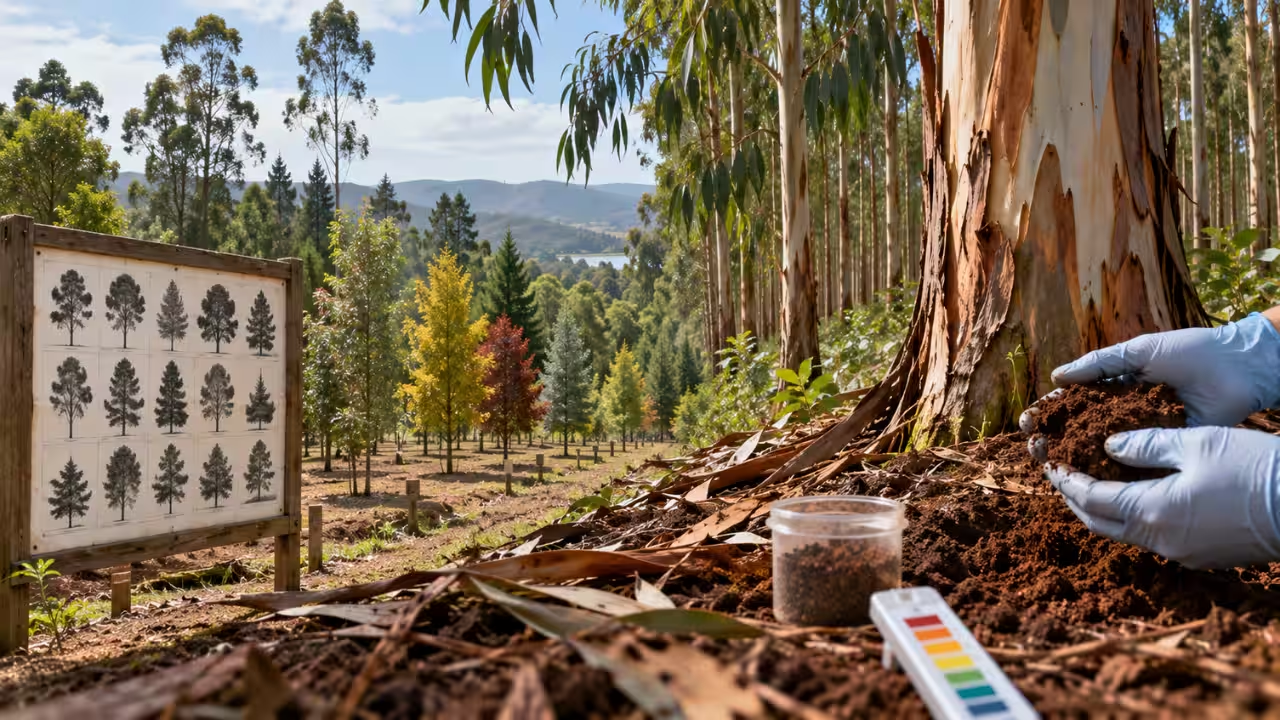
In Rwanda, an experiment with exotic trees grew into a much larger forestry programme, with eucalyptus eventually becoming the country’s dominant plantation tree. A 200-hectare arboretum was established at Ruhande in Butare to test exotic species, including 63 species of eucalyptus, as Rwanda prepared to expand plantation forestry. By the early 1970s, eucalyptus plantations in Rwanda had reached about 23,000 hectares, part of a wider 95,684-hectare area across several East African countries. The expansion also brought questions about what intensive eucalyptus planting could mean for the environment. Researchers have examined concerns ranging from nutrient removal and soil quality to water use. According to the study published in Springer Nature Link, titled ‘Water use by short rotation Eucalyptus woodlots in southern Rwanda’, eucalyptus has been described as taking up large amounts of nutrients, potentially leaving soils poorer for other uses. However, the available research does not establish a 90-year soil-acidification finding at Ruhande, and the study discussed here focuses primarily on eucalyptus water use in southern Rwanda.Eucalyptus became Rwanda’s dominant plantation treeThe experiment was followed by a much wider expansion of eucalyptus planting. By the early 1970s, eucalyptus plantations across Ethiopia, Rwanda, Uganda, Kenya and Sudan covered 95,684 hectares, with Rwanda accounting for about 23,000 hectares at the time. The supplied paper notes that Rwanda and Ethiopia had the largest areas among those countries.In Rwanda itself, eucalyptus became the dominant plantation tree. The study states that eucalyptus accounted for 78% of forest plantations, with most plantations managed as short-rotation coppice. Small woodlots were particularly common, often appearing as groups or rows of trees scattered across farmland.Scientists raised concerns about eucalyptus and soilThe environmental effects of eucalyptus planting were already an area of scientific discussion. The supplied source notes that some researchers supported eucalyptus plantations for their economic, social and environmental benefits, while other research raised concerns about their effects on soil. In particular, it reports that eucalyptus had been described as taking up substantial quantities of nutrients, potentially leaving soils poorer for subsequent uses.The paper does not, however, report a 90-year comparison showing that eucalyptus at Ruhande acidified the soil. Its own research examined water use by short-rotation eucalyptus woodlots in southern Rwanda, rather than measuring a century-long change in soil acidity. The source cites a separate 2009 study titled Soil CO2 flux in six monospecific forest plantations in Southern Rwanda, but the supplied material does not provide that study's soil-pH results.Researchers measured eucalyptus water use in southern RwandaThe researchers examined eucalyptus woodlots in the Butare and Busoro catchments in southern Rwanda. The study found that the stands were generally small, frequently coppiced plantations, with tree diameters ranging from 2 to 36 centimetres. Potential tree transpiration ranged from 0.41 to 6.44 millimetres per day in the Busoro catchment and from 1.34 to 3.44 millimetres per day in the Butare catchment.The study's overall estimate was about 3 millimetres of potential tree transpiration per day, or roughly 1,095 millimetres per year. Long-term precipitation at the study site averaged 1,245 millimetres annually, and those dry-season water deficits could be reduced through lower leaf area and stomatal closure. The paper therefore concluded that the short-rotation woodlots studied did not necessarily produce a negative annual water balance.Catch the latest World News and Live updates. Download the TOI app.
Topics in this story
Gathered from external sources. Rights to this text belong to whoever originally published it.