Israel elections, West Asia wars & Bibi’s last gambit
The miraculous survival of Israeli passengers on the flydubai flight that saw an attempted hijacking and potential terror plot – thwarted only by the
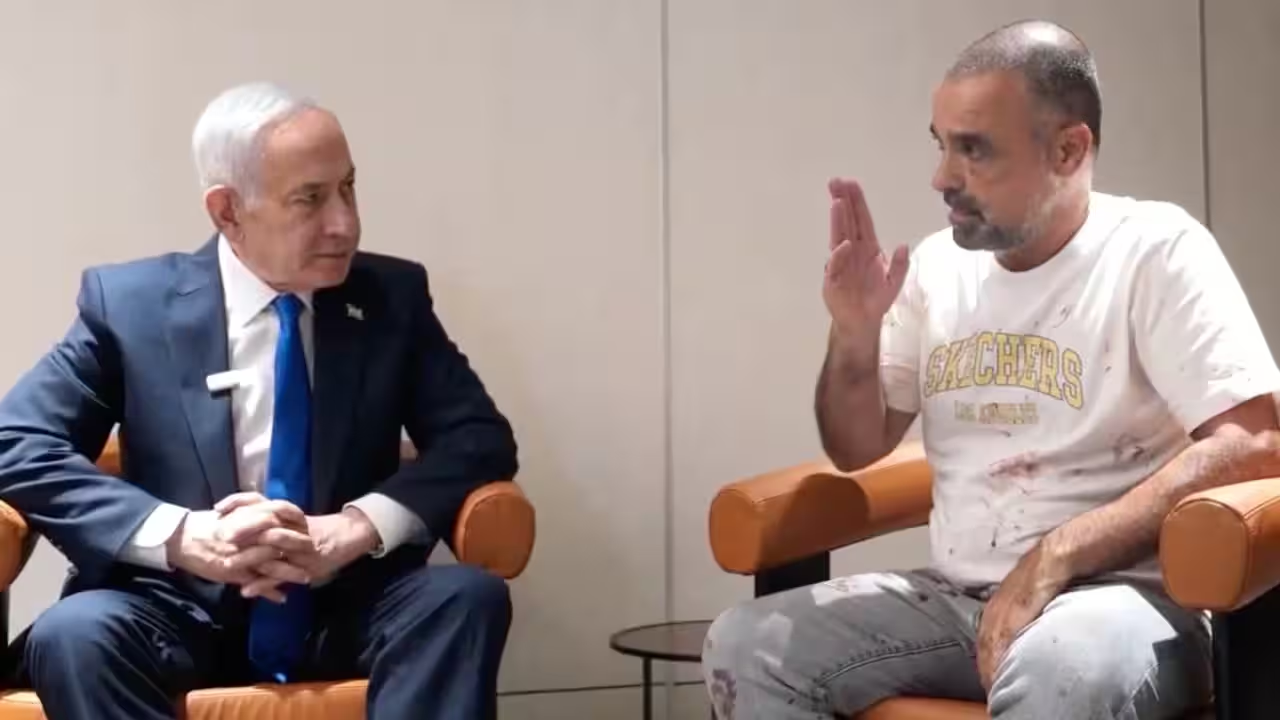
The miraculous survival of Israeli passengers on the flydubai flight that saw an attempted hijacking and potential terror plot – thwarted only by the quick thinking of Indian Captain Smit Machchhar and the passengers – has become the latest hot button issue in Israel’s upcoming Oct 27 polls. Even before the high-altitude drama, the election was shaping up to be a pivotal one, not just for Israel but also the wider West Asia.For, the polls are taking place at a time when US and Iran are still engaged in war – a war Tel Aviv started together with Washington but now seems to have quietly exited – Strait of Hormuz is still not fully open for oil and cargo traffic, and Israel itself is militarily mobilised on four fronts – Gaza, Lebanon, Syria, and West Bank. Plus, these are the first polls since the Oct 7 Hamas attack on Israel that appears to have fundamentally changed Israeli society. Here’s the lowdown on the Oct 27 polls, the key players, and the issues animating Israeli voters.Lion of JudahThe flydubai incident is literally godsent for Netanyahu. He and his Likud Party have been consistently trailing in opinion polls. But ever the political wizard, Netanyahu is approaching the polls on the front foot. He knows the election will essentially be a referendum on his handling of Israel’s security situation since Oct 7. Thus, he is presenting himself as the only leader who can guarantee Isreal’s security. And flydubai just exemplified his long-running narrative that Israel still isn’t safe, there are enemies everywhere, and only a strong leader like him can lead the country.His tactic? Go on the offensive against any hint of criticism of Israel’s policies – be it at the UN General Assembly (where Netanyahu basically delivered a campaign speech defending his govt’s record) or blasting New York mayor Mamdani.In doing so, Netanyahu is using an old political trick: fuse his image with that of Israel. Thus, criticising him would be seen as criticising Israel. But Bibi’s campaign isn’t without headwinds.The ChallengerNetanyahu’s main challenger in these polls is Yashar Party’s Gadi Eisenkot, a former Israeli army chief of staff. Eisenkot was once No.2 to former PM hopeful Benny Gantz. But he launched Yashar in Sept 2025, months after leaving Netanyahu’s emergency coalition formed after Oct 7. The war in Gaza is very personal for Eisenkot – he lost his son Gal two months into the fighting.Eisenkot has sought to build a centrist coalition, consolidating opposition votes, while also indicating openness to those who are part of the Netanyahu coalition. A poll projection, published this week, showed the opposition bloc led by Eisenkot’s Yashar winning 54 seats in the 120-member Knesset. Netanyahu’s governing bloc was down to 50 seats.Can Eisenkot pull off an upset? Difficult to tell. Eisenkot’s coalition, should it perform per the poll projections, will still be short of the 61-majority mark. Netanyahu, in fact, could be betting on this. He rode out a similar situation between 2018 and 2022, when Israel had five elections. That saw Netanyahu repeatedly frustrate the opposition, eventually returning to power with the most right-wing govt in Israel’s history.So, Netanyahu’s strategy is simple. If he is not getting a majority, make sure the opposition doesn’t get one either. This will see Israelis head back to polls, and run the whole thing again. Netanyahu is banking on the fact that people will get tired and conclude there’s no alternative to him.The Arab dilemmaThat’s the other problem for the opposition. The only way it can cobble together a clear majority is with the support of Arab-led parties. However, in the post-Oct 7 scenario, when Israeli society is so polarised, tying up with Arab parties is kryptonite for anyone vying to form govt. Even if there is no formal alliance, any opposition bloc that relies on votes of Arab parties in the Knesset will be meat for Netanyahu. The latter is already questioning the credibility of the opposition to form govt, saying can Israelis really trust a coalition that would potentially need the support of Arab parties.Will the results impact geopolitics? The regional scenario will remain much of the same, no matter who forms the next Israeli govt. At least in the near term. The divisions within Israeli politics are more on internal issues – corruption charges against Netanyahu, establishment of a state commission of inquiry into Oct 7 failures, judicial reforms, mandatory conscription for the ultra-orthodox Haredi, and the high cost of living. Those looking to unseat Netanyahu see the same threats from Hamas, Hezbollah, and Iran. Only their approach may differ, to a moderate degree.What about Israel’s relations with US? This may be the trickiest issue. Following Israel’s post-Oct 7 wars in Gaza, Lebanon, and West Bank, criticism of Israel and Netanyahu’s govt has grown in US, both on the political left and right. Even MAGA supporters are questioning the unquestioned Washington support for Tel Aviv. Netanyahu essentially believes that US has no choice but to back Israel. Washington, long dependent on Israel to carry out its West Asia policy, may finally be looking to pull back, and allow other allies in the region – Saudi Arabia, UAE, Qatar – to play a bigger role. This would mean that the Abraham Accords are not just a template for Arab-Israeli relations, but also a template to balance against Israel in West Asia.You use AI every day. Now get your AI Quotient. Take the AIQ test.
Topics in this story
Gathered from external sources. Rights to this text belong to whoever originally published it.