Early Israeli election turnout highest in decades as Netanyahu fights to keep power
The first vote since the October 7 attacks is a tight race between Benjamin Netanyahu and ex-military chief Gadi Eisenkot — with the future direction of Israel at stake. Follow for live updates.
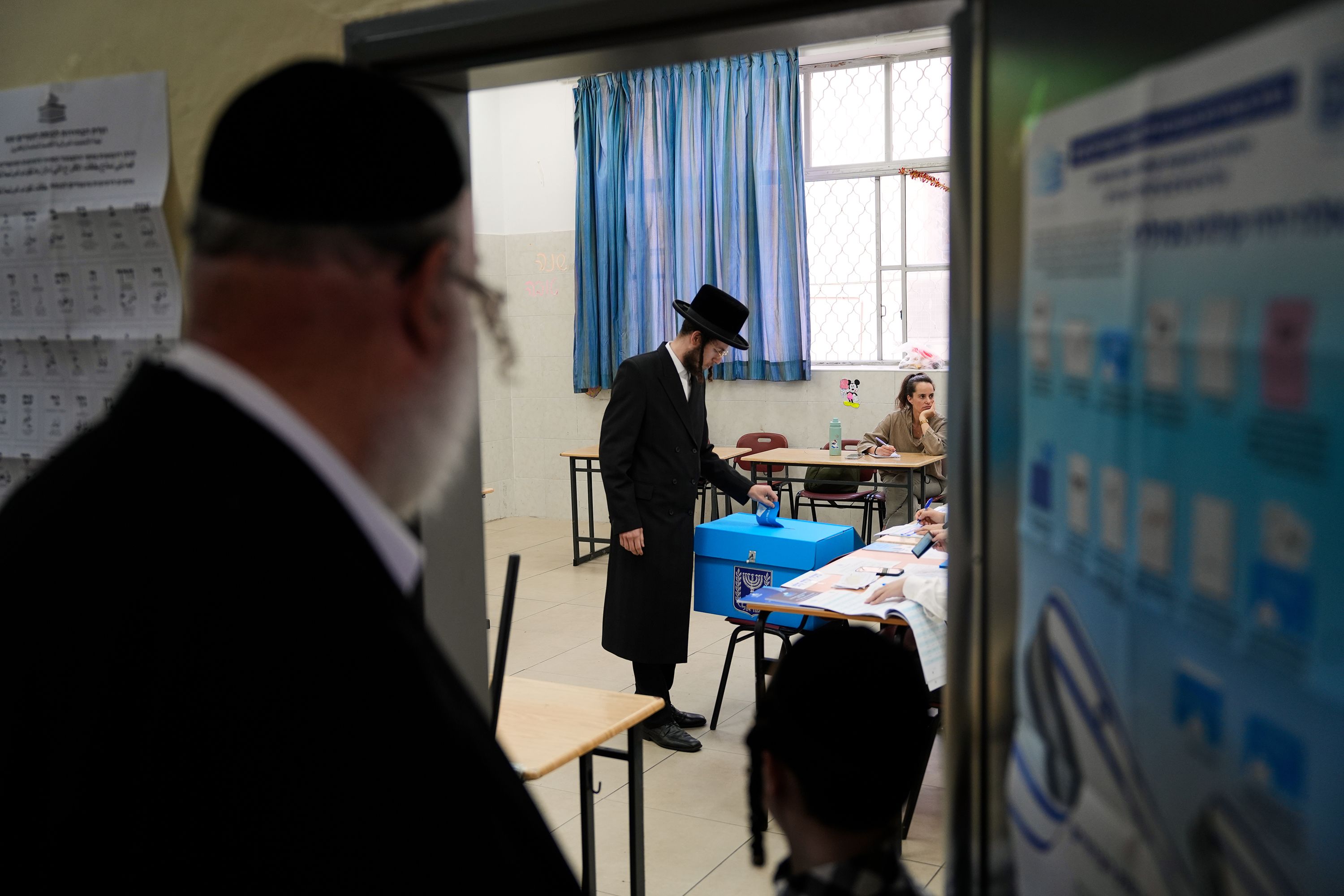
• Crucial election : Turnout in the first few hours of voting in Israel’s election remains at the highest levels in more than 50 years. Israeli Prime Minister Benjamin Netanyahu has cast his ballot in an important election seen as a referendum on his leadership since the October 7, 2023 attacks.
• Key timings: Polls will close at 10 p.m. local time (4 p.m. ET). Opinion polls suggest the race will be too close to call, with Netanyahu in a tight race against Gadi Eisenkot , a former military chief.
• Main issues: Security and accountability are powerful electoral forces after years of war. Opinion polls suggest the economy and cost of living are also leading concerns for many voters.
• Parliamentary make-up: No single party has ever won a 61-seat majority in Israel’s 120-member parliament, or Knesset. Instead, governments are formed through alliances, which can take weeks or even months to form.
Israel’s two leading candidates have made emotionally charged stops on their election day trail.
Gadi Eisenkot, the leading challenger to Israeli prime minister Benjamin Netanyahu, visited the grave of his son, Gal Meir, who was killed in Gaza in December 2023. Eisenkot and his wife Hannah made a stop at the cemetery in Herzliya on his way to vote.
“Over Gal’s grave, I swore that the price he paid, he and his friends, those he knew, and those he didn’t, would not be in vain,” Eisenkot wrote about his son in Yedioth Aharonoth in April 2026, calming that promise central to his political mission. Two other nephews were killed during the war.
On Monday, the night before the vote, Netanyahu visited the Jerusalem Western Wall, as did other right-wing party leaders, traditionally placing a prayer note between the stones.
‘To the lives of IDF soldiers, our heroes, To victory over our enemies. To the success of our people, The eternity of Israel will not lie,” he said.
Families affected by the Hamas-led attacks on October 7, 2023 have held pictures of their loved ones outside of several polling places in Israel throughout the day.
Gil Dickmann is the cousin of Carmel Gat, 39, who was kidnapped from the kibbutz of Be’eri near the Gaza border and killed in Hamas captivity. Standing outside a Tel Aviv polling station holding a picture of Gat, he told CNN he came “to remind everyone that October 7 is still here.” Prime Minister Benjamin Netanyahu, he said, “did not admit that it was his responsibility that he was in charge of keeping us safe and secure, and he’s running again, for reelection. It’s unbelievable that he has the guts to run again.”
Outside a polling station in the coastal city of Netanya, Ruby Chen held a picture of his son Itay, a soldier killed on October 7, whose body was kidnapped to Gaza for over two years.
Early Tuesday morning, families of October 7 victims and former hostages gathered at Tel Aviv’s Hostages Square to hold a somber minute of silence at 6:29 a.m. - the exact moment the Hamas - led attacks began - before calling to vote for political accountability.
Voter turnout in Israel’s elections remains at the highest levels in more than 50 years, according to the Central Elections Committee. As of 2 p.m. local time, 44.9% of voters had cast a ballot, the committee said, the highest turnout recorded since 1973 at that hour.
A total of 3,290,480 voters out of approximately 7.3 million voted already, the committee said.
“It’s a historic high since measurement began in 1973,” said Ofer Kenig, a research fellow at the Israel Democracy Institute, “but of course we have to see whether turnout increase in all sectors and in all strongholds.”
Kenig told CNN that, from preliminary information, “In all sectors we have an increase, except for one, and a very significant one. Only in the ultra-orthodox cities, we see a decrease in voter turnout. In other segments of the Israeli society, we see an increase. Very, very cautiously we can see a higher increase in liberal strongholds rather than the Netanyahu coalition strongholds.”
Kenig cautioned that there are still hours of voting left and some groups may simply vote later in the evening.
High voter turnout poses a risk to the smaller parties running for the Knesset, putting them in danger of falling below the electoral threshold as the turnout rises. Parties need to secure 3.25% of the vote to cross the threshold; the total number of votes needed rises as overall turnout increases.
Meanwhile, voter turnout amongst the Israel Defense Forces stood at 48% as of 1 p.m. local, the military said, an increase from the 2022 election in which 44.4% had voted at the same hour.
Palestinians in Gaza have no vote in Israel’s election. But its outcome will shape their future.
More than 74,000 people have been killed in Gaza since October 2023, with Israeli strikes a near daily occurrence, despite a nominal ceasefire agreed a year ago. Meanwhile, the humanitarian catastrophe continues to deepen, with severe food shortages, widespread displacement, and collapsing basic infrastructure.
Israeli Prime Minister Benjamin Netanyahu’s right-wing coalition and his main rival, Gadi Eisenkot, have both centered their election pitches on ending Hamas rule there.
But for many in the enclave, who wins the election is moot. Here’s what three people in central Gaza told CNN.
Ahed Ferwana: “The programs announced by the Israeli parties — whether parties of Netanyahu’s camp or parties of the opposition — all agree that there will not be an independent Palestinian state. They will not withdraw from the Gaza Strip and will continue military campaigns both in the Strip and even in the West Bank, as is currently seen in the city of Hebron.
“Therefore, these elections are not expected to produce significant results in favor of the Palestinian cause, especially since Eisenkot recently said frankly that he might return to war on the Gaza Strip because there is no quicker option, as he puts it. … As for Netanyahu’s camp … it has been committed to the war for more than three years.”
Musa Ubeid: “I do not count on the right, nor the left, nor anyone in Israel, because they consider our children terrorists, so how can we want or count on any party? They are two sides of the same coin.”
Tareq Abu Eweimeh: “Trump and Netanyahu have one policy, which is wars and their continuation and bloodshed. Therefore their goals are united and they are walking on one path.”
The polls in Israel’s pivotal national election – widely seen as a referendum on Prime Minister Benjamin Netanyahu – are still open for about seven more hours.
Turnout in the first few hours of voting is the highest it has been in 45 years, the country’s Central Elections Committee said.
Opinion polls suggest the race will be too close to call, with Netanyahu in a tight race against centrist opposition candidate Gadi Eisenkot . And many Israelis have said the choice is more consequential than ever .
Many other opposition candidates in Israel’s national elections have also already cast their votes.
In total, there are 37 parties running in the election, although most parties will fall below the threshold of votes needed to get into Israel’s parliament. Candidates can continue to campaign throughout the day, in last-minute pushes to turn out the vote.
Former Israeli Prime Minister Naftali Bennett, leader of the temporarily named Bennett 2026 party, said that it’s “a fateful day for the future of our country” as he dropped his ballot in the box. Bennett voted in the city of Ra’anana, Israel.
The leader of the Democrats party, Yair Golan, cast his ballot in the city of Rosh Haayin, Israel. “A morning of great hope. In this morning, we begin the journey of rebuilding Israel (to be) better – better for its citizens, better for its prosperity and its renewed success,” Golan said as he voted
Meanwhile in Tel Aviv, opposition leader Yair Lapid voted alongside his wife.
Former Israeli Defence Minister and leader of the Yisrael Beiteinu party, Avignon Lieberman, voted in the village of Nokdim, in the occupied West Bank. Calling on everyone to “come out and vote,” Lieberman said, “I am confident that tomorrow we will wake up to a new morning, one in which we can form a Zionist coalition.”
Israelis vote for party lists, not individual candidates. In a society divided by nationality, religion, ethnicity and ideology, that produces a crowded field. There are 36 parties in play.
Dozens of lists register each cycle, but only those that pass a 3.25% vote threshold win seats and enter the 120-seat Knesset, Israel’s parliament.
Polls suggest 11 to 13 parties will meet the bar; seats are allocated through a proportional representation system.
The two largest parties are Netanyahu’s right-wing Likud and Yashar, a new centrist party led by Gadi Eisenkot, a former military chief of staff who has emerged as his principal challenger.
What do the polls say? The latest Channel 12 opinion poll puts Eisenkot first with 23 seats, ahead of Likud with 21, though other pollsters differ. On the pro-Netanyahu Channel 14, Likud is projected to take 30 seats and Eisenkot about 20.
In head-to-head matchups about who is better suited to be prime minister, Eisenkot has led Netanyahu by a steady margin.
But coming out as the largest party is not enough to win. A prime minister needs 61 seats to form a government, and no party has ever won that majority alone. So, election night usually settles very little. The real contest is the coalition calculus that follows, which can take days, weeks or even months.
As voters across Israel head to the polls, some of the country’s leaders have already cast their ballots and are urging people to do the same.
Gadi Eisenkot, the main challenger to Prime Minister Benjamin Netanyahu in this election and head of the new Yashar party, went to the Gaza periphery to meet Gadi Mozes, one of the Israeli hostages captured during the October 7 attacks and later released by Hamas.
“I promise you that I will do everything to be worthy of your trust. That I will bring unifying leadership. That I will be prime minister of everyone – if you choose me.”
His opponents were also vocal online on Tuesday.
Defense Minister Israel Katz, a longtime Netanyahu ally, framed the election as a choice between a “decisive approach” to Israel’s security – or “a return to the policy of containment and restraint.”
President Isaac Herzog and National Security Minister Itamar Ben-Gvir both posted photos of themselves submitting their paper votes into the ballot box.
“I call on all female and male citizens of the country - we are all equal, this is our day to go, to influence and to vote,” Herzog said in a statement. “Tomorrow, we will all continue here together - we have no other country.”
Voting has begun in one of Israel’s most significant elections in its history, where voters are facing a familiar question: Should Benjamin Netanyahu, Israel’s longest-serving prime minister, stay in power?
It is the first national vote since the Hamas-led attack of October 7, 2023 , the deadliest security failure in Israel’s history, and the wars that followed in Gaza, Lebanon and Iran — conflicts that have mobilized much of the country and subsequently deepened Israel’s international isolation.
Here’s what’s been happening so far today:
Voter turnout is currently the highest it has been in 45 years , according to the country’s Central Elections Committee. It is the highest voter turnout since 1981, the committee said at a press conference.
Israeli Prime Minister Benjamin Netanyahu – leader of the Likud party – cast his vote at a polling station in Jerusalem, calling it a “very moving and fateful moment.”
Opposition candidate and former Israeli military chief of staff Gadi Eisenkot has also voted at a polling station in the coastal city of Herzliya, in the northern part of the Tel Aviv district. “I suggest not to get excited by Netanyahu’s scare tactics,” Eisenkot said outside the polling station.
Family members of those killed and taken hostage in the October 7 attacks gathered at Hostages Square in Tel Aviv for a minute of silence at 6:29 a.m., marking the moment when Hamas-led gunmen began the attack.
CNN’s Tal Shalev, Oren Liebermann, Lauren Kent and Kathleen Magramo contributed to this reporting.
Opposition candidate and former Israeli military chief of staff Gadi Eisenkot has just voted at a polling station in the coastal city of Herzliya, in the northern part of the Tel Aviv district.
Eisenkot, the main rival to Israeli Prime Minister Benjamin Netanyahu, has spent the rest of the morning visiting other polling locations to greet voters.
“I suggest not to get excited by Netanyahu’s scare tactics. … He does this in every election campaign,” Eisenkot said outside the polling station after casting his ballot.
His new party Yashar – “straight” in Hebrew – is considered centrist, and Eisenkot has primarily campaigned on issues that are domestic and address government accountability.
You can read CNN’s full profile of Eisenkot and his policies here .
In the prominent Israeli settlement of Efrat in the occupied West Bank, voters said they were focused on uniting a country that has grown more fractured and divided over the last four years.
“I hope my children will have a good place to grow up, that there will be brotherhood among us, not just wars,” Elinor Veinglas told CNN. She said she hopes “that we will remember to come together and that will be our foundation here in this country.”
Even so, Veinglas said she would only decide for whom to vote “when I see the ballots.”
Her husband, David Veinglas said he would vote for Prime Minister Benjamin Netanyahu’s rival, Gadi Eisenkot. “I believe whatever comes in the end will be fine,” he told CNN. “I hope for a united government.”
Meanwhile, Haviva, who declined to give her last name, said she prays for “the people of Israel, especially that there will be unity and that they will first find what they have in common between right and left.”
Just south of Jerusalem, Efrat is more ideologically diverse community than settlements deep in the West Bank that are aligned with far-right parties. Israeli settlements are considered illegal under International law by most of the international community and the United Nations.
Zvolon, who also declined to give his last name, said he was voting for far-right Finance Minister Bezalel Smotrich. “The people of Israel were exiled for 2,000 years living among the non-Jews. We had no government. Today we come and vote. I can say it seems my ancestors dreamed of this day,” Zvolon said.
One week before Israel’s Election Day, President Donald Trump finally gave the full-throated endorsement that Prime Minister Benjamin Netanyahu had long sought.
The president called Netanyahu a “Great Warrior Prime Minister” in a post on social media, which he said serves as his “Complete and Total Endorsement of Bibi Netanyahu.”
Trump also hinted at a possible resumption of hostilities in the unpopular war with Iran — a war the US launched alongside Israel eight months ago — saying that if the Iranians do not “change their ways, rapidly, we will soon finish the job.”
Netanyahu was quick to respond, thanking Trump for the “tremendous support and the joint work.”
Trump told Axios journalist and CNN Global Affairs analyst Barak Ravid in a brief phone interview that he had always intended to endorse Netanyahu. “I was always going to do that. I just didn’t want to do it too soon,” he said.
Trump added that they have a “good relationship” and would “continue to do well” together if Netanyahu is reelected, according to Ravid.
“It is important that Israel has a person they can count on,” Trump said.
It was an endorsement that seemed uncertain until it finally arrived and cannot mask what has become at times a rocky relationship between the two.
As soon as polling stations close at 10 p.m. local time, Israel’s main TV stations publish their exit polls. The projections trigger an explosion of chatter and conjecture, as pundits and voters alike digest the results.
Thirty years ago, exit polls pointed to a close result but, still, the winner looked clear.
Liberals and leftists who had work the next day, and could not afford to keep watching through the night, switched off their TVs comfortable their man, Shimon Peres, had won.
But overnight, as votes were counted, and exit pollsters adjusted their projections, the tide started to turn in favour of Peres’s opponent. It does not always change like that, but in 1996 it did.
And the longer the night went on, the more the tide turned.
For the Israeli left, it meant the most appalling shock when they switched their TVs and radios back on in the morning to get the news.
Likud was back in office under their new, young, leader.
“What just happened” they asked themselves. “We went to bed with Peres, we woke up with Netanyahu!”
Israeli Prime Minister Benjamin Netanyahu – leader of the Likud party – and his wife Sara Netanyahu just cast their votes at a polling station in Jerusalem. Already Israel’s longest-serving prime minister, Netanyahu is running for a record seventh term .
“It’s a very moving and fateful moment. My wife and I are impressed. … We really know what’s on the line, and because I can’t say things explicitly, I will say vote correctly,” Netanyahu said on Tuesday as he placed his vote in the ballot box. “That’s what we’re doing for the future of the State of Israel.”
Israel’s election is set to be a test of Prime Minister Benjamin Netanyahu’s leadership and of his ability to form a coalition, a professor on Israel studies told CNN.
“The key to his political longevity is that he is the master of coalition making and putting together a coalition, which can be a very complicated process. He’s shown time and again, even when he’s actually not received the largest number of seats in the parliament, he’s still been able to end up as prime minister,” said Dov Waxman, director of the UCLA Y&S Nazarian Center for Israel Studies.
For many voters, the election is a chance to make a decision who should lead the country in conflict and demand accountability over October 7 security and intelligence failures
“Although this is in many ways a referendum on Netanyahu’s leadership, Israelis aren’t actually voting for or against Netanyahu or for his main rival,” Waxman told CNN’s Elex Michaelson.
Israel’s far-right Finance Minister Bezalel Smotrich, leader of the Religious Zionist Party, has just cast his vote at a polling station in Kedumim settlement, in the occupied West Bank.
Far-right National Security Minister Itamar Ben Gvir, chairman of the ultranationalist Otzma Yehudit party, also just voted in the occupied West Bank settlement of Kiryat Arba.
Smotrich and Ben Gvir – both key members of Prime Minister Benjamin Netanyahu’s government – have drawn intense international scrutiny for their far-right policies in relation to Palestinians and Arab citizens. Both leaders have made the push to rebuild Jewish settlements in Gaza and the expansion of settlements in the occupied West Bank into central issues of their campaign .
CNN’s Tal Shalev contributed to this post.
Benjamin Netanyahu has already secured his record in Israeli political history: He is the longest-serving prime minister, notching up roughly 19 years across three periods in office.
In 2019, he surpassed David Ben Gurion, Israel’s founding prime minister, who was in office 13 years and 127 days.
Netanyahu, now 77, was 46 when he first became prime minister in 1996. He held the post for three years before losing power and spending a decade out of office.
In 2009 he made his first comeback, returning to the premiership for 12 consecutive years. In 2021, Naftali Bennett and Yair Lapid succeeded in assembling an alternative governing coalition, but it collapsed after barely a year. Bennett served for one year and 17 days, and Lapid succeeded him for just 181 days, making them the two shortest-serving prime ministers in Israel’s history.
After a brief period in the opposition, Netanyahu made his second comeback, returning to power in December 2022 for his sixth term. His outgoing government also set a record, becoming the first Israeli government to conclude its full term in almost 40 years.
Netanyahu carries another historic distinction. He is the first sitting Israeli prime minister to stand trial for corruption while in office, a legal saga that has shaped his political alliances over the past decade and increased his reliance on far-right and ultra-Orthodox partners, with whom he formed his last coalition.
As Netanyahu seeks a seventh term, the election is once again a referendum on his leadership, but this time he also bears another historic burden. Netanyahu was the sitting prime minister on October 7, 2023, the date of the deadliest security failure in Israel’s history. He is the only top Israeli official who served that day to remain in office.
This election will determine if Netanyahu extends his record-setting tenure, or if another chapter in Israel’s political history begins.
In the first few hours of voting in Israel’s election, voter turnout is the highest it has been in 45 years, according to the country’s Central Elections Committee.
As of 10 a.m. local time, voter turnout stood at 16.68%, the committee said, higher than the turnout at the same hour four years ago, which was 15.9%. It is the highest voter turnout since 1981, the committee said at a morning press conference.
Ofer Kenig, a research fellow at the Israel Democracy Institute, said it showed that Israelis clearly viewed the elections as a pivotal moment, even as he warned it was still too early to draw broad conclusions.
“I think it’s a sign of enthusiasm, of the perception of many Israelis of very significant elections - very crucial elections,” Kenig told CNN. But he also urged caution, since the turnout wasn’t dramatically higher yet than the previous election.
“Let’s see how it will develop during the day.”
Even so, far-right Finance Minister Bezalel Smotrich tried to use the figure to drive his own voter base. In a post on X, he claimed, “The high voter turnout figure is a result of exceptional turnout rates in the Arab sector and in left-wing strongholds.”
Outside a polling station in the Jerusalem neighborhood of Katamon, signs for a diverse spectrum of parties decorated the street. From the far-right party of Finance Minister Bezalel Smotrich to the left-wing party of Yair Golan, campaign activists pitched voters one last time before they entered the polling place early Tuesday morning.
Israelis last voted in an election in November 2022 and viewed this as a critical chance to decide the future direction of the country.
“We are a Zionist family who loves the country, and we want as quickly as possible to exercise the right to vote and to feel that we are part of this whole country and are doing good,” Gabi Touboul told CNN.
Shirel, who voted early to avoid the lines said: “We are taking advantage of this day because my daughters came from the corners of the country to make a change, amen!”
At a polling place near the entrance to Jerusalem, signs for Gadi Eisenkot covered fences in the area. As of Tuesday morning, only the far-right Noam party – which polls show is not expected to qualify for the Knesset – also had signs there.
Adam Maayan voted at the polling site early “in order to make a change,” he told CNN.
Family members of those killed and taken hostage on October 7 in 2023 gathered at Hostages Square in Tel Aviv for a minute of silence at 6.29 a.m, marking the moment when Hamas-led gunmen began the attack.
The families, in a statement, reiterated their demand for a state commission of inquiry on the attack and also called on Israelis to “remember the loved ones they lost and to carry their memory” when casting their ballots.
Her daughter Mappel Adam was killed at the Nova music festival, she said.
“Vote responsibility. Vote state commission of inquiry. Vote change. Vote hope.”
Topics in this story
Gathered from external sources. Rights to this text belong to whoever originally published it.