In 2009, two former Royal Marines rowed from Japan to San Francisco; 189 days and almost 7,000 miles later they set a Pacific record
For months, the Pacific offered Mick Dawson and Chris Martin little indication that their destination was getting any closer.
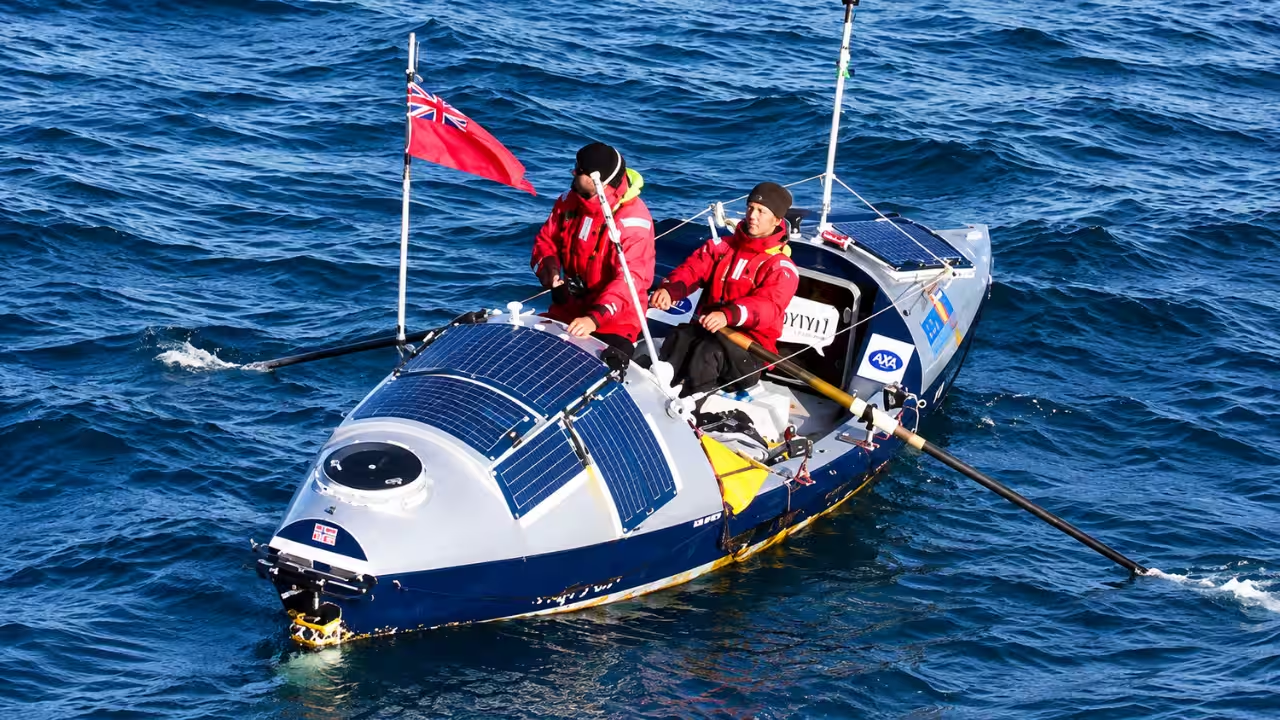
For months, the Pacific offered Mick Dawson and Chris Martin little indication that their destination was getting any closer. They left Choshi (Japan), in a small rowing boat in 2009, expecting a long passage across one of the world's largest stretches of open water. Instead, wind and currents repeatedly pushed them away from their intended line. By the time they finally reached San Francisco, their route had stretched to almost 7,000 miles. They had spent 189 days at sea, rowing in shifts, sleeping in a cramped cabin and living largely on freeze-dried food. According to Reuters, the pair passed beneath the Golden Gate Bridge completing a journey that Dawson had already attempted twice on his own.Dawson’s failed Pacific attempts led to a new boat with Chris MartinFor Dawson, the crossing was tied to several earlier attempts to travel between Japan and California by rowing boat. The former Royal Marine and professional yacht skipper had already crossed the Atlantic twice, first with his brother Steve in 2001 and again in 2005 with Andrew Morris.The North Pacific had proved considerably less forgiving. Dawson first tried the Japan-to-San Francisco route alone in 2003, but severe weather tore away his rudder and forced him to abandon the attempt and return to Japan. He tried again the following year in 2004. That voyage ended after 109 days when his boat capsized and sank, despite having covered more than 4,500 miles.Rather than leave the route behind, Dawson designed another boat for the specific demands of the Pacific. He called it ‘Bojangles’ and brought Chris Martin, a fellow ocean rower and friend, into the project.Bojangles became a tiny home for the pair on their Pacific journeyReuters reported, the pair departed from Choshi, near Tokyo, in May 2009. Bojangles was about 23 feet, or seven metres, long, with a layout that allowed the men to row together or separately. Their daily routine revolved around two-hour periods of rowing and sleep. The compact cabin at one end provided their sleeping space, while the other section carried food, communications equipment and the machinery needed to turn seawater into drinking water.They had hoped to complete the voyage without outside assistance. That plan held for most of the crossing, but food eventually became a problem. With California about 100 miles away, the men ran short of supplies and accepted a helicopter drop of provisions. The intervention meant the voyage was not entirely unassisted, although the pair continued under their own power towards the coast.A 4,600-mile journey became a far longer battle against the PacificThe distance between Japan and San Francisco is roughly 4,600 miles by the more direct ocean passage. Their actual journey was far longer. Winds and currents repeatedly altered the course of Bojangles, leaving the rowers dealing with a route that expanded towards 7,000 miles. Near the end, their plotted track formed a large loop in the Pacific rather than a straightforward line towards California.Martin, who was 28 at the time, later recalled how frustrating it became to watch the remaining distance fail to fall as expected. The boat could be moving for hours while the figures on their navigation chart seemed barely to change.The conditions also shifted with the seasons. They had started in relatively warm weather and initially rowed without clothes, but the final part of the journey brought colder conditions and more difficult weather.Life inside a small ocean-going boatBojangles gave the two men enough room to operate but little space for comfort. Its design was closer to a large ocean-going rowing craft than a conventional boat, with seats on rollers allowing the rowers to bring their legs into each stroke. They alternated between rowing and sleeping, meaning that neither man followed a normal day-night routine. Food was mostly freeze-dried, while a desalination system supplied drinking water from the surrounding ocean.Technology was another part of the expedition. The pair carried equipment to document the journey and publish updates, giving people on land a view of what was happening far offshore. The physical surroundings, however, remained simple. There was the boat, the ocean, their equipment and whatever weather came across the Pacific.The final approach to San FranciscoBy the time the California coastline came within reach, the men had spent more than six months at sea. The journey that began in Choshi had become a 189-day passage, with the additional distance caused by the diversions making the final approach especially prolonged. According to Reuters, on the morning of November 13, 2009, Bojangles entered San Francisco Bay. At about 8:30 am, the pair passed beneath the Golden Gate Bridge.They marked the moment in a simple way, opening beers as they reached the bay. Soon afterwards they were at the Golden Gate Yacht Club, where the change from a restricted diet at sea to substantial meals was hard to miss. Both had lost considerable weight during the crossing.A Pacific record after earlier failuresDawson and Martin became the first crew to row successfully from Choshi in Japan to the Golden Gate Bridge. According to the official 189 days website, their recorded passage lasted 189 days, 10 hours and 55 minutes, covering roughly 7,000 miles rather than the much shorter direct distance between the two points.For Dawson, the arrival also closed a chapter that had included two unsuccessful solo attempts at the same crossing. The first had ended with a damaged rudder. The second had ended when his boat sank after a capsize.This time, Bojangles carried two rowers all the way across. The route was longer than planned, the food eventually ran short and the weather became harsher towards California, but the boat reached San Francisco under the pair's own rowing effort.You use AI every day. Now get your AI Quotient. Take the AIQ test.
Topics in this story
Gathered from external sources. Rights to this text belong to whoever originally published it.