Rescues underway as two men pulled alive from Nepal hydro tunnel more than a week after flooding
The dramatic breakthrough comes after voices were heard from inside the tunnels of the stricken plant. Follow for live updates.
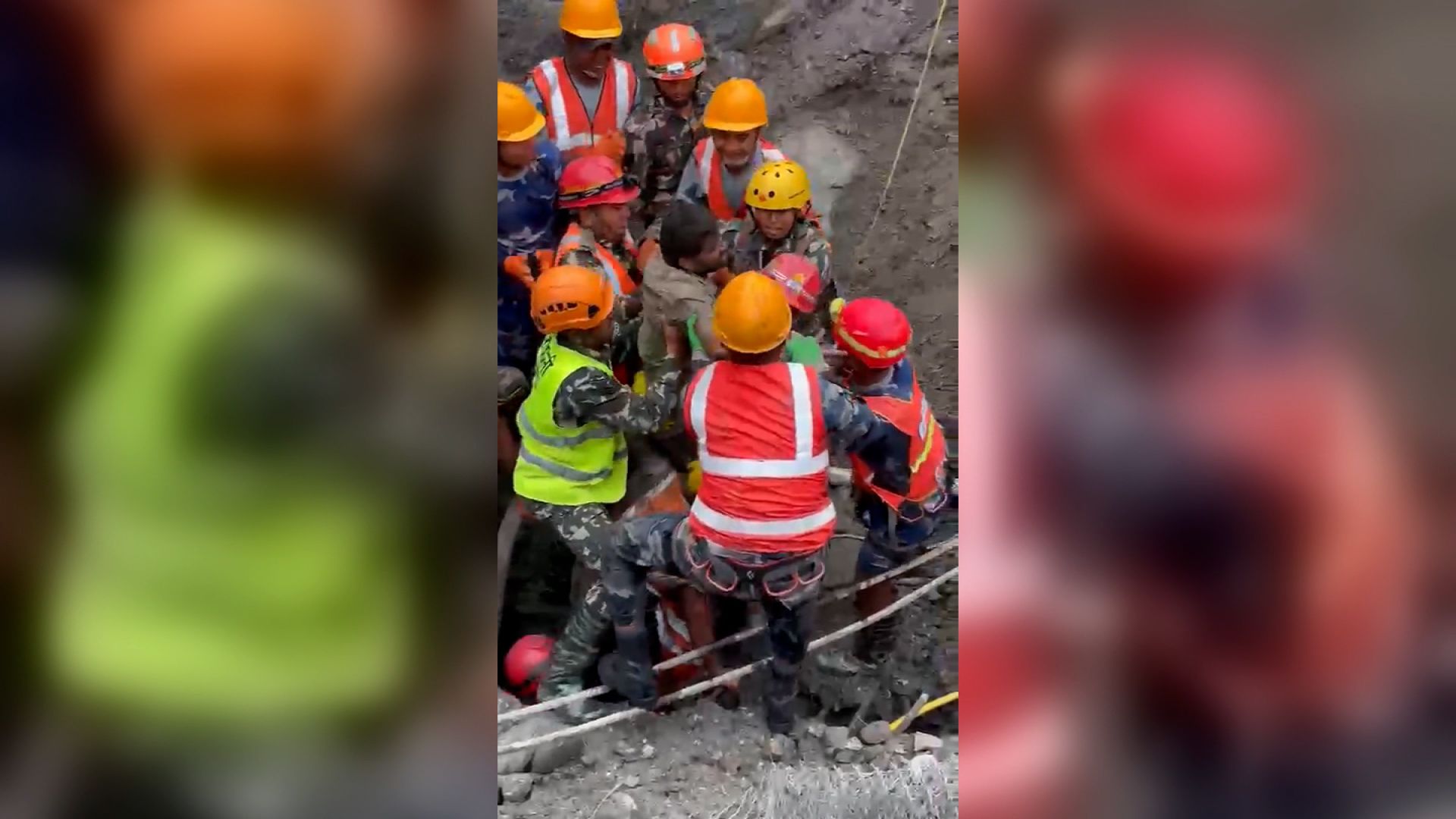
• Men rescued: Two people have been rescued from a hydropower tunnel in Nepal, a dramatic breakthrough for a desperate, round-the-clock effort in treacherous conditions more than a week after catastrophic floods hit the country’s border with China.
• Voices heard: Rescue operations are underway. A local police chief and a lawmaker said voices have been heard from inside the tunnels of the stricken plant, after the disaster trapped hundreds of workers inside multiple Himalayan energy projects.
• “World first”: A disaster-response expert advising the rescue efforts described the operation as a dangerous and unprecedented attempt to identify buried tunnel entrances. He said the hydropower tunnels were “full of water” in the aftermath of the floods.
• Death toll: The number of people killed in Nepal following the flash floods now exceeds 1,290.
As water, concrete and debris stormed through the darkness, almost sweeping him off his feet, Ram Chandra tightly gripped onto one of the rungs studded into the roof of the tunnel he was working in on the banks of Nepal’s Trishuli river.
His quick reaction likely saved his life, in an earlier extraordinary rescue at the tunnels five days ago.
“The water was rising and it was difficult to move my legs. If I had let go from that rung I would have fallen,” Chandra told a CNN team on the ground after being brought down from the disaster zone by helicopter on Sunday.
He had grabbed hold of a tin sheet to have something to place under his feet and the group passed it around as they inched their way forward, rung by rung, for six hours.
“There were six of us and we later found someone else at the gate of the tunnel,” he said.
Arnold Dix, a disaster-response expert and tunnel engineering professor advising the rescue efforts, described the operation as a dangerous and unprecedented attempt to identify buried tunnel entrances.
“It appears we now have proof of concept for a methodology to perform a rescue, because this is a world first,” he said from Singapore, en route to Nepal.
“We’ve never done this before, and now we have a proof. And there’s other power stations we still haven’t got to.”
“Of course, we pause and celebrate. But it now also means we need to take a back step and go, ‘Okay, of the 500 reasons we all thought we could fail, we’ve been able to prove one method that works. Now, how can we apply that somewhere else?’” he told CNN.
Dix described the hydropower tunnels left as “full of water” in the aftermath of the floods. Teams have to make the high-risk decisions to blow up “rocks the size of cars” to reach people trapped inside, he said.
“So we’re tunneling along under the roof, and we know in our heads that underneath us are likely people who died. So there’s a whole lot of psychology and all of that,” he said.
There were 42 people missing at the Trishuli 3A hydropower project, where two people were pulled alive from a tunnel Friday, according to a Nepal Army list released on Thursday morning local time.
More than 900 workers in total are still considered missing at 11 different hydro schemes in Nepal.
People missing at hydropower projects (as of Thursday):
Parikshit Mehra, an Indian army colonel, told CNN’s Anderson Cooper , who reported from the Trishuli 3A site earlier this week, that for a rescue mission like this one, “the first 48 hours are the most crucial.”
“People who are stuck tend to panic much more than when they are outside in the open,” Mehra said in an interview with Cooper earlier this week, outside the tunnels where the colonel was leading a team of specialized troops.
“Getting stuck in a tunnel you can’t see anything. Generally if you stay in the dark you get disoriented in about 24-25 hours,” he said. “Beyond that, (after) 48 hours, you start hallucinating. And then I think from there on it’s always a fight.”
But, Mehra added: “There have been miracles.”
For context: Today’s rescues took place nine days after the disaster struck, underscoring how significant this breakthrough is. However there are some 900 workers missing inside the tunnels at multiple energy projects in the Himalayas.
A second person has now been rescued from inside the tunnels of the stricken Nepali hydropower plant, Bipin Regmi, police chief for the district of Nuwakot, told CNN.
Shri Ram Neupane, a local lawmaker, confirmed the rescue on Facebook and posted a picture of the man lying on a stretcher with an oxygen mask on his face.
Cheers erupted as a man was pulled alive from a tunnel at Nepal’s Trishuli 3A Hydropower project on Friday morning, after being trapped inside for nine days after catastrophic floods tore through the region.
Video showed the man being hoisted by a group of rescuers from a hole bored down into the tunnel, as onlookers clapped and cheered.
Dozens of hydropower worker are believed to have been near the powerhouse inside the tunnel when the disaster stuck last Wednesday.
A man has been rescued from inside the tunnels of a stricken Nepali hydropower plant, where more voices have been heard, local officials told CNN, nine days after massive flash floods and landslides trapped hundreds of workers inside multiple Himalayan energy projects.
In a dramatic breakthrough for what has been a desperate, round-the-clock rescue effort in treacherous conditions, the man was pulled from inside the Trishuli 3A hydropower plant, where an operation has been underway to bore into a tunnel to search for 42 workers that were unaccounted for.
“Rescuers heard voices,” said Bipin Regmi, police chief in the flood-hit district of Nuwakot told CNN, adding a medical team was on its way to the site.
The tunnel that leads to the underground powerhouse there, where dozens of people were working when the catastrophic flood hit, is more than four kilometers (2.5 miles) long.
Hopes had been fading for the safe rescue of the workers at the plants that run along Nepal’s Trishuli River – among them foreigners from China, South Korea and India. A torrent of cement-like floodwater had engulfed the river and its surrounding areas, killing more than 1,200 people in Nepal.
Topics in this story
Gathered from external sources. Rights to this text belong to whoever originally published it.