From 1979 into the early 2000s, Michael Kahn and Leda Livant built Eliphante from found materials, transforming a 3-acre Arizona property into a sculptural desert compound
Explore the fascinating story of Eliphante, a sculptural art environment created by Michael Kahn and Leda Livant using found materials over nearly three decades in Arizona.
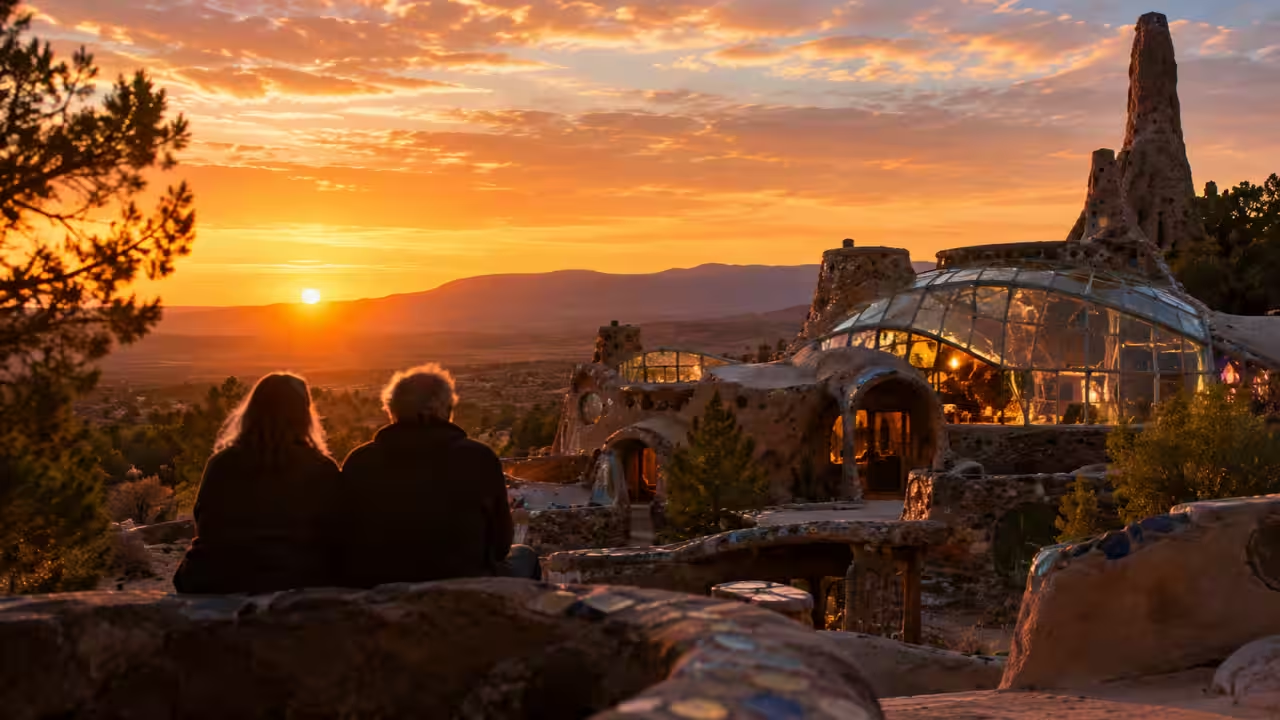
Michael Kahn and Leda Livant began the construction of Eliphante in 1979 on a three-acre property near Cornville, Arizona. Rocks, driftwood, construction waste, glass, pottery fragments and other salvaged materials were used to build a collection of unusual structures that grew over nearly three decades, and the SPACES Archives records the site as a sculptural environment that was built between 1979 and the early 2000s.The couple were in search of a place where Kahn could paint, so they moved west from Provincetown, Massachusetts, and settled near Oak Creek after meeting landowners who allowed them to stay on part of their property. Their first shelter was a truck, and the rocky landscape that surrounded it soon became part of Kahn’s approach to building. Kahn and Livant started building structures as ideas developed, and used materials that were gathered from the creek, nearby washes and construction sites, and the compound that resulted included domes, curved rooms, passageways, mosaics and a subterranean gallery.The building that gave Eliphante its nameThe first major structure was completed in roughly five years, but the couple never lived in it, and the name Eliphante came because a friend remarked that the building was similar to an elephant because of its trunk-like entrance and irregular roof. Kahn and Livant later built the Hipadome, which became their home, while another major structure, called Pipe Dreams, functioned as an underground gallery, with its interior incorporating mosaics that were made from stained glass and ceramic pieces, along with fabrics and carpet assemblages.Kahn collected rocks from nearby terrain and used driftwood that was deposited by seasonal floods, and the pair also incorporated waste from community construction projects into domes, shelters and other structures. A 2008 profile in The New York Times, titled “A Handmade Home,” described the compound and the couple’s approach to building without conventional architectural plans.A home that became a sculptural environmentKahn had studied at the Art Students League and the National Academy of Design before moving to Arizona, with his expertise in painting and sculpture. The site that he built eventually included more than the elephant-shaped building and the Hipodome, and its separate structures, galleries, and outdoor installations created a network of spaces across the property. Glass, mirrors, pottery shards and other materials became part of both the interiors and exteriors.The couple continued building for almost 30 years, and eventually the structures themselves became part of Kahn’s artistic practice. In 1987, Kahn and Livant started the nonprofit Eliphante Ltd. to help protect the site after their deaths, and in 1994, Eliphante was included in the Smithsonian American Art Museum’s Save Outdoor Sculpture! catalogue.Preservation and public access remain difficultKahn died in December 2007, following which Livant moved off the property in 2009, according to the SPACES Archives, which also notes that Eliphante is a private residence and is not open to the public. The site has faced questions about its long-term condition and access, with Atlas Obscura’s listing stating that Eliphante was permanently closed to visitors.Although photographs and archival records document the buildings, the compound is not a public attraction with routine visitor access, and the structures remain on private property in Cornville, with the nonprofit’s preservation role being separate from a guarantee that the public can enter. Eliphante’s construction spanned the years from 1979 into the early 2000s, and the site’s surviving buildings preserve the couple’s use of found materials and their decision to let the design develop through the work itself.You use AI every day. Now get your AI Quotient. Take the AIQ test.
Topics in this story
Gathered from external sources. Rights to this text belong to whoever originally published it.