'Calibrated non-kinetic measures': How Indian Navy foiled Somali pirates, rescued 20
NEW DELHI: The Indian Navy rescued all 20 crew members of a hijacked fishing vessel after carrying out a coordinated operation lasting more than 48 hours
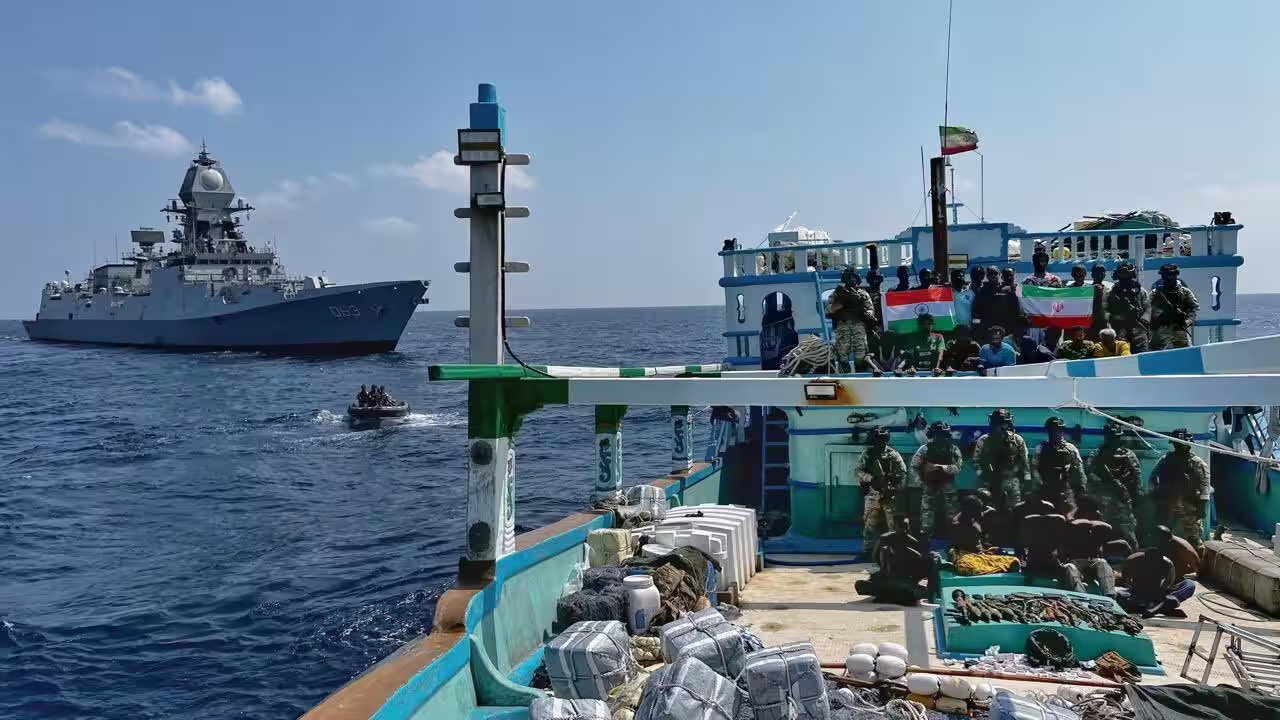
NEW DELHI: The Indian Navy rescued all 20 crew members of a hijacked fishing vessel after carrying out a coordinated operation lasting more than 48 hours off the northeastern coast of Somalia. The operation involved a mission-deployed warship, a maritime reconnaissance aircraft, Marine Commandos and an Indian Air Force (IAF) C-17 aircraft.The Navy tracked the vessel, contained its movement and launched a tactical intervention to overcome the armed pirate threat, news agency ANI reported citing sources. All 20 crew members were rescued safely, with no casualties or injuries.The fishing vessel Azini had been hijacked by an armed pirate group earlier last month. The incident raised serious maritime security concerns, as the pirates could potentially have used the vessel as a ‘mother ship’ to launch further attacks against merchant ships operating in the region.The Indian Navy responded by deploying a warship and a maritime reconnaissance aircraft to locate and intercept the hijacked vessel. The operation involved sustained surveillance, coordinated tracking and the deployment of Marine Commandos to secure the vessel.How Indian Navy foiled pirate threatThe operation involved multiple stages, with naval and air force assets working together to locate the vessel, restrict its movement and eventually secure it.1. Warship and reconnaissance aircraft deployedFollowing the hijacking, the Indian Navy tasked a mission-deployed warship with intervening in the situation. A maritime reconnaissance aircraft was also deployed to provide aerial support.The two platforms worked in close coordination to locate Azini after persistent surveillance. Their tasks included:Locating the vessel: The warship and reconnaissance aircraft worked together to establish the location of the hijacked fishing vessel.Tracking its movements: The platforms maintained surveillance and monitored the vessel's movements to prevent the pirates from escaping.Restricting its movement: The Navy employed calibrated non-kinetic measures to contain the vessel and prevent it from moving away.The use of non-kinetic measures was an important part of the operation. These measures were intended to restrict the vessel's movement without relying on direct kinetic force. The Navy, however, did not specify the exact equipment or techniques used.2. Marine Commandos brought in through IAF C-17 aircraftThe operation was further strengthened with the deployment of Marine Commandos.The commandos were augmented through a precision airdrop carried out by an IAF C-17 aircraft. This brought together the operational capabilities of the Indian Navy and the Air Force.The deployment was part of the coordinated effort to secure the hijacked fishing vessel and overcome the armed pirate threat.3. Navy launches tactical intervention to secure vesselAfter locating and containing Azini, the Indian Navy executed a swift and coordinated tactical intervention.The operation culminated in the Navy securing the fishing vessel and overcoming the pirate threat.The intervention ensured that all 20 crew members were released safely. There were no casualties or injuries during the operation.The entire mission took more than 48 hours to complete.Why was hijacking of Azini a maritime security concernThe hijacking was not just a threat to the fishing vessel and its crew. It also raised concerns about the possibility of the vessel being used to facilitate further pirate attacks.According to the Navy, the pirates could potentially have employed Azini as a ‘mother ship’.A mother ship can serve as a base for pirates to operate farther out at sea. It can help them approach merchant vessels and launch further attacks.The possibility of Azini being used in this manner posed a wider threat to maritime security, particularly to commercial shipping operating in the region.By securing the vessel and overcoming the pirate threat, the Indian Navy prevented its potential use as a platform for further attacks.What did Navy sayNavy described the successful rescue as evidence of its operational preparedness and ability to undertake complex maritime security missions through coordination between the armed forces."The successful operation is a testament to the Navy’s high operational preparedness and ability to undertake complex maritime security operations through seamless inter-service coordination. It also underscores India’s unwavering commitment to remaining First Responder and Preferred Security Partner in the Indian Ocean Region," the Indian Navy said.The Navy also reiterated its commitment to safeguarding seafarers, protecting vital maritime trade routes and ensuring a safe, secure and stable maritime environment in the Indian Ocean Region.The operation highlighted India's role in responding to maritime security threats in the Indian Ocean and its efforts to protect seafarers and commercial shipping from piracy.Get the latest India News and Live updates. Download the TOI app.
Topics in this story
Gathered from external sources. Rights to this text belong to whoever originally published it.