Scientists planted trees on abandoned cattle pasture in Mexico; 17 years later, nearly 5,000 plants were growing across the experimental forest
Rest of World News: Scientists have spent 17 years tracking what happens when native trees are planted on former cattle pasture in Mexico, and the experiment has now reco.
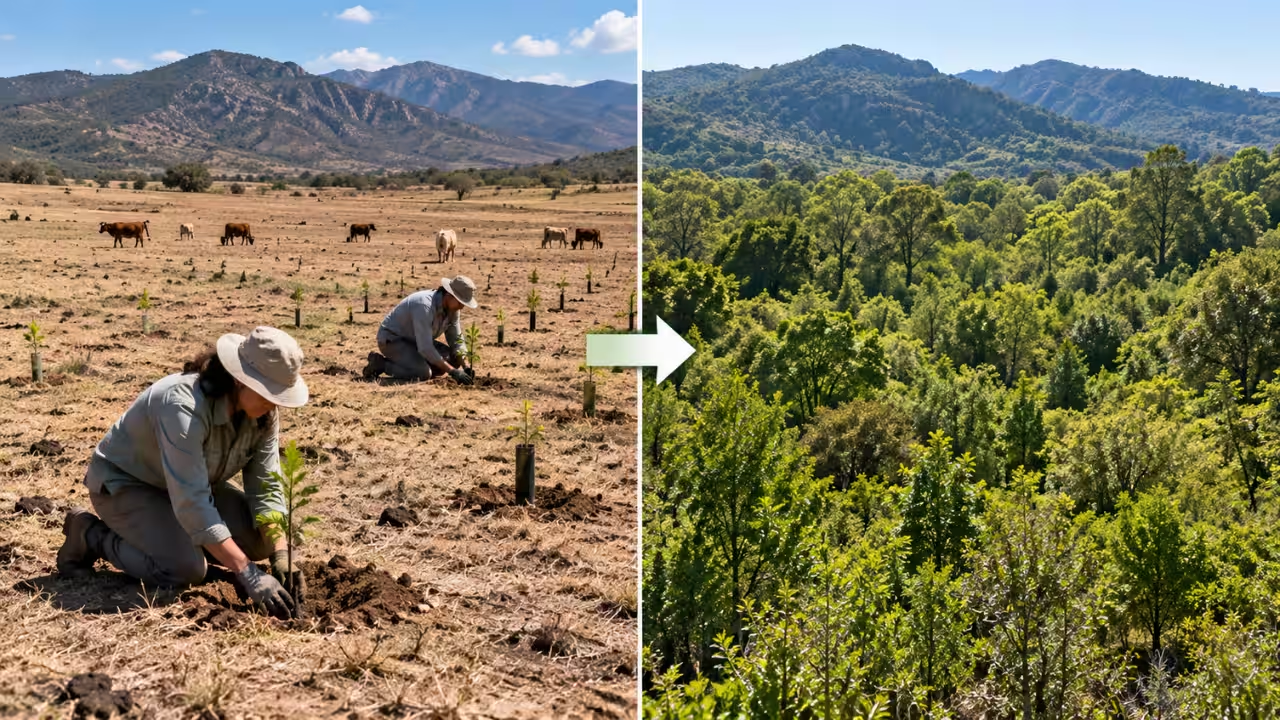
Scientists have spent 17 years tracking what happens when native trees are planted on former cattle pasture in Mexico, and the experiment has now recorded nearly 5,000 plants growing across the restoration plots. The experiment carried out in the Los Tuxtlas region of Veracruz began in 2006, when researchers fenced off sections of a pasture and planted trees using two different strategies, while leaving other plots to recover naturally. By 2023, a survey had recorded 4,847 plants across 109 taxa, providing a long-term view of how vegetation developed after cattle grazing stopped. According to the study published in ScienceDirect, titled ‘Understory contrasts across experimental tropical forest restoration’, the planted plots generally supported more plants and species than areas left to natural succession. When trees that had originally been planted were excluded from the analysis, animal-dispersed plantings continued to show higher recruit density. The researchers also found that planted areas supported unique forest species, while the overall understory composition became broadly similar across restoration treatments.How did tree planting in Mexico boost plant growth after 17 yearsThe experiment was surveyed again in July 2023, 17 years after it began. Researchers recorded woody plants and palms between 40 and 225 centimetres tall, allowing them to capture smaller plants that had arrived through more recent dispersal events. The study described this vegetation as the understory that would form the template for the future restored forest.Across the restoration plots, the researchers recorded 4,847 plants belonging to 109 taxa. Of these, 80 were identified to species, five to genus and four to family, while 20 could not be identified more precisely. Two reference forest plots surveyed for comparison contained 309 plants. As the study states, “tree planting increases recruitment magnitude relative to natural succession”.How did tree planting affect plant recruitmentWhen all recruited plants were counted, both types of planted plots contained more plants than areas left to natural succession. Animal-dispersed plots averaged about 253 plants per plot, compared with about 219 in wind-dispersed plots and 134 in plots undergoing natural succession. Species density followed a similar pattern, with animal-dispersed plots averaging 33.5 species per plot, wind-dispersed plots 29.1 and natural succession plots 20.The researchers also analysed the plots after excluding recruits belonging to species that had originally been planted. This separated the plants that had regenerated from the planted trees from species arriving as part of natural succession. Under this analysis, animal-dispersed plantings still had a higher recruit density than natural succession. The study reports that planting treatments increased recruitment compared with natural succession, while animal-dispersed plantings maintained the higher density when planted species were removed from the calculation.How did animal-dispersed plots support more forest speciesAnimal-dispersed plots contained 21 unique taxa, compared with 20 in wind-dispersed plots and 10 under natural succession. They also had 22 recruits from unique non-pioneer species, twice as many as wind-dispersed plots. Natural succession was instead dominated by three unique pioneer taxa, which accounted for 31 recruits. In the wind-dispersed plots, Vochysia guatemalensis made up 23.8% of recruits, with 56 trees taller than two metres recorded by the 13-year census.Despite these differences, understory community composition became broadly similar across treatments when planted species were excluded. Restoration strategy explained only 3.7% of community variation. After 17 years, the experiment had recorded 4,847 plants, with planted plots supporting greater plant and species densities than natural succession. Animal-dispersed plantings also supported more recruits when originally planted species were excluded, while planting created habitat that helped forest species arrive and persist in the former pasture.Catch the latest World News and Live updates. Download the TOI app.
Topics in this story
Gathered from external sources. Rights to this text belong to whoever originally published it.