In 1983, scientists poured dye into Wyoming’s Popo Agie River before it vanished underground; two hours later, it resurfaced about 3,500 feet away with more water than entered
US News: In Sinks Canyon State Park in west-central Wyoming, the Middle Popo Agie River does something few rivers do: it disappears underground. At a point kno.
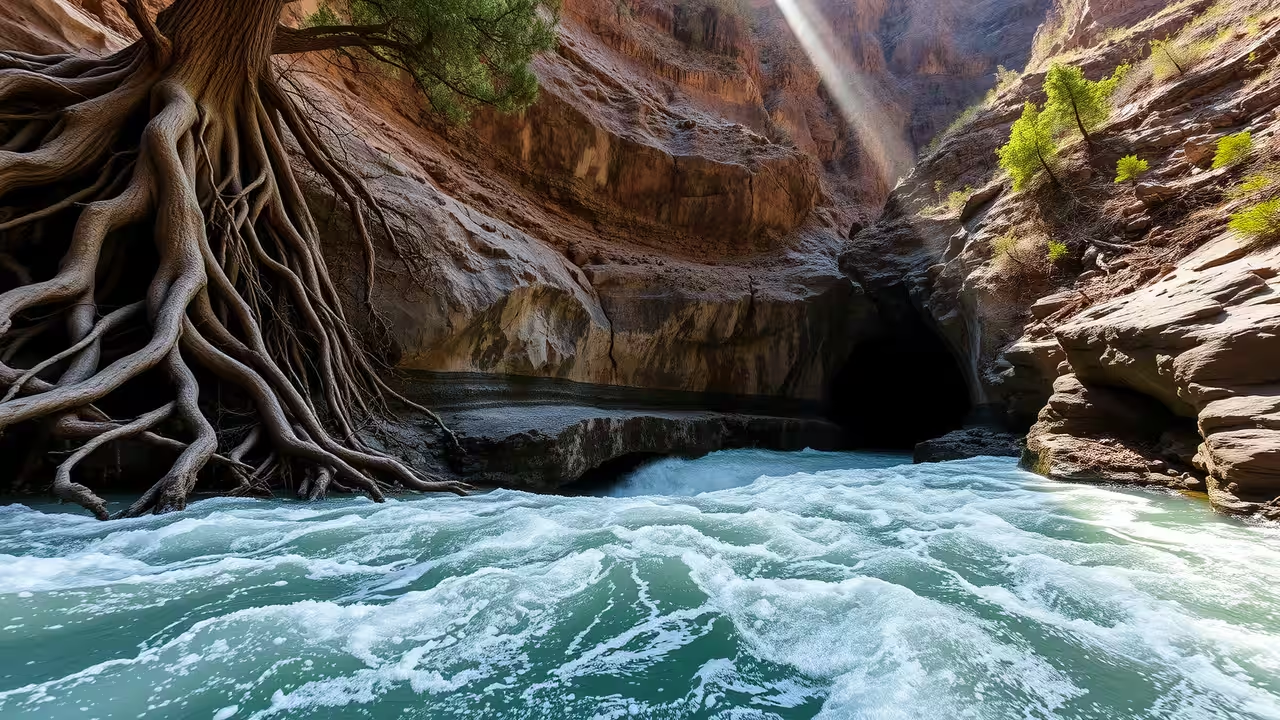
In Sinks Canyon State Park in west-central Wyoming, the Middle Popo Agie River does something few rivers do: it disappears underground. At a point known as the Sinks, the river's entire flow vanishes into a cave system instead of continuing along an open channel. Downstream, the water reemerges at a separate location known as the Rise, where springs return the river to the surface. Although the underground relationship between the two points had long been recognised, U.S. Geological Survey hydrologists wanted to establish the connection through a direct test. In August 1983, they released fluorescent dye into the Middle Popo Agie at the Sinks and monitored water downstream at the Rise for the tracer's return. The dye appeared at the Rise about two hours later, providing direct evidence that water entering the Sinks travels through the underground system before resurfacing at the Rise. Researchers recovered about 84 per cent of the injected dye during the investigation, providing further evidence of the connection.How USGS hydrologists tested the underground connection at Sinks CanyonAccording to the U.S. Geological Survey's report on dye tracing in Wyoming, researchers used rhodamine WT, a fluorescent tracer commonly employed in hydrological investigations. The dye was released directly into the Middle Popo Agie at the Sinks, where the river disappears beneath the surface. Hydrologists then collected water samples at the Rise and analysed them for the dye's fluorescent signature. Dye tracing provides a way to establish underground connections that cannot be followed visually, allowing researchers to determine whether water introduced at one location subsequently appears at another. At Sinks Canyon, the experiment provided a direct test of whether the river disappearing at the Sinks was connected to the water emerging at the Rise.Why the dye appeared at the Rise just two hours laterThe fluorescent tracer reached the Rise approximately two hours after it was released at the Sinks. Researchers recovered about 84 per cent of the injected dye through their sampling, providing strong evidence of a hydraulic connection between the two locations. The speed of the tracer's movement was particularly notable because the river's path between the two points is largely hidden from view. Rather than relying only on the surrounding geology or the visible direction of the river, researchers could track the water through the underground system using a measurable chemical tracer. The experiment therefore established a measurable link between the Sinks and Rise and provided an estimate of how quickly water could travel through the underground system.What the experiment revealed about underground waterways in WyomingThe Sinks Canyon investigation was part of a broader series of dye-tracing studies conducted by the USGS to investigate groundwater movement and underground connections in Wyoming. Such tests are particularly useful in areas where soluble rock has created caves, underground channels and other pathways that allow water to move beneath the surface. Other Wyoming investigations produced very different results. In a 1970 test, dye released into the North Fork Powder River below Dullknife Reservoir took about 16 hours to travel 5.8 miles downstream to a spring. The journey included a stretch of about 0.6 miles where the river crossed a limestone outcrop and disappeared completely underground before resurfacing. A 1974 test on the Little Tongue River produced another result: only about 35 per cent of the injected dye was recovered at a cave roughly 2.6 miles away. The differing results demonstrate why dye tracing is useful for mapping underground water movement, since surface geography alone cannot always reveal where water travels once it disappears.Why the Sinks and Rise remain one of Wyoming's strangest river featuresAt the Sinks, the Middle Popo Agie appears to end abruptly as its flow disappears into the cave system. Just downstream, the Rise returns that water to the surface, creating a geological feature that looks almost impossible without knowing what lies beneath the canyon. The 1983 USGS experiment transformed that visible curiosity into a documented hydrological connection. By releasing a fluorescent tracer at the point where the river disappears and detecting it downstream only about two hours later, researchers were able to follow the river through a section of its journey that cannot be seen from the surface. The result is one of the clearest examples of how dye tracing can reveal hidden connections between surface rivers and underground waterways: at Sinks Canyon, the Middle Popo Agie does not simply disappear. Its water continues through the subsurface before emerging again at the Rise.Catch the latest World News and Live updates. Download the TOI app.
Topics in this story
Gathered from external sources. Rights to this text belong to whoever originally published it.