Trump’s ‘economic D-Day’ on Iran puts China in the crosshairs
President Trump’s announcement of a major economic warfare campaign against Iran also has the effect of putting China in the crosshairs, the Islamic republic’s largest trading partner and primary purchaser of its oil exports. Trump’s threats to go after any country, business or banking institution supporting Iran come as diplomatic efforts have unraveled, six months…
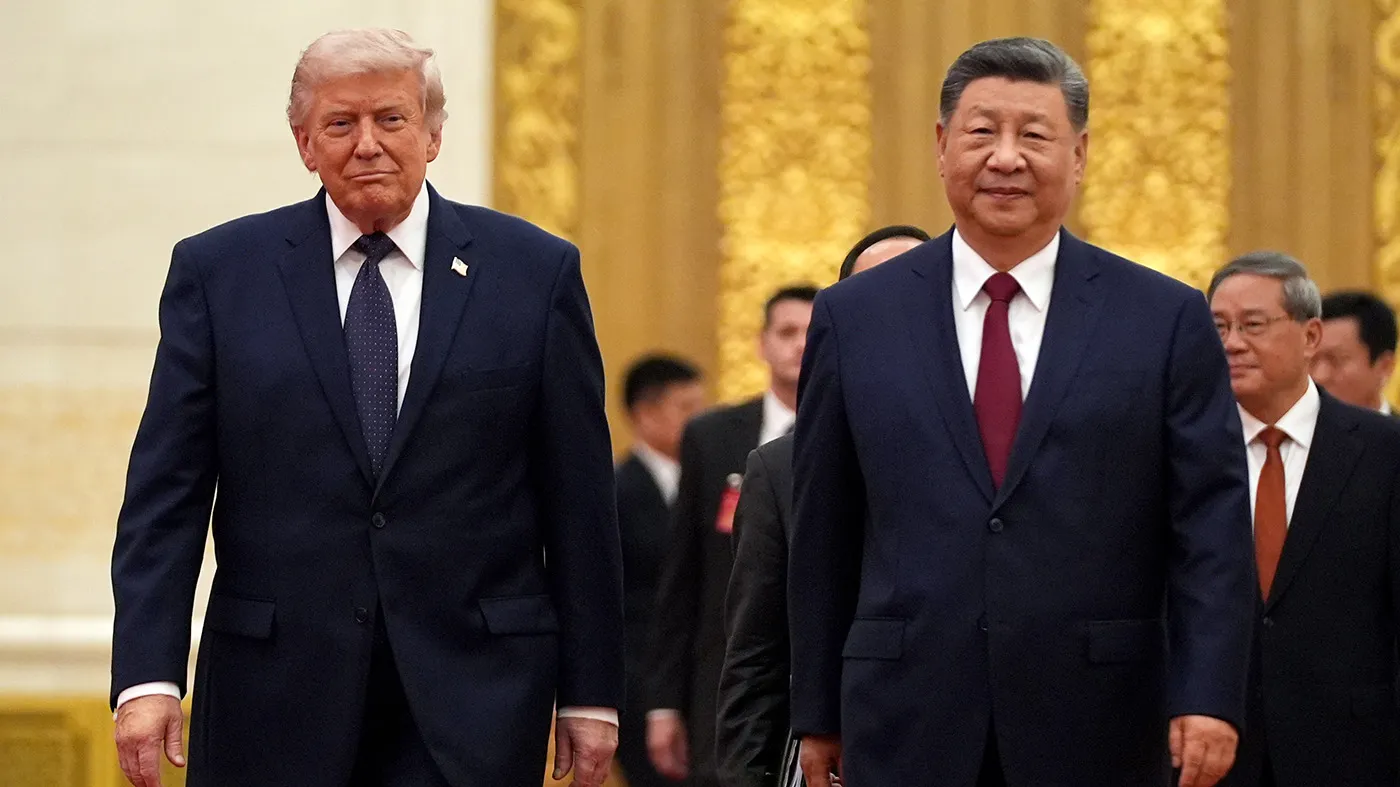
President Trump’s announcement of a major economic warfare campaign against Iran also has the effect of putting China in the crosshairs, the Islamic republic’s largest trading partner and primary purchaser of its oil exports.
Trump’s threats to go after any country, business or banking institution supporting Iran come as diplomatic efforts have unraveled, six months of military pressure have failed to cow the Islamic republic and transit through the Strait of Hormuz remains a dangerous gamble.
While Trump held back from calling out China specifically in a Truth Social post on Wednesday, Treasury Secretary Scott Bessent was blunt, calling for the Chinese “to get with the program.”
“We are confident that everyone wants the strait reopened and for energy prices to come back down … keep in mind that the Chinese get 50 percent — 5-0 — of their energy from inside, from the gulf. So it would do them a big service to get with the program,” he said Thursday in an interview with CNBC.
Bessent said he will hold a press conference Monday to detail the administration’s game plan.
“Sanctions and pressure tactics are not the solution. China calls on parties to act responsibly and stick to the political and diplomatic approach,” Chinese Foreign Ministry spokesperson Lin Jian said when asked by Bloomberg about the impact on China.
Analysts are cautious on whether Trump’s threats of economic “D-Day” against Iran and its enablers will bear fruit — and whether the president is determined to follow through with punishing economic actions against China ahead of a state visit for President Xi Jinping on Sept. 24.
Trump is eager for China to follow through on buying American agriculture, Boeing jets and U.S. oil, as well as preserve American access to Beijing’s supply of critical minerals — essential components of U.S. weapons production that have been depleted by the war.
“A much larger move against China one month before a leader-level summit in Washington would carry real diplomatic risk, invite a Chinese counterresponse and potentially put the meeting itself under pressure,” said Craig Singleton, senior fellow at the nonpartisan Foundation for Defense of Democracies.
Trump imposed earlier sanctions against so-called Chinese teapot refineries — small-to-medium independent plants processing Iranian oil — as part of the economic pressure campaign against Tehran. But Beijing rejected those sanctions and told blacklisted refineries to ignore the U.S. penalties.
“If the administration is unwilling to target the larger Chinese entities and financial channels sustaining Iranian trade, it is hard to see sanctions alone bringing Tehran to its knees,” Singleton continued.
He pointed to Russia as an example. While broad, international sanctions have imposed economic hardship, Moscow has demonstrated resilience by relying heavily on countries — like China — holding back sanctions to avoid economic collapse.
“‘Economic D-Day’ sounds dramatic, but it may say more about shrinking options than expanding leverage,” Singleton said.
“The military campaign has produced diminishing returns, so Trump is pivoting from missiles to markets. The harder question is whether Washington is actually willing to impose costs on major Chinese actors and risk disrupting the trade truce before the summit.”
Likewise, Jason Brodsky, policy director at United Against Nuclear Iran, said the administration’s sanctions are a very strong warning to China and its banks enabling Iran, but “the proof will be in the follow-through and enforcement.”
And Josh Lipsky, vice president and chair in international economics at the Atlantic Council, told Bloomberg News that Trump’s threats against Iran are likely to fall flat absent close coordination with Europe and Chinese banks willing to cut off Tehran. He also raised both Trump’s and Xi’s desires for a good visit in September.
“It’s unclear to me how we’re going to choke off Iran more than we have financially without triggering immense blowback from China on the eve of President Xi’s visit to Washington, which has been so carefully choreographed over many months now,” he said.
The last face-to-face between Trump and Xi occurred in May in Beijing. The summit was regarded as successful in maintaining relationship stability and avoiding major ruptures. The leaders discussed the U.S. war against Iran, and Trump told reporters at the time that Xi said he feels strongly that Iran can’t have a nuclear weapon — one of the administration’s stated priorities for starting the war on Feb. 28 — “and he wants them to open up the strait.”
The six-month war in the Middle East is a burden on China. In June, Iranian oil imports to China hit a historic low, dropping to below 800,000 barrels per day, Reuters reported , citing data from ship-tracking company Vortexa.
Oil is only one part of the trade relationship between Iran and China, with Tehran relying on Chinese technology exports being critical to building its drone and missile programs. The U.S. bars the sale of such components to Iran.
The U.S. has blacklisted 366 entities based in China and Hong Kong for evading sanctions on Iran, the U.S.-China Economic and Security Review Commission wrote in a March fact sheet.
The fact sheet also noted a network of front companies and small regional banks in China and Hong Kong helps Iran launder most of the renminbi — Chinese currency — proceeds from the oil sales into the global financial system.
But the disruption in global energy supplies, rising inflation and knock-on effects to supply-chain networks impact China’s push to see the U.S.-Iran war resolved.
“China has powerful incentives to see the conflict end as quickly as possible,” wrote Zhao Long, director and senior fellow at the Shanghai Institutes for International Studies, in an article for the Brookings Institution.
But while China helped push Iran to a ceasefire with the U.S. in April, there are few signals that Beijing wants to intervene again.
“When a conflict involves major military powers and China is not the cause of the war or a party to it, Beijing generally sees neither a particular responsibility nor a realistic possibility of becoming the primary mediator,” Zhao wrote.
Topics in this story
Gathered from external sources. Rights to this text belong to whoever originally published it.