In 1951 Kobe, the centuries-old Japanese 'uchimizu' ritual was used to cool hot pavement; later experiments found it could also cool the surrounding air
Explore the age-old Japanese ritual of Uchimizu that provides natural cooling during summer heat. Discover its effectiveness, significance, and modern revival in urban settings.
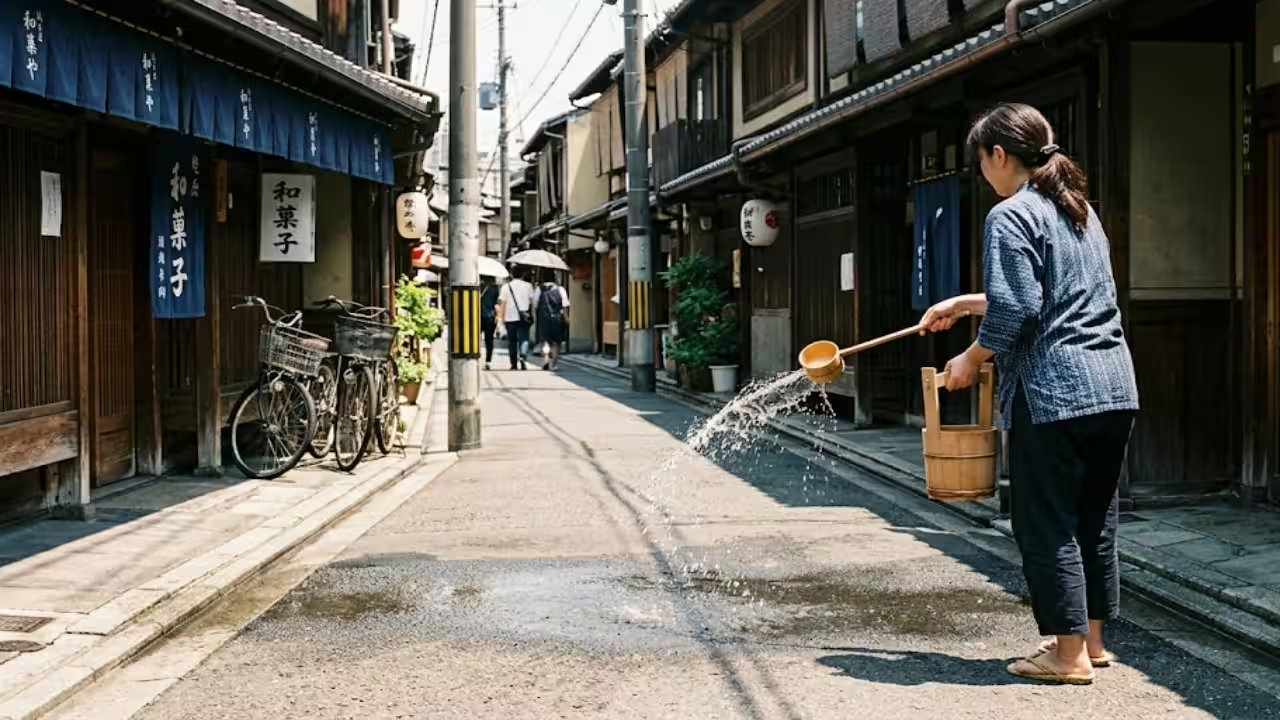
An ancient custom still appears in front of stores and homes during the warmest weeks of the Japanese summer. A ladle is picked up, a bucket is filled, and water is thrown across the parched land. The idea behind the technique, known as uchimizu, is that the water will lessen the heat's pain. As cities get hotter, researchers have become increasingly curious about it. Organisers of Mission Uchimizu, a Japanese effort that began in 2003, put it plainly: water has a high heat of vaporisation, so when it evaporates after being sprinkled, it draws heat out of the ground. The program began as a social experiment to see if summer temperatures could be reduced by two degrees Celsius if one million individuals sprayed water at the same time.One image in particular captures how firmly rooted the habit was in everyday life: a 1951 photograph from Kobe showing a woman splashing water across a roadway. The photographer was an amateur named Koji Takashima, and the woman in the frame was reportedly his wife, though the attribution hasn't been independently confirmed. The photograph is also said to have placed fifth in the black-and-white category of a Popular Photography magazine contest that year. Nobody was measuring temperatures with sensors back then; people simply knew the street felt better afterward, and it's only in recent years that scientists have checked whether that sense was right.How does the water coolEvaporation demands energy, and the water draws that energy from whatever it contacts, which in this case is the scorching pavement and the air directly above it. In a 2018 study published in the journal Water, researchers at Delft University of Technology identified two benefits: less radiant heat reaches your body because of the cooler surface, and the evaporating water also draws heat from the air itself.The same study traces the tradition back to the 17th century, noting it has been losing ground for the past 50 years or so. Air conditioning filled the void, and some people came to see older methods as too much work or unfashionable. Today, Japanese cities are attempting to revive uchimizu, including Tokyo, where municipal programmes have sponsored public events in recent years.What the Delft team measuredOn 24 August 2016, six uchimizu experiments were carried out on a brick paved street at their campus. They sprayed water over a three-metre square patch, then tracked the air above it with a one-metre cube of fibre-optic cables that measured temperature at more than 34,000 locations. These are some of the clearest figures to date on how Uchimizu actually performs.The air at a height of two metres was cooled by around 1.5 degrees Celsius. In a test run in the shadow of a tree, where the bricks started at 36 degrees and only a millimetre of water was utilised, the decrease was much greater closer to the ground, reaching 8.3 degrees at its highest.One or two millimetres made little difference, but soaking the bricks with more than five millimetres roughly doubled the cooling near the ground compared with one millimetre. The weakest result came on bricks that began at 47.7 degrees: the surface cooled to about 38 degrees, yet the air just above the ground barely cooled at all, a gap the researchers attribute to how quickly such hot bricks evaporated the water before it could draw much heat from the surrounding air.Testing it in publicJapanese municipal authorities have been testing the idea in public. The 2003 program was stated to have data at four Tokyo sites showing a lowering of around one degree Celsius on average. Most recently, the Tokyo Metropolitan Government sponsored uchimizu events in Ueno Park in the 2016 financial year and in Hibiya Midtown in 2018, according to NIES, Japan’s National Institute for Environmental Studies. Staff assessed the air temperature, humidity and radiant heat, then compared the readings with areas where nothing had been done.The Delft findings suggest several common-sense routines. The best results came on shaded pavement, and the test on very hot bricks showed almost no cooling of the air. The cooling effect lasts only as long as the pavement stays wet. In the Delft trial, it held for more than an hour, and while the added humidity was negligible in the Netherlands' climate: the researchers note it may be worth more consideration in damp regions.Tradition isn't only an old habit. The lesson is that a bucket of water on shaded pavement can cool the neighbouring air by a degree or more, though results vary with conditions, and it's a temporary effect that only works as long as the ground stays wet. The experts said the impacts on the city as a whole still need proper study, as does the question of how much water would be needed. But for an entrance or a courtyard, the woman in that 1951 photo had it right.You use AI every day. Now get your AI Quotient. Take the AIQ test.
Topics in this story
Gathered from external sources. Rights to this text belong to whoever originally published it.