Hindutva is Bhartiyata and Hindustaniat - it is the living essence and expression of the non-partisan, all encompassing Hindu Dharma
The applause that Smit Machchhar, the Captain of the FlyDubai flight got for saving the passengers on board and preventing a reportedly catastrophic
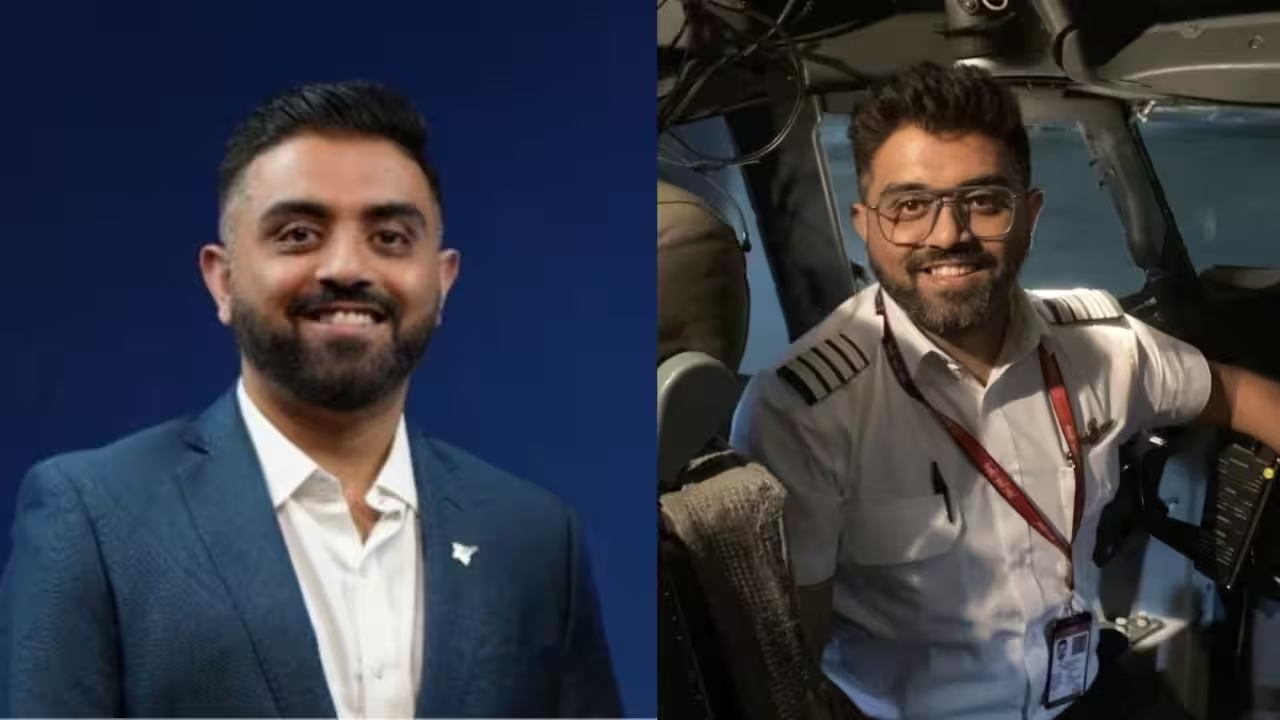
The applause that Smit Machchhar, the Captain of the FlyDubai flight got for saving the passengers on board and preventing a reportedly catastrophic international terror incident is a reflection of the on-going Indian Renaissance. His conversation with the Prime Minister, Shri Narendra Modi today on a Video Call, wherein he articulated his thoughts and actions after being fatally stabbed by his co-pilot, reflect the essence of the core values that his culture and religion inculcated in him. His valour in saving others even in the face of death, is nothing but a natural reiteration of always being the protector and never the aggressor, as underlined in our scriptures, epics and ballads over millennia. This incident should serve as an eye opener to all those who are paranoid of our assertions of identity.The composite cultural renaissance that is finding expression in Bhartiyata, Hindustaniat or Indianness has unnerved many. Most of all, an entitled, elitist and now dethroned political oligarchy, which is suffering from acute paranoia. This paranoia emanates out of fear of a people- a civilisation waking up, after decades of ideological slumber, forced upon them by the ruling elite of a newly independent India.This renaissance, loosely termed as Hindutva Bhartiyata or Hindustaniat has irked many with vested interests to make baseless, indeed unsavoury statements. Left-leaning scholars and cosmopolitan voices have repeatedly argued that Hindutva contradicts India's constitutional secularism, failing to grasp that dharma transcends narrow religious categories. It is a philosophical claim about the nature of an ancient civilisation, which is an oxymoron. Such a claim cannot be answered with slogans or counter slogans. It must be met with texts, ideas, jurisprudence, and the long memory of a civilisation that has reflected on power, restraint, and duty for over three millennia. It is this civilizational memory engrained culturally in the Indian psyche that was at display when the pilot of the FlyDubai flight endangered his life to save the life of others. These others were neither his relatives nor compatriots. They were fellow human beings.Tragically, the proponents of anti Hindutva/Bhartiyata/Hindustaniat rhetoric are those, who are themselves deeply entrenched in dogma and convolutedly, define the Hindu, Bauddh and Jain Dharmas in terms of dogmatic “isms”. These “isms” applicable to political and economic theories like Marxism-Leninism-Maoism-Naxalism, Liberalism, Socialism and Conservatism etc, are being blatantly misused to define civilizationally evolved ancient faiths and religions. For this methodically devious class of people, while the practice of the Christian faith is Christianity & practice of the Muslim faith is Islam, the practice of Hindu, Bauddh and Jain faith are, Hinduism, Buddhism and Jainism. Suffice to say that such people deliberately, or in their informed ignorance, do not understand that our Dharmas- Religions, find expression in their essence- the tatva.Hinduism has never been a faith confined to belief or ritual alone. It has never rested on dogma or depended on a single theological proposition or a book. It is dharma - a comprehensive framework governing conduct, ethics, social harmony, and the pursuit of truth. Former President of India, Dr S Radhakrishnan repeatedly reminded us that, Hinduism is not a religion in the narrow sense but a way of life, a spiritual discipline that accommodates plurality without surrendering moral coherence. Hindutva emerges from this civilizational self-understanding. It is not fear dressed as identity. It is continuity asserting itself in history.To separate Hinduism from Hindutva is to misunderstand both. Hinduism is the civilizational source and Hindutva is the civilizational consciousness and its expression. While the former provides metaphysical depth, the latter provides cultural articulation. They are not opposites. They are expressions of the same dharmic worldview, responding to different historical moments.Our foundational texts leave little room for caricature. The Manusmriti, frequently invoked, but rarely read with seriousness, begins not with hierarchy but with universal ethical restraint. Manu defines the core of dharma thus:Ahimsa satyam asteyam shaucham indriya nigrahahEtam samasikam dharmam chaturvarnye abravin manuhNon-violence, truth, non-stealing, purity, and control of the senses are the guiding principles of Bharat and the Hindu Dharma. Manu explicitly declares these as, samasika dharma, i.e. universal duties applicable to all human beings, irrespective of social station. Sarvajana Narayan’s classical commentary clarifies, that these virtues are enjoined upon all people, not merely the four varnas. Yajnavalkya reinforces this view, when he states, that virtue itself is the means of happiness for all. This is not paranoia. This is moral universalism.The Bhagavad Gita deepens this ethical architecture. Lord Krishna enumerates the divine qualities in language that leaves no ambiguity:Ahimsa satyam akrodhas tyagah shantir apaisunamDaya bhutesv aloluptvam mardavam hrir achapalamTejah kshama dhritih shaucham adroho natimanitaBhavanti sampadam daivim abhijatasya BharataHarmlessness. Truthfulness. Freedom from anger. Compassion towards all beings. Absence of greed. Modesty. Steadiness. Forbearance. Purity. Absence of pride. These are the marks of, one born to a divine disposition. A civilisation that elevates such qualities as ideals, cannot be reduced to fear or insecurity.Even war, the harshest of human enterprises, is governed by ethical law in Hindu thought. Manu’s instructions on warfare are among the most striking moral texts in world literature. He states:Na cha hanyat sthalarudham na klibam na kritanjalimNa muktakesham nasinam na tavasmiti vadinamNa suptam na visannaham na nagnam na nirayudhamNayudhyamanam pashyantam na parena samagatamNayudhavyasanapraptam nartam natiparikshatamNa bhitam na paravrittam satam dharmam anusmaranA warrior must not kill one who is dismounted, helpless, supplicating, wounded, terrified, asleep, disarmed, naked, surrendering, or turning away. Even in the midst of battle, Manu insists, that one must “remember the dharma of the good.” Victory achieved through wanton cruelty is no victory at all. This is not paranoia. It is ethical restraint elevated to law.India of the Hindu Dharma has lived and practiced these values in continuity through millennia. From the ancient examples of rectitude in battles between Porus and Alexander to those between Huns and our indigenous rulers, from Kshamadan of Munshi Prem Chand to as recent as the 1971 Indo-Pak War that led to liberation of Bangladesh, ours is an ongoing civilization that finds no parallel. The 1971 War resulted in about hundred thousand, Pakistani ‘Prisoners of War’, held captive in India. We could have used them as leverage or killed them, however, in another expression, the Hindu civilizational values, we not only treated them with dignity, but returned them to a reluctant Pakistan with all humility.The Ramayana and the Mahabharata return to this moral vision repeatedly. Heroes are defined not by conquest but by fidelity to duty. Rama relinquishes power to uphold Dharma. Yudhishthira refuses falsehood even at the cost of defeat. Bhishma chooses suffering over dishonour. These are not romantic myths. They are civilizational pedagogy of the ancient Hindu civilization. They teach that moral order matters more than success.Hindutva flows from this ethical universe. It is not a theological doctrine. It is not a claim of religious supremacy. It is the assertion, that this civilizational ethic, shaped by centuries of reflection on duty, restraint, and compassion, has the right to endure and to express itself without apology.Even the traditional understanding of the word Hindu dissolves the charge of paranoia. Classical derivations explain Hindu as one who rejects what is low and sinful, or one who feels pain at the suffering of others. One derivation traces it to hin, meaning hinsa or harm, and du, meaning distance. A Hindu is one who distances himself from harm to others. Another derivation suggests one who feels pain at the pain of others and cruelty is therefore, not merely social failure but civilizational betrayal.The Bhagavatam reinforces this moral demand with striking clarity. It declares that God does not accept the worship of one who harbours hatred toward living beings, even if the rituals are performed with perfection. Love and goodwill toward all creatures are declared the highest form of devotion. Without this, worship is hollow.It is these Hindu values that find expression in,“Sarve Bhavantu Sukhinah, Sarve Santu Niramaya,Sarve Bhadrani Pashyantu, Ma Kaschid Dukh Bhag Bhavet”Vasudhaiv Kutumbakam - the whole world as a family, is another expression of timeless Hindu thought.Tulsi Das distils this worldview in a single couplet that captures the spirit of Hindu civilization and its overarching ability to tolerate, co-exist, absorb and assimilate:Tulsi ih sansar mein bhanti bhanti ke logSabson hil mil chaliye nadi naav sanjogThis world contains people of many kinds. Live in harmony with all. Human association is as brief as a shared boat journey. This is not sentimentalism. It is civilizational wisdom.Political order, too, is framed as a moral necessity, in Hindu thought. The king exists not for domination but for the prevention of chaos. Without lawful authority, society descends into insecurity, where the strong prey upon the weak. Loyalty to just rule is therefore presented as a dharmic duty, essential for social stability and the pursuit of virtue.When modern thinkers articulated Hindutva, they were not inventing a new religion. They were naming this civilizational consciousness, in the language of their time. Swami Vivekanand and Dr Radhakrishnan themselves argued repeatedly, that Hinduism survives because it is flexible yet rooted, adaptive yet continuous. Hindutva, in this sense, is Hinduism aware of itself in history.The Supreme Court of India recognised this reality when it described Hindutva as a way of life rather than a religious dogma. In doing so, law acknowledged what philosophy had long understood. We have to understand and appreciate that a civilizational ethic, cannot be reduced to narrow theological categories.To dismiss Hindutva as paranoia is to mistake self-awareness for insecurity. It amounts to judging a civilization by political noise rather than by its moral foundations. Hindutva is not fear of difference or plurality. To term it as paranoia of the Hindu religion, is refusal to forget inheritance. Hindutva is not aggression. It is continuity.Hindutva is Hinduism, conscious of its civilizational journey. Rooted. Ethical. Enduring. And civilisations that have taught restraint even in moments of power do not survive through fear. They survive through memory and ever continuing rectitude. Hindutva as the practice and expression of Hindu faith does not need to be apologetic. It has for thousands of years faced many attacks aimed at annihilating it. The evidence of history demonstrates that Hindutva, far from weakening under sustained assault, has grown organically stronger as Indians reclaim their dharmic heritage - a civilizational awakening that Prime Minister Narendra Modi has articulated to the world. Hindutva is nothing but that all encompassing and all assimilating majestic river, that Guru Rabindranath Tagore described as Bharat Tirtha - a pilgrimage that embraced even its destructors as its own.The author is the Lieutenant Governor of LadakhDisclaimer: Views expressed above are the author's own.
Topics in this story
Gathered from external sources. Rights to this text belong to whoever originally published it.