Spain train crash: Audio reveals chilling exchange between operators before deadly collision
Audio recordings released by Spanish media have shed light on the minutes before a train collision that killed at least 68 people and injured dozens,
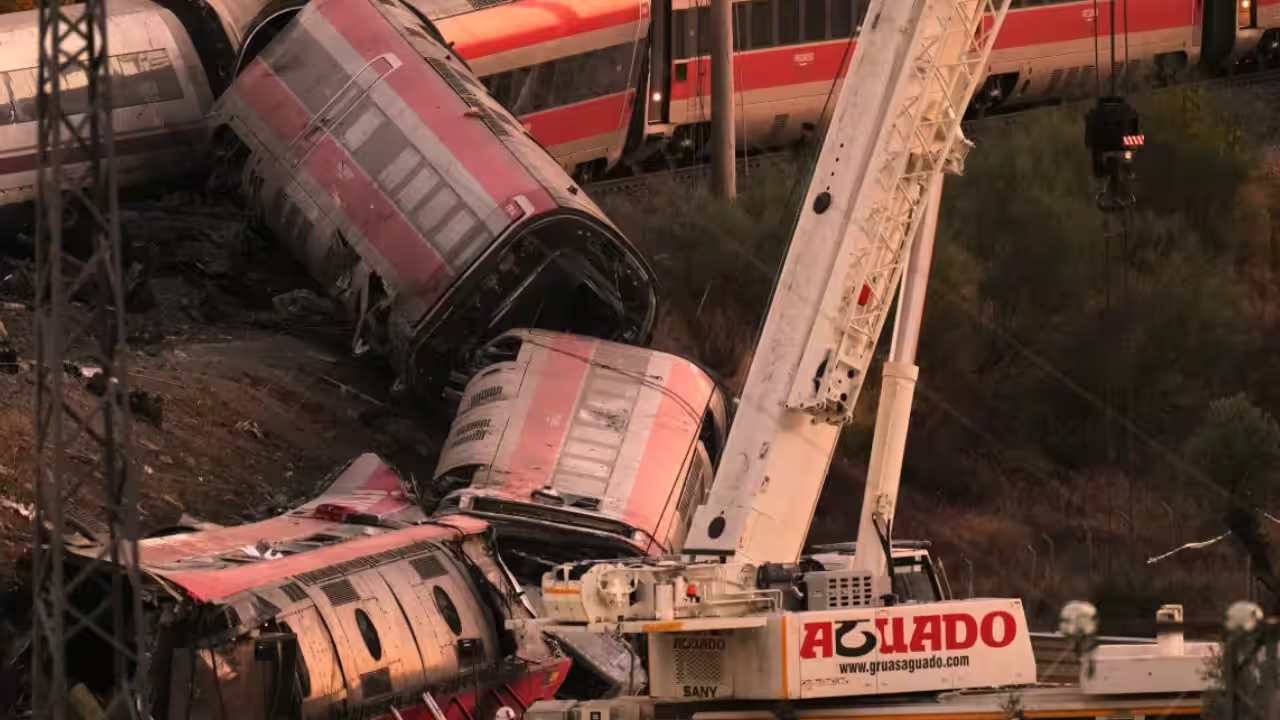
Audio recordings released by Spanish media have shed light on the minutes before a train collision that killed at least 68 people and injured dozens, raising questions about why a train was allowed to move while another remained stranded on the tracks.The recordings capture conversations between train drivers and a railway control centre in Madrid before the crash on Wednesday morning. Investigators are examining the circumstances in which a train travelling from Madrid to Seville struck another train that had stopped ahead of it.The disaster has triggered three days of national mourning in Spain and renewed concerns about railway safety, with officials investigating a possible signalling failure and the decisions taken by railway controllers.According to the recordings published by Spanish outlets including El País and RTVE, a technical problem had disrupted the automatic signalling system, forcing trains on the affected stretch to stop. The system helps control train movements and prevents trains from entering sections of track when it may be unsafe to do so.Spain's transport minister said the Renfe train was later instructed to move again in "error", without speed restrictions.Recordings capture exchanges One recording captures a control centre operator telling the driver of the Renfe train to continue at normal speed after technical problems."Continue your journey and then proceed under [Lateral Signalling Block], at normal speed with normal operation," the control centre operator says to the driver.The driver replies, "At normal speed?" To which the controller says: "Yes."Lateral Signalling Block is an alternative procedure used when the regular automatic signalling or data transmission system fails. It allows train movements to continue under a different operating arrangement.In another recording, the driver of the Iryo train reports losing communication with the train control system and says the train is stationary at Urda.The train "is stationary in front of the entry signal at Urda", the driver tells the control centre operator.Following several exchanges, the driver is instructed to "resume the journey" normally.However, a later recording appears to show that the Iryo train was still unable to move. Its driver contacts the control centre again and explains that a problem with the train's security system is preventing it from restarting."The train won't allow me to control the [security] system. That's why I am still stopped in front of the entry signal," they say.The exchange suggests that the control centre had been informed that the Iryo train remained stationary as the Renfe train approached. Investigators will need to establish how the two trains were managed and whether the procedures followed were appropriate.Officials question decision The Renfe train was carrying 397 passengers, while the Iryo train had 147 people on board. Iryo said its train was "struck from behind" by the Renfe service.Spain's transport minister Óscar Puente described the decision to allow trains to move again without speed restrictions as "inexplicable". The investigation is expected to examine the signalling disruption, communications between drivers and controllers, and the instructions issued before the collision.Emergency workers spent the night at the crash site using powerful floodlights to search damaged carriages and recover victims. Some bodies remained unidentified as recovery operations continued.Spain's interior ministry said hundreds of personnel had been deployed to help at the site. Drones and helicopters were also being used to locate victims and clear rubble.Witnesses described scenes of devastation, with passengers trapped in their seats, people crying and bleeding, and smoke filling the carriages. One carriage caught fire.Prime Minister Pedro Sánchez said the "whole of Spain is grieving", adding that "lives have been shattered, families have been torn apart, the pain is immense".Sánchez also said it was "unacceptable" that Spain had experienced two serious rail disasters this year. A separate high-speed train crash near Córdoba in January killed 46 people on the same line, although at a location much further south.Crash sparks protests The disaster has prompted political reactions and public anger over railway safety. Most political parties suspended campaigning for upcoming elections following the crash.The far-right Vox party was an exception. Its leader, Santiago Abascal, said his party would not take part in what he described as attempts to "use mourning to silence criticism" of Spain's rail infrastructure.Around 1,500 people gathered outside the Spanish Transport Ministry in Madrid overnight, broadcaster TVE reported. Many demonstrators called for the resignations of Sánchez and Puente.Police used tear gas to disperse the crowd after protesters threw bottles and flares. No injuries or arrests were reported.Railway drivers are also expected to proceed with a planned strike on Thursday. The Spanish Union of Railway Drivers, known as Semaf, said the action would be held "in defence of railway safety".Alberto Núñez Feijóo, leader of Spain's main opposition People's Party, said "Spain has the right to know what is happening with its infrastructure."The recordings have raised questions about the decisions made in the minutes before the collision, but they do not by themselves establish the cause of the crash. Investigators will have to determine how the signalling failure occurred, why the trains were instructed to move and whether any safety rules were breached.You use AI every day. Now get your AI Quotient. Take the AIQ test.
Topics in this story
Gathered from external sources. Rights to this text belong to whoever originally published it.