Austria's Semmering Railway, completed in 1854 across 41 kilometres of mountains with tunnels and viaducts, still carries trains 172 years later
Infrastructure is built to last, and few are as striking as the Semmering Railway in Austria.
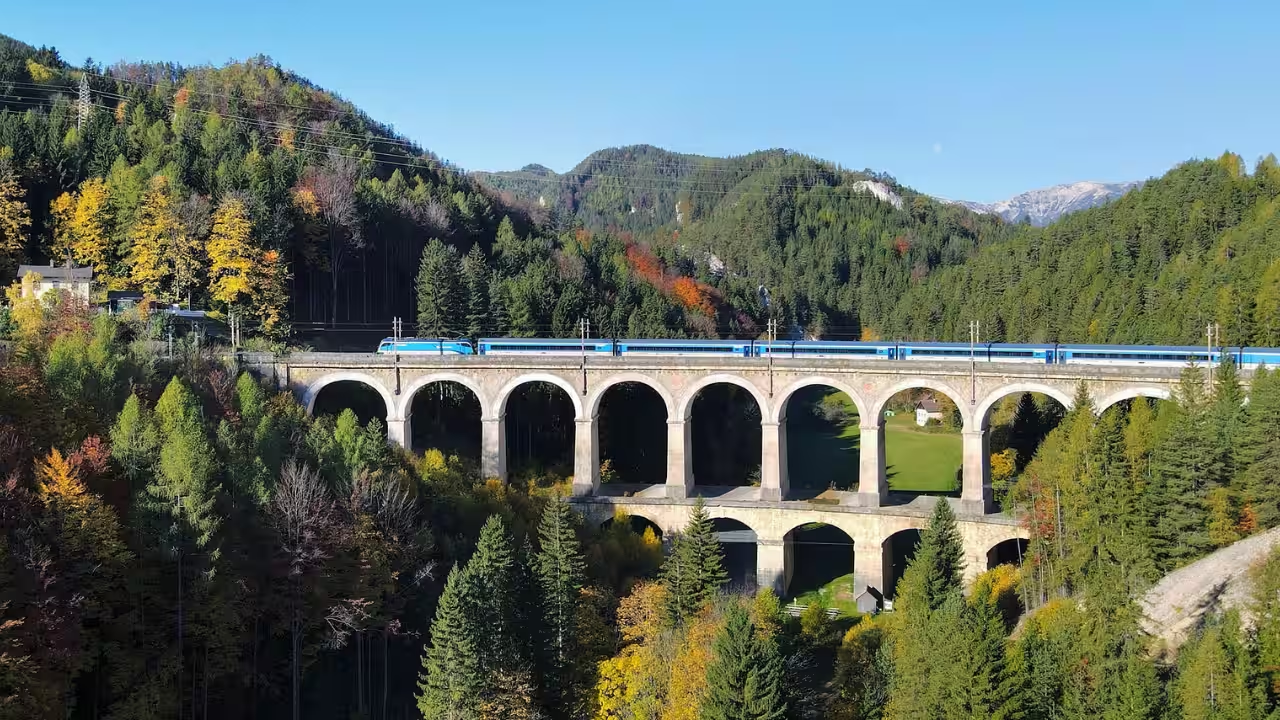
Infrastructure is built to last, and few are as striking as the Semmering Railway in Austria. Constructed between 1848 and 1854 over 41 kilometres of high mountains, it was one of the greatest feats of civil engineering from the pioneering age of railways. Its tunnels, viaducts and other works were built so well that the line has stayed in continuous use ever since. In 2026, more than 170 years after completion, engineers finished the main renovation work on its largest viaduct, and regular trains are running again. The old stonework and modern upkeep show how heritage can keep working.Where the Semmering Railway runs: From Gloggnitz to MürzzuschlagUNESCO notes the line begins at Gloggnitz station in Lower Austria, 436 metres above sea level, and climbs for 29 kilometres to its highest point at the pass, 895 metres up. It then descends for a further 12 kilometres to Mürzzuschlag station in Styria, at 677 metres. Along the way, it passes through a series of tunnels and viaducts, including the Klamm Tunnel, the Schwarza viaduct and the two-storey curving viaduct over the Kalte Rinne, before the 1,431-metre Semmering Tunnel leads to Semmering station. The World Heritage Centre describes the last section as the most dramatic of the route. The inscribed property covers 156 hectares, surrounded by a buffer zone of 8,581 hectares.The engineering that made the Semmering Railway a feat of civil engineeringThe line's fourteen tunnels are 1,477 metres long in total, nearly one-tenth of the route, and its sixteen major viaducts also add up to 1,477 metres. There are 118 smaller arched stone bridges and eleven iron bridges. Most tunnel portals are simple but monumental, with varied ornamentation, and the support structures are largely stone, with brick used for the viaduct arches and tunnel linings. Fifty-seven two-storey attendants' houses stand at roughly 700-metre intervals, a characteristic feature of the line. According to the World Heritage Centre, the continued operation of the line testifies to the engineering genius of project engineer Carl von Ghega.Why the Semmering Railway is a World Heritage site, it has been in continuous use since 1854The railway was inscribed as a World Heritage site in 1998 for two reasons. First, it represents an outstanding technological solution to a major physical problem in early railway construction. Second, it opened areas of great natural beauty to residential and recreational use, creating a new form of landscape. The Semmering Pass became one of the first purpose-built Alpine resorts, known for the summer architecture of its villas and hotels. The line's appearance changed when overhead wire poles were erected between 1957 and 1959 for electric locomotives. Federal protection has applied since 1923, and a management plan has been in place since 2008.How Austrian Federal Railways keeps the Semmering line running until the base tunnel opensKeeping a line this old running takes constant work. According to Austrian Federal Railways, about two and a half months of work, chiefly to renovate the Kalte Rinne viaduct, ended on 29 May 2026, when normal traffic resumed. Crews renewed the reinforcement with around 92 tonnes of steel, laid roughly 1,200 square metres of waterproofing, and renewed 200 metres of track; the company is investing about twenty million euros this year. Trains kept running on one track from 14 March to 28 May. The operator says the mountain line will stay vital until the Semmering Base Tunnel opens at the end of 2029.You use AI every day. Now get your AI Quotient. Take the AIQ test.
Topics in this story
Gathered from external sources. Rights to this text belong to whoever originally published it.