The cost of Iran’s regional leverage
Tehran’s use of pressure across the region is putting its rapprochement with Gulf states under increasing strain.
For more than two years, the 2023 Beijing-brokered agreement between Saudi Arabia and Iran seemed to mark a shift in Gulf politics: Away from confrontation and towards managed coexistence. The agreement neither ended strategic rivalry nor sought to do so. Its significance was more limited but still consequential: It created political space for competition to be managed without repeatedly spilling into direct regional escalation. That space came under severe strain earlier this year, when direct Iranian attacks on Saudi Arabia led Riyadh to expel Iran’s military attache and four other embassy staff. Renewed Houthi attacks on Saudi territory and the postponement of planned talks in Oman are now placing what remains of that diplomatic framework under further strain. Together, these developments expose a deeper contradiction at the heart of Tehran’s regional strategy: Can Iran sustain stable diplomatic relations with its Arab Gulf neighbours while continuing to draw strategic leverage from a regional network capable of directly threatening their security?
The attacks: When Yemen’s war crosses the border
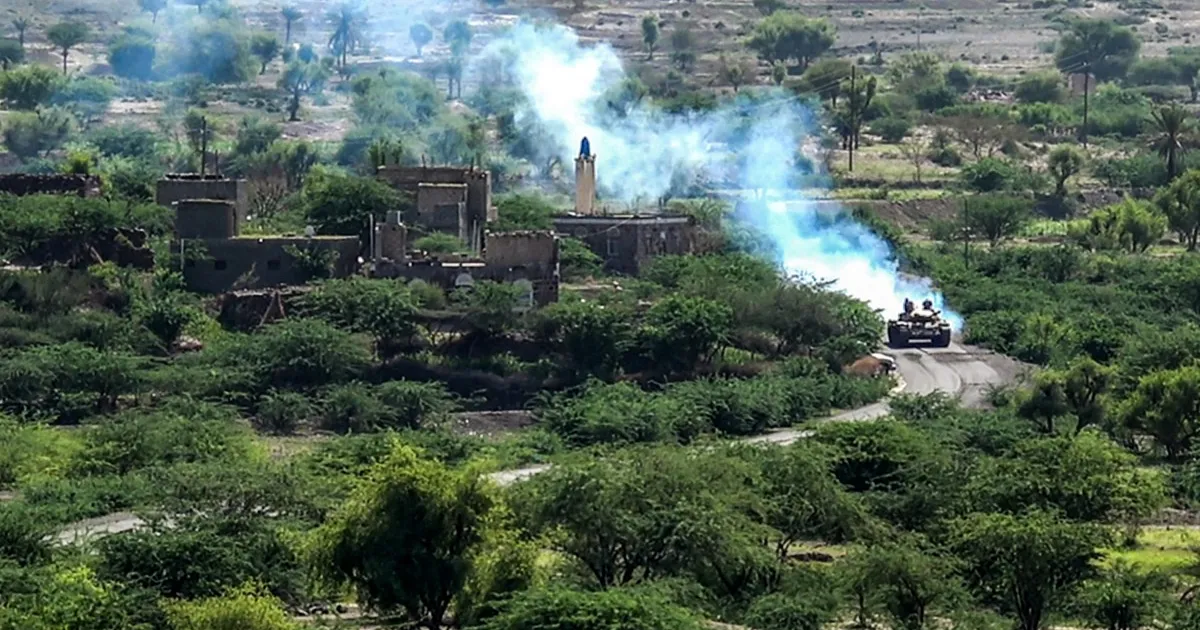
The latest escalation marks an important shift in the trajectory of the conflict in Yemen. Fighting that had largely remained within Yemen’s borders has once again crossed into Saudi territory, drawing the consequences of the war directly into the Gulf security environment. On September 8, the Houthis launched a coordinated wave of drone and ballistic missile attacks against several Saudi cities and strategic sites, including Abha, Khamis Mushait, Jizan and Najran.
The significance of this escalation lies not only in the intensity of the attacks but also in their timing and geographic reach. The strikes coincided with renewed fighting between the Houthis and Yemeni government forces around Bab al-Mandeb, one of the region’s most strategically important maritime chokepoints. By mid-September, the escalation had also produced serious humanitarian consequences, displacing tens of thousands of people within Yemen and pushing others across the Red Sea to Djibouti. The Houthi seizure of Mocha and strategic islands around Bab al-Mandeb further underscored the confrontation’s strategic dimension. The conflict, in other words, is no longer defined solely by control of territory within Yemen. It is increasingly tied to control of strategic geography and to the capacity to project pressure beyond Yemen’s borders.
Why now: Hormuz, the Red Sea, and the expanding geography of pressure
The timing matters because the escalation is unfolding alongside growing pressure elsewhere in the region. Since Israel and the United States launched their war on Iran in February, Tehran has severely restricted shipping through the Strait of Hormuz, sharply increasing the importance of Saudi Arabia’s western export routes through the Red Sea. That shift has, in turn, increased the strategic importance of Bab al-Mandeb as an alternative gateway for energy flows.
These developments connect two maritime theatres that are often analysed separately. Hormuz is the Gulf’s principal eastern gateway; Bab al-Mandeb provides access to the Red Sea from the west. Simultaneous pressure around both creates a broader geography of strategic vulnerability, extending the consequences of confrontation well beyond the immediate battlefield. In that context, the Houthi position along Yemen’s western coast takes on significance beyond the internal dynamics of the Yemeni conflict. It becomes another point through which pressure can be exerted across the wider regional security system.
The central issue, then, is not whether Tehran directly determines every Houthi military decision. More important is whether developments in Yemen advance or complement Iran’s broader strategic objectives. When pressure around Hormuz coincides with instability around Bab al-Mandeb, two distinct maritime arenas can begin to operate as interconnected sources of leverage. The result is more than an expansion of the conflict itself: It is an expansion of the geography through which strategic pressure can be applied.
The Oman talks: When escalation narrows the space for diplomacy
The postponement of the Oman-hosted talks shows how quickly military escalation can constrict the political space available for diplomacy. Gulf states and Iran had been expected to meet in Salalah to discuss arrangements for managing navigation through the Strait of Hormuz, building on an existing understanding between Tehran and Muscat. The proposed talks were intended to focus on practical maritime security measures, including navigation arrangements and mechanisms for reducing risk around one of the world’s most strategically important waterways.
The regional environment, however, changed faster than the diplomatic process could absorb. Bahrain had already indicated that it would not participate, and Oman subsequently announced the postponement of the meeting, with no new date announced, concluding that the conditions required for productive negotiations were no longer in place. Iran acknowledged that the delay followed concerns raised by some regional states, while reports also pointed to disagreements over elements of the proposed framework.
The importance of the postponement therefore extends beyond the cancellation of a single meeting. It exposes a broader problem for regional diplomacy: Negotiations cannot easily be insulated from the security environment in which they occur. For Saudi Arabia, discussing maritime security with Tehran while simultaneously facing missile and drone attacks from an Iran-aligned actor created an increasingly difficult political contradiction. The question was no longer simply whether dialogue could continue, but whether enough strategic confidence remained for that dialogue to produce meaningful results.
The current escalation therefore raises a broader strategic question: Can Iran continue to extract leverage from regional pressure while preserving its longer-term objective of stable relations with its Arab Gulf neighbours? Since Saudi-Iranian diplomatic relations were restored in 2023, Tehran has sought to present regional dialogue as an alternative to permanent confrontation and to demonstrate that Gulf security can be managed through engagement rather than continual escalation. The durability of that approach, however, depends on more than keeping diplomatic channels open. It also requires convincing neighbouring states that rapprochement can provide a meaningful degree of strategic reassurance.
The current pattern of escalation puts that premise under increasing strain. When missile and drone attacks by an Iran-aligned actor reach Saudi territory at the same time that instability grows around Bab al-Mandeb and Hormuz, Gulf states may find it increasingly difficult to separate their diplomatic relationship with Tehran from their wider security concerns. Again, the decisive issue is not whether Iran directly controls every Houthi decision. Strategically, what matters is the perception that Tehran continues to benefit from a regional network capable of imposing costs on neighbouring states during periods of confrontation.
That dynamic creates a difficult paradox for Tehran. Iran has long sought to prevent the emergence of a more consolidated regional security architecture directed against it. Yet as the geography of pressure widens, Gulf states may have stronger incentives to deepen their external security partnerships and coordinate more closely with one another. An instrument intended to create strategic depth and bargaining leverage can therefore produce the opposite effect: Greater regional coordination around the very security concerns Iran is seeking to contain.
There is, however, another way to interpret Tehran’s calculation. Under direct military pressure and amid growing uncertainty about its regional position, Iran may view pressure generated across multiple fronts as a wartime source of leverage, rather than as the basis of its long-term relations with its neighbours. From that perspective, strategic pressure and regional diplomatic engagement need not be treated as mutually exclusive. They can instead be understood as different phases of the same strategy: Maximise leverage during confrontation, then return to diplomacy once the immediate balance of pressure has shifted.
That calculation carries a substantial strategic risk. It assumes that political trust can be suspended during confrontation and rebuilt afterwards. Yet diplomatic rapprochement involves more than restoring diplomatic representation or reopening channels of communication; its durability depends on expectations about future behaviour. Repeated cycles of escalation followed by diplomatic reset can gradually erode those expectations. Each cycle may therefore make the next attempt at reassurance more difficult and reduce the confidence on which future agreements depend.
The consequences extend beyond Saudi-Iranian relations. China’s role in brokering the 2023 agreement gave the rapprochement a wider international dimension, while the postponement of the Oman talks shows how quickly developments on the ground can narrow the space for regional diplomacy. The more often diplomatic arrangements are overtaken by renewed escalation, the harder it becomes for mediation and regional engagement frameworks to generate durable confidence. The damage is therefore not limited to a single negotiation; it can accumulate across the broader diplomatic architecture intended to contain regional rivalry.
This is ultimately the cost of leverage. Tactical pressure may broaden bargaining options in the short term, but its strategic value becomes harder to sustain when the same pressure begins to weaken the relationships needed for long-term regional stability. For Iran, the central challenge is therefore not simply how much pressure its regional network can generate. It is whether continuing to draw leverage from that network can remain compatible with the regional order Tehran says it wants to build.
The views expressed in this article are the author’s own and do not necessarily reflect Al Jazeera’s editorial stance.
Gathered from external sources. Rights to this text belong to whoever originally published it.