In 1916, a New York widow raising five children refused to sell her Manhattan row house; developers put 14- and 15-storey apartment buildings on both sides, leaving her home standing
In the heart of Manhattan, a determined widow raised her five children and resisted developers' offers, leading to the survival of her family’s five-story row house amidst towering skyscrapers. Uncover the story of Mary Cook and her historic home at 249 West End Avenue, standing as a testament to resilience against urban development.
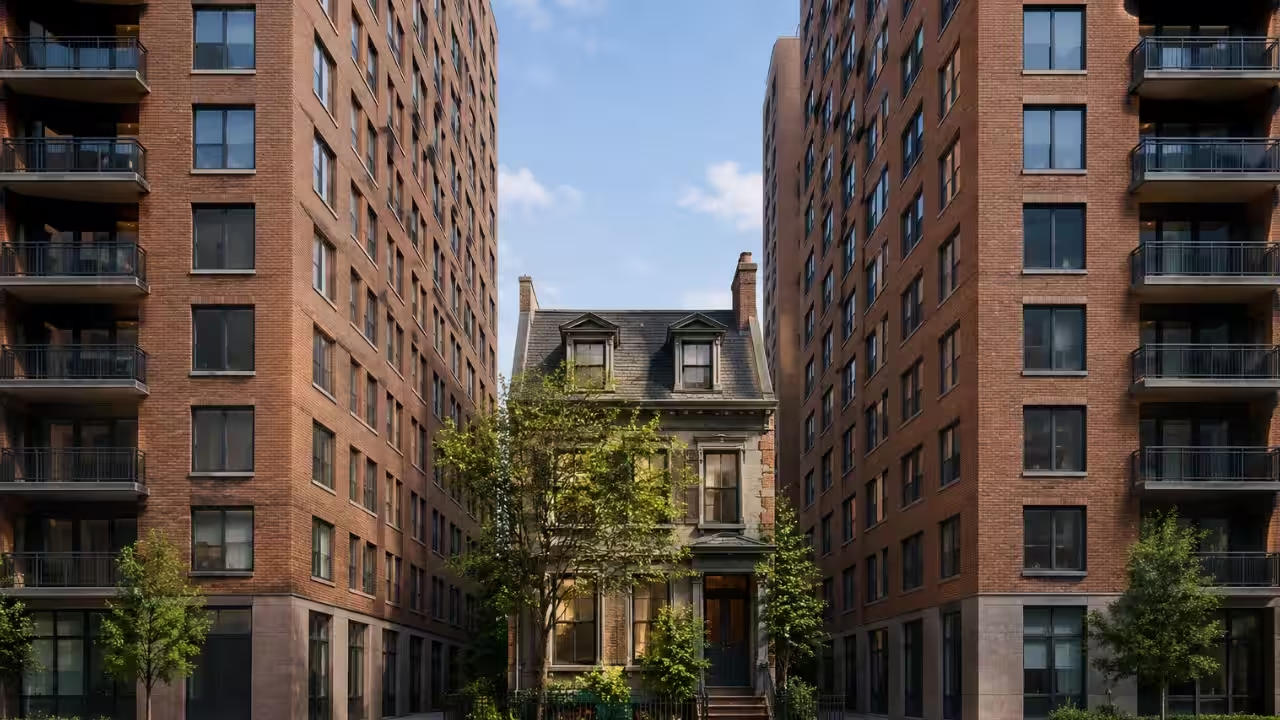
The five-story row house at 249 West End Avenue on Manhattan's Upper West Side stands between two much taller apartment buildings. The Landmarks Preservation Commission's West End-Collegiate Historic District Extension Designation Report, adopted on June 25, 2013, states that Clarence True designed the house at 249 West End Avenue in the Romanesque Revival style in 1892 and 1893, with an American basement plan that lowered the stoop nearly to street level. The report calls it one of the few remaining single-family houses on West End Avenue. The commission's building notes describe it as one of four or five similarly designed houses, while Newyorkitecture counts five. That fit the avenue's first phase. Dolkart's 2009 survey, West End Avenue Survey: A Proposal for Historic District Designation, says the first phase of development, largely from 1885 to 1900, created a street of fine, upper-middle-class, single-family row houses, along with a few larger French flats and several churches and other institutional buildings.The Cook family raised five children in the houseFerdinand Huntting Cook and his wife, Mary Aldrich Cook, bought the house and made it the home of their five children. The location suited their two sons, who attended the nearby Collegiate School, as 6sqft reported. On January 3, 1913, Ferdinand left the house and did not return, and his body was found about a month later in a wooded area in Queens, leaving Mary a widow, as Daytonian in Manhattan recounts.Apartment houses of 12 to 16 stories replaced row housesThe designation report explains that after 1900, rising construction costs made new row houses impractical, and the opening of the IRT subway in 1904 made the Upper West Side more accessible to the city's expanding population. The 1901 Tenement House Act, which also regulated light, ventilation, fireproofing and lot coverage, capped building height at one and a third times the width of the street. The ratio was amended to one and a half times in 1902 and remained in effect until 1929.Before World War I, apartment buildings in the area were 12 to 14 stories high, and after the war they rose to 15 or 16 stories. Developers bought row houses less than 30 years old to assemble sites, and Riverside Drive and West End Avenue were especially vulnerable to the trend. Dolkart's survey counted 218 buildings on West End Avenue as of January 2009, including 112 large apartment buildings and 70 narrow single-family homes, many converted to apartments.Mary Cook declines offers as 255 West End Avenue rises 255 West End Avenue rose on the north side of her house. The designation report dates it to 1916 and credits Schwartz & Gross, listing it among the two earliest Colonial Revival apartment buildings in the extension, and New Yorkitecture gives its height as 14 stories. The commission notes that Mary Cook repeatedly declined offers to sell even as similar houses to the north and south were demolished for apartment buildings.243 West End Avenue rises 15 stories to the south The designation report credits Emery Roth with 243 West End Avenue and dates it to 1925, and Newyorkitecture gives its height as 15 stories. Development on the south side was underway in the early 1920s, as 6sqft reported, so the house waited several years for its next neighbor. Developers hoping to assemble the whole block could do nothing without Mary Cook's agreement.The Continental Club moves in and the district is designatedMary Cook died in 1932, as New Yorkitecture and Daytonian in Manhattan note, and the house changed hands. The designation report says the Continental Club was in the building during the 1930s, possibly into the 1940s, offering lectures, musical performances and other cultural events, and its Uptown Gallery showed works by artists including Adolph Gottlieb and Mark Rothko. The house was later converted to apartments. When the extension was designated in 2013, the district consisted of about 220 buildings between West 70th and 79th Streets, and No. 249 is the last survivor of its row, as Untapped Cities notes.You use AI every day. Now get your AI Quotient. Take the AIQ test.
Topics in this story
Gathered from external sources. Rights to this text belong to whoever originally published it.