Partial Lunar Eclipse 2026: Date, timings, when and where to watch; why does the Moon turn red and all you need to know
Trending News: A lunar eclipse happens when the Sun, Earth, and Moon are in a linear path, such that the Earth casts its shadow on the Moon and it appears like a glo.
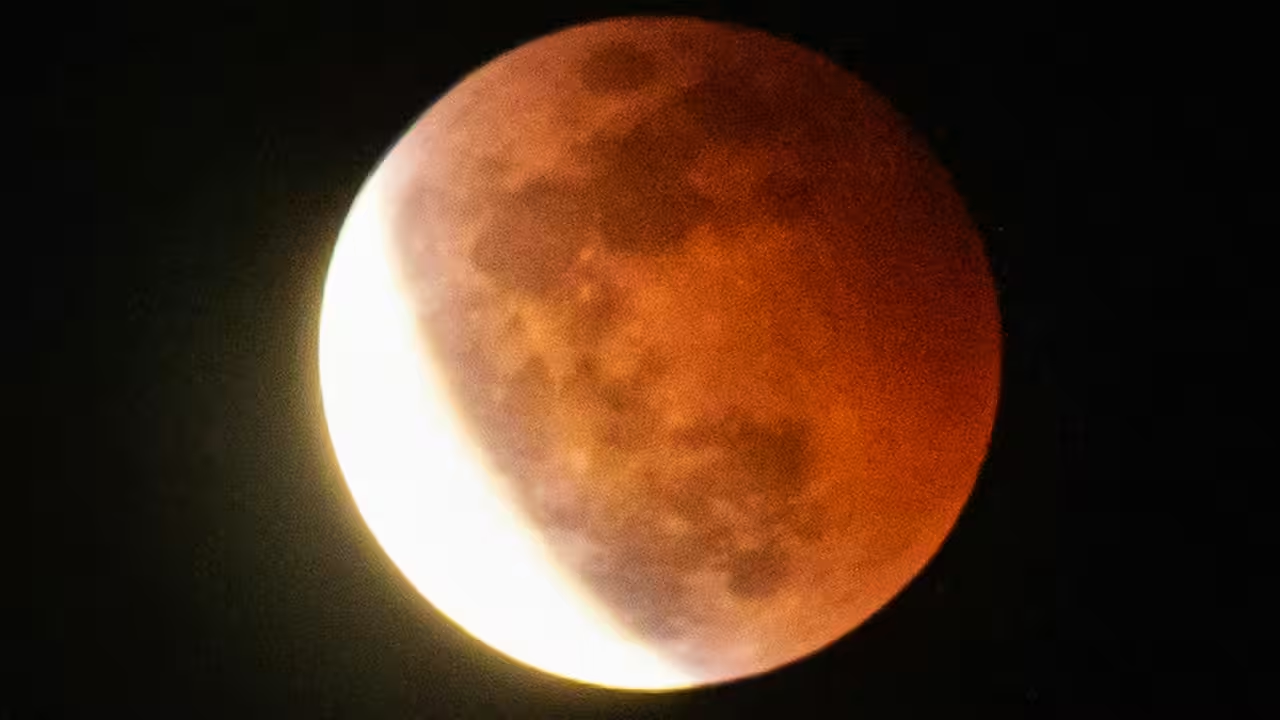
A lunar eclipse happens when the Sun, Earth, and Moon are in a linear path, such that the Earth casts its shadow on the Moon and it appears like a glowing red ball in the night sky.The partial lunar eclipse is set to happen on the night of August 27 into the early hours of August 28, 2026. This won't be a full "blood moon," but quite close to it, at its peak, as nearly the entire lunar disk will remain in Earth's darkest shadow, leaving only a slim, bright sliver untouched.What exactly is happening during this timeThis is a deep partial lunar eclipse, meaning Earth will pass between the Sun and Moon, but the three bodies won't align perfectly enough to produce a total eclipse.According to NASA's Scientific Visualization Studio, at the moment of greatest eclipse, 96.3 percent of the Moon's disk will be covered in Earth's umbra, its darkest shadow, making this the most beautiful lunar eclipse anywhere on Earth until 2028.Date and Time of the Partial Lunar EclipseThe partial Lunar Eclipse will take place on August 28 in UTC. According to NASA, the partial phase starts at 2:34 am UTC, when Earth's shadow first takes a visible "bite" out of the full Moon, reaching its highest point or peak roughly at 4:13 am UTC, before fading back through partial and penumbral phases by around 7:01 am UTC.Where to watch the eclipseThe best places to watch the eclipse include mainly the North and South American regions, where the entire eclipse, from first bite to greatest eclipse and beyond, will be visible in a dark sky.Parts of western Europe, including Spain, Portugal, France, Italy, and Germany, and western Africa will catch the event before dawn, though the Moon may set during the later stages in some locations. NASA says the eclipse will not be visible in its entirety from every location worldwide.Why does the Moon look like a glowing red orb?During a lunar eclipse, the Moon gets covered into Earth's shadow as our planet lines up between it and the Sun. But even then, the Moon doesn't go completely dark.A little sunlight still passes through Earth's atmosphere on its way to the Moon. As it passes through, the atmosphere filters out most of the blue light, letting the red and orange wavelengths through instead. That reddish light then falls on the Moon and bounces back to the planet, which is what gives an eclipsed Moon its warm, coppery glow.Lunar Eclipse August 2026: Will it be visible in India?The geographical location of India is such that it sits on the daytime side of Earth when this eclipse peaks. The eclipse will peak at around 9:43 am IST, well after sunrise, with the Moon already below the horizon and out of view.Partial Lunar eclipse timing according to ISTIf you convert the eclipse's global timings to Indian Standard Time, here are the stages:The faint penumbral shadow first touches the Moon around 6:54 am IST.The more visible partial eclipse reaches by about 8:04 am ISTThe peak will be at 9:43 am IST.From there, it fades slowly; the partial phase will conclude by 11:21 am IST, and the last trace of penumbral shadow clears by around 12:31 pm IST.Keep in mind, these are just the eclipse's global stages translated into Indian time, not a viewing schedule.Does watching a Lunar eclipse require safety measures?Unlike a solar eclipse, a lunar eclipse is completely safe to watch with the naked eye and needs no special glasses or filters. Apart from that, one can use binoculars or a telescope to simply sharpen the view.For those in India or anywhere else without a clear night sky at the right time, NASA and the European Space Agency are playing the online stream of the event online.Get the latest movie news, reviews, and celebrity updates. Download the TOI App.
Topics in this story
Gathered from external sources. Rights to this text belong to whoever originally published it.