Young people wanted community. They got 'eventslop.'
Are all these strange gatherings designed to go viral fostering togetherness or algorithm slop?
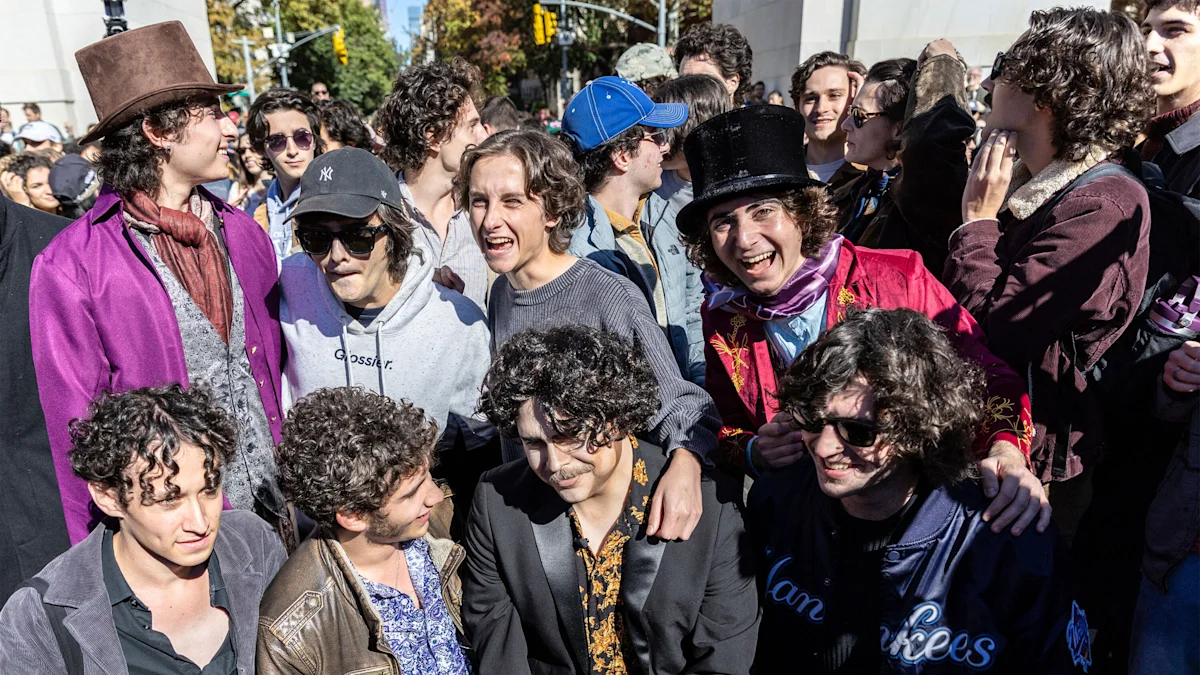
If you spend any time on social media, chances are a wacky or oddly specific event has hit your feed at some point in the last couple of years: A celebrity lookalike contest , a meetup for Wasian people , an aura battle among teenagers , an invitation to eat pudding with a fork with strangers.
The list goes on. But is this rash of viral gatherings in major metropolitan areas a sign that the masses are feeling more whimsical these days , or that human interaction is becoming more superficial, manufactured to feed an algorithm?
Adam Aleksic , a linguist and author of Algospeak: How Social Media Is Transforming the Future of Language , posed a theory on TikTok.
"People don't host real public gatherings anymore; they host 'eventslop,' where the main purpose of the event is to generate algorithmic engagement above all else," Aleksic, who goes by etymologynerd on TikTok, said in the video .
Aleksic noted that these events have largely been organized by influencers and suggested they were designed to be filmed "less to create social connections, and more to serve as a free laugh track for whatever crazy stunt is currently happening." They also rely on trending buzzwords, like "aura" and " Wasian ," he said, meaning they were "very likely orchestrated for algorithmic momentum."
Viral events are nothing new — I vividly remember receiving dozens of invites to bizarre gatherings on Facebook in the 2000s and 2010s, like pillow fight flash mobs and a plot to storm Area 51 — but there's no denying that they feel more common and social media-friendly now.
In this era of AI dominance, "slop" became a slang term for low-quality content created by the technology, but has since broadened to describe anything lazily produced. Aleksic said that while these events are probably plenty of fun, they're still "degraded versions of what they could have been" because the organizer's goal is to extract views from the public's desire for community.
One gathering that Aleksic cited as an example of eventslop is the 2024 Timothée Chalamet lookalike contest , which was followed by many other copycat contests, including one for the Heated Rivalry cast and another for New York City Mayor Zohran Mamdani .
Content creator Anthony Po was responsible for starting the trend and has a knack for making events go viral. (Remember when a masked guy ate a jar of cheeseballs in front of a crowd ? That was him.)
Po told the Hollywood Reporter in 2024 that for the Chalamet lookalike contest, he considered, "What would be fun? What would get people talking?"
"Wholesome fun things that are free for people to gawk at and tell their grandkids about," he said, answering his own question.
Going viral certainly appeared to be the point. Po said he spent more than $4,000 on the event, flew in a judge and hired production assistants. He was also expecting a crowd and had a hunch that the real Chalamet could show up, but the chaos was a happy surprise. It's likely the contest wouldn't have gone viral if it weren't zeitgeisty and fun. Whimsy was integral to its success.
Gael Aitor, who organizes play-focused events for the social club Grownkid — like a " fight your evil situationship " rave in Los Angeles — argues that young people actually crave eventslop.
"Youth no longer want to be just consumers of content but rather part of the creation process itself, going offline to have a reason to enjoy the online again," he wrote in a February post on Grownkid's Substack . "With slop events, both sides win. Creators get a steady stream of moments to turn into long-form content and spread through clips, and attendees get to help create it while connecting with their communities."
People crave community. The loneliness epidemic among Gen Zers has been widely covered, as has the dwindling number of third spaces where people can gather. We might be more connected to each other and our interests thanks to social media, but in-person interactions still offer something uniquely valuable.
If lookalike contests and aura battles feel too inauthentic for your taste, there are plenty of other quirky gatherings where you'll find community. Axios reported that there's been an increase in people gathering around shared hobbies like mahjong and silent reading. And according to Eventbrite , there's also been an increase in "soft socializing," where people get together to make connections naturally, without necessarily having the goal of networking. Some concerts have banned phones, encouraging attendees to live in the moment.
What viral events and phone-free ones have in common is this: People know what they're getting into when they go. When attending something you found on social media that seems buzzy and of-the-moment, it's pretty obvious that it'll involve creating content. But offline soirees are still possible too. Consider the fact that we still don't know what Taylor Swift's wedding dress looks like.
Therapist Lynn Zakeri told Yahoo that the rise of eventslop might not be such a bad thing. Attending often requires bravery and social interaction.
"Look at it like this: You got out of the house, made eye contact with someone and made a new friend," she said. "If you want to be there as a hater, go do it! Take a risk. Do whatever you want to do."
Dressing up, going somewhere and mingling with others are all part of joining a community, and the end goal of going viral doesn't necessarily diminish that.
Gathered from external sources. Rights to this text belong to whoever originally published it.