Delaware's 2017 bike yield law let riders roll through some stop signs; bicycle crashes at stop-sign intersections fell by 23% over the next 30 months
Discover how Delaware's 2017 bike yield law significantly decreased bicycle crashes at stop-sign intersections by 23% within 30 months, promoting safer cycling practices.
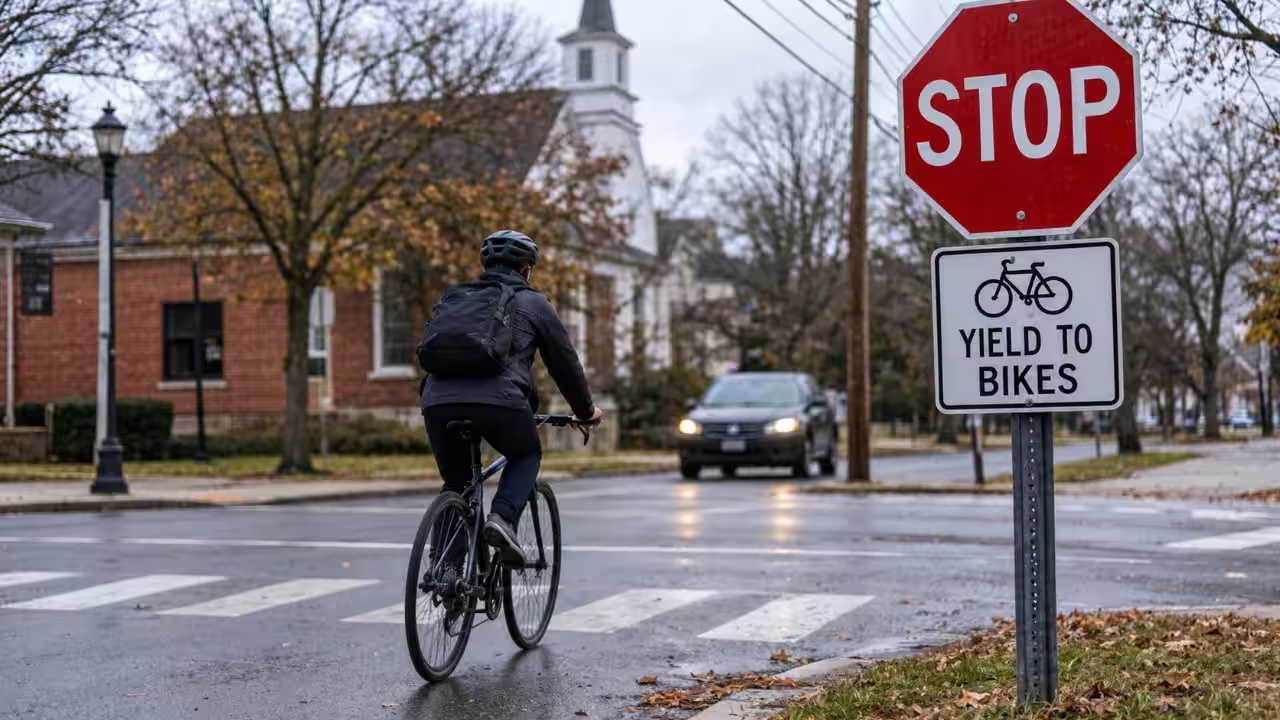
At an intersection, cyclists face a dilemma drivers rarely have to calculate. Instead of just pausing, they have to stop, balance, and start again when approaching a stop sign. According to Bike Delaware's testimony to the Maryland General Assembly, Delaware changed the rules when Governor John Carney signed the Bicycle Friendly Delaware Act.Nationally, the National Highway Traffic Safety Administration (NHTSA) recorded 938 bicyclist fatalities in 2020, up from 682 in 2011. Moreover, 26% of these fatalities occurred at intersections. A provision known as the Delaware Yield allowed cyclists to treat stop signs as yield signs. Bike Delaware recorded that during the 30 months after the Act was signed, bicycle crashes at stop-sign-controlled intersections decreased to 23%, compared with the preceding 30 months.How the Delaware Yield actually works The Bicycle Friendly Delaware Act was signed in May 2017. Under the Delaware Yield, a cyclist approaching a stop sign may slow down and assess the intersection. Then they can proceed without making a complete stop if it is safe to do so. However, the rider must still give way to traffic with the right of way. The Act, in essence, changed the requirement to stop; it did not grant cyclists priority over motorists or pedestrians. NHTSA also clarified that stop-as-yield laws do not remove cyclists’ responsibility to give way to other traffic before crossing an intersection. Riders must also follow traffic instructions in work zones.According to NHTSA, stop-as-yield laws allow cyclists to treat stop signs as yield signs, and in some states, red signals as stop signs. Delaware’s law applies only to stop signs, not red lights. According to NHTSA, there are eight states that allow cyclists to treat stop signs as yields. These include Arkansas, Delaware, Idaho, North Dakota, Oklahoma, Oregon, Utah and Washington. Delaware appears in the stop-sign category only. Idaho enacted the earliest law in 1982, while Delaware followed in 2017.The logic behind the lawBike Delaware identified visibility and exposure as the two considerations that the Delaware Yield can use to prevent collisions at intersections. A moving cyclist is easier to spot for a driver than a stationary rider. The rule allowed cyclists to stay in motion instead of coming to a stop. It also noted that people can see objects directly ahead more easily compared to those positioned to the side. The second consideration is the time cyclists spend at an intersection. By moving through the intersection when safe, cyclists can enter and exit more swiftly. This reduces their exposure risk to passing vehicles. Idaho was the first to introduce a stop-as-yield law in 1982. According to NHTSA, injuries incurred by cyclists from traffic crashes fell by 14.5% in the year following its introduction.Safety in numbers and real-world complianceThe "safety in numbers" effect concerns the relationship between the number of cyclists on the road and their safety, because motorists tend to drive more cautiously when more cyclists are present. NHTSA's assessment also examined cyclist and driver behaviour. A naturalistic study conducted in Florida’s Tampa Bay recorded cyclist compliance with general traffic rules at 88.1% during the day. Similarly, the rate was 87.5% at night, NHTSA noted. In that Tampa Bay study, drivers were mostly non-compliant (87.6%) with the legal requirement that mandated them to yield to cyclists' right of way at non-signalised crossings.NHTSA also examined how pedestrians and cyclists approach traffic signals. Both groups exercised greater care and attention before crossing at red signals than at green lights. Collisions between cyclists and pedestrians, as well as between cyclists themselves, were uncommon. It also found no evidence that stop-as-yield laws had increased conflicts between cyclists or between cyclists and pedestrians.You use AI every day. Now get your AI Quotient. Take the AIQ test.
Topics in this story
Gathered from external sources. Rights to this text belong to whoever originally published it.