In 1978, Seoul began dumping its rubbish on a river island; 15 years and 92 million cubic metres of waste later, two 98-metre garbage mountains were sealed beneath five ecological parks
Rest of World News: Discover how Nanjido Island in Seoul transformed from a massive landfill into a beautiful ecological park featuring hiking trails and green spaces, following years of waste disposal and remediation efforts.
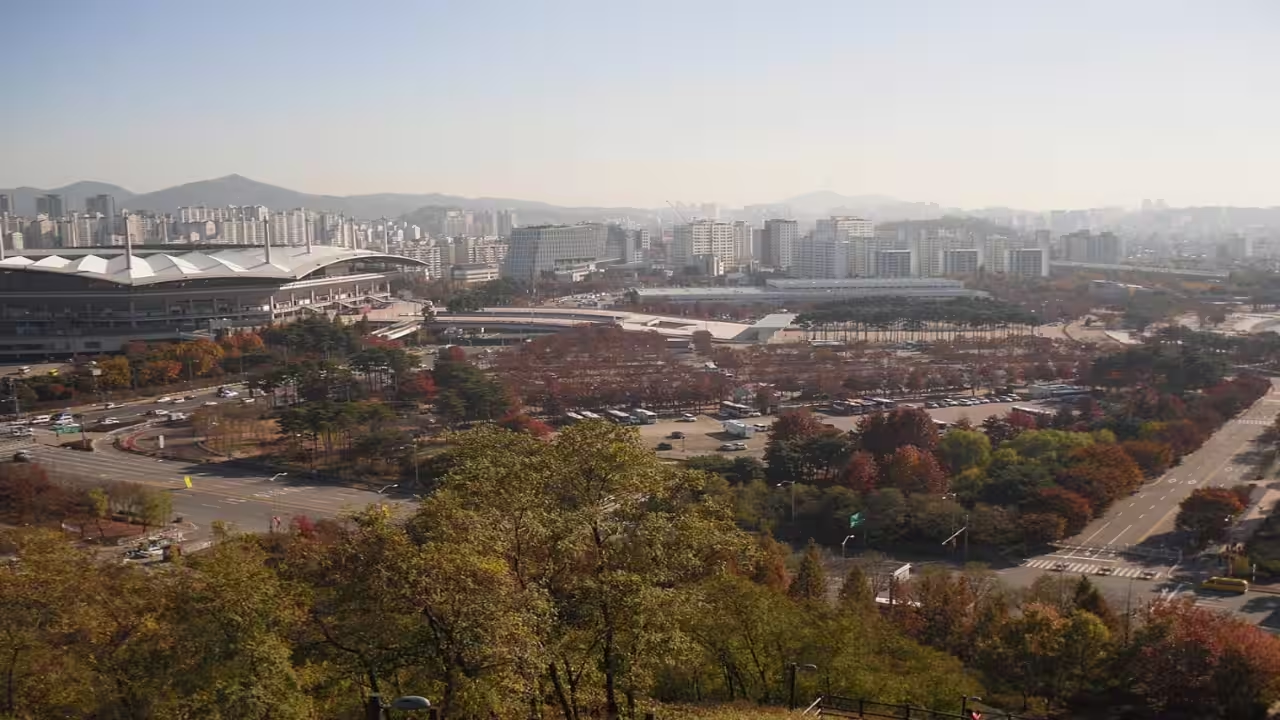
For fifteen years, a small island on the Han River took in almost everything Seoul threw away. By the time the dumping stopped, the site held two mounds of trash nearly a hundred metres tall. What happened next was a slow process of sealing, planting and rebuilding that transformed one of the cityâs most notorious eyesores into a cluster of public parks with football stadiums, hiking trails and silver grass festivals.1978: Nanjido was chosen after Seoul's existing dump sites reached capacity Waste generation in Seoul in the 1970s was outstripping the capacity of existing waste disposal sites. For instance, areas such as Gunja-dong, Sangwolgok-dong and Yeomchang-dong, which have been dumping grounds since 1964, were becoming overcrowded due to the increased population and construction in Seoul. The government sought a site that would be easily accessible by transportation and chose Nanjido Island in the Han River, where wild orchids used to grow. The research on this history, A Study on the Current Status of Landfill in Seoul and the Solutions to Future Generation Landfill Problems, published in the Journal of Wellbeing Management and Applied Psychology, records that dumping at Nanjido ran from March 1978 to March 1993. During this period, Nanjido served as Seoul's primary waste disposal site, though independent verification of the city's exact population served or the precise share of household waste processed was not available.March 1978 to March 1993: 92 million cubic metres dumped to create two 98 metre high moundsNanjido landfill differed from sanitary landfills of today in not being lined, covered, and controlled in terms of pollution control measures. The study also says Nanjido landfill covered 2,720,000 square metres, roughly the same as Yeouido Island, and that the low-lying fill reached 13 metres above sea level at its highest point in December 1985.Thereafter, the Nanjido landfill site was divided into two parts named Noeul Park and Haneul Park, as documented in Seoul Solutionâs official record of the landfill recovery project. Initially, officials set a 45-metre height limit in line with international standards for sanitary landfill sites. However, due to delays in the construction of the new site at Gimpo, Seoul had to continue filling the site with more waste and ended up with the creation of two high mounds, each of a height of 92 to 98 metres high, storing nearly 92 million cubic metres of waste. Living conditions at the dump were so poor that it was dubbed âSamdado,â or the island of three excesses: dust, smell and flies. Almost 3,000 people collected trash there for a living, recycling paper, bottles and cans, but gas from decomposition caused about 1,390 fires during the dumpâs 15 years of operation.1998 to 2002: Impermeable barriers, leachate treatment and 106 gas wellsSeoul closed Nanjido to new waste in March 1993 and turned its attention to containing the damage already done. The stabilization project formally began in January 1998 and was completed in October 2002, a span of nearly five years. It included impermeable walls to keep leachate from seeping into local groundwater, leachate management, methane gas extraction wells, mound stabilization to reduce the risk of collapse, and a soil cover on both mounds to allow vegetation to grow on top of them. Leachate from the facility had contained a Biological Oxygen Demand of 72 mg/l and a Total Nitrogen concentration of 1,416 mg/l, levels which could contaminate the Han River and its associated groundwaterTo address methane accumulation within the mounds, engineers constructed 106 gas extraction wells distributed evenly across the old landfill at 120-metre intervals. The methane was then used to provide heating for three public sites, including the World Cup Stadium, 40 office buildings, and 16,335 households in surrounding residential areas. The volume of energy extracted from 2002 to 2014 also amounted to almost 43.85 million cubic metres, worth more than 8.7 billion Korean won.Post-capping survey finds exotic species dominating the landfill slopesOnce the mounds were capped, the question became whether anything could grow on ground built entirely from buried rubbish. A vegetation and soil survey, The Plant Community of Nanjido, a Representative Nonsanitary Landfill in South Korea: Implications for Restoration Alternatives, published in Water, Air, & Soil Pollution, set out to answer exactly that. The researchers surveyed the landfill and nearby forest controls with 10 Ã 10 m quadrats, then analysed soil pH, conductivity, organic matter, nutrients, and texture before running canonical correspondence analysis. They found that landfill soils were less acidic and significantly richer in P, Ca and Mg and that the slopes were already dominated by tree species such as Salix babylonica, Robinia pseudoacacia and Ailanthus altissima.Tree species that had taken hold on their own included willow, plane trees, black locust, tree of heaven and Korean forsythia, while Mongolian oak, the region's natural late-successional species, was largely absent from the disturbed ground. The study found that invasive and exotic plants were more common where disturbance was greater, soil conditions differed, and more exotic species were already present. The authors recommended introducing native plant stock from similar disturbed sites and limiting further ground disturbance as the more realistic path toward a stable, native-dominated cover.May 2002: Opening of five parks on the former landfill siteAhead of the Korea-Japan World Cup, the parks opened to the public in May 2002, several months before the broader landfill stabilization project was formally completed in October 2002 The five parks make up World Cup Park, built on the former landfill site and adjacent land. Haneul Park and Noeul Park are located on top of the two old garbage heaps, whereas Pyeonghwa Park and Nanjicheon Park are found on the flattened reclaimed land and Nanji Hangang Park is found along the riverside.The project is widely known internationally. According to Seoul Solution, the city received a Special Award from UN-HABITAT and attracts about 3,000 visitors a year from other countries who come to learn about the project. What began as a last-resort response to a waste problem became a 24-year lesson in restoring heavily polluted land. Methane is still being monitored beneath the turf at Haneul Park, showing that the landfill remains active beneath the surface.Catch the latest World News and Live updates. Download the TOI app.
Topics in this story
Gathered from external sources. Rights to this text belong to whoever originally published it.