In 1952, John Steinbeck wrote a novel, putting in some of his own family’s history in California’s Salinas Valley; half a century later, Florence Pugh starred in the drama series that drew on the biblical story of dark impulses
Imagine writing a story, drawing inspiration from your family drama, and over 50 years later, that same story shows up on our screens, winning the
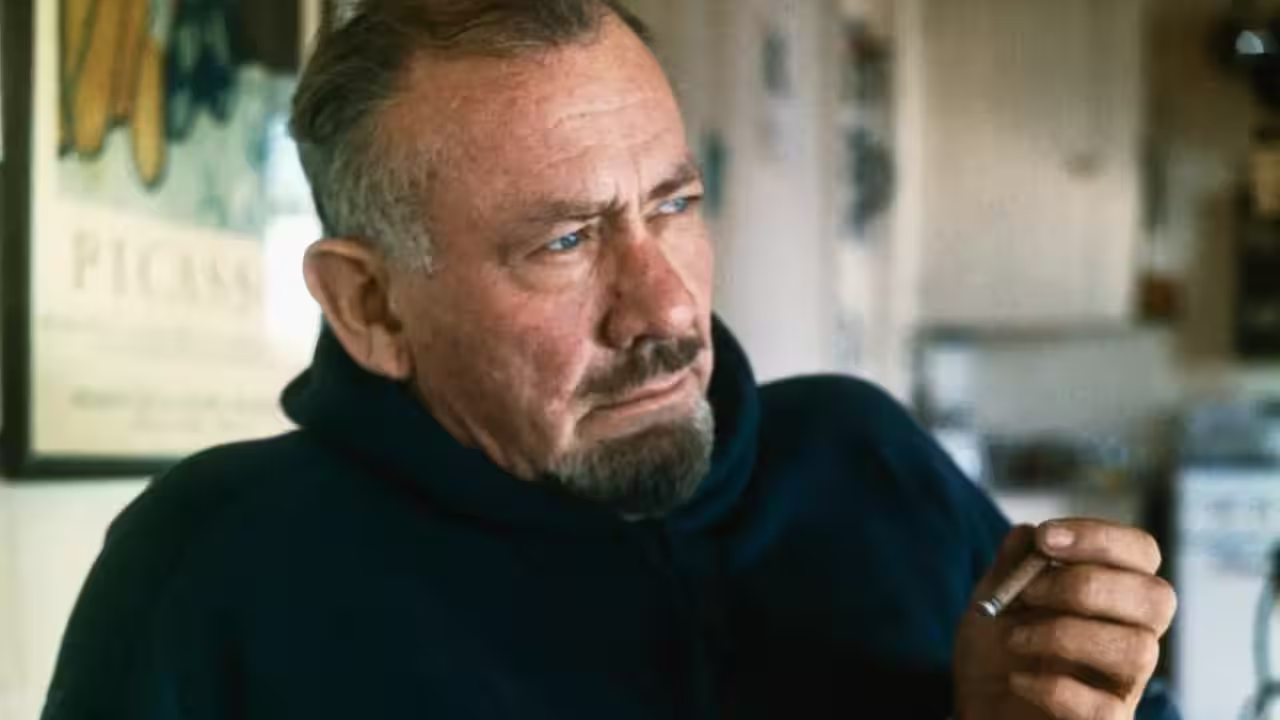
Imagine writing a story, drawing inspiration from your family drama, and over 50 years later, that same story shows up on our screens, winning the audience globally!Per History.com, back in 1952, John Steinbeck sat down to write a story that felt almost too close to home. East of Eden wasn't just a novel to him; it was his attempt to pin down what made his family, and maybe even himself, tick. He poured into its pages memories of California’s Salinas Valley, the home turf where his mother’s people, the Hamiltons, had built their lives. But Steinbeck wasn’t just interested in tracing his own roots. He wanted to dig deeper, to understand what drives families apart, or pulls them together, over generations.Steinbeck found a mirror in one of the oldest tales around: Cain and Abel, that biblical story of two brothers locked in an endless struggle of jealousy and yearning. Steinbeck wove his family history together with that ancient story. So, while ‘East of Eden’ has the rolling farmlands and wild edges of California, it’s also haunted by bigger questions: Why do we hurt the ones we love?Moreover, is our fate set by what’s come before, or do we ever get to make our own choices?Decades later, these questions haven’t faded. If anything, they're just as sharp in the world of streaming TV. Netflix’s new adaptation, with Florence Pugh stepping into the shoes of the enigmatic Cathy Ames, picks up where Steinbeck left off. This isn’t your typical period drama. The show asks, just as the book did: Are we stuck repeating our parents’ mistakes, or can we carve out a new path? That question, raw and uncomfortable, still hangs in the air.Why did Steinbeck write East of Eden in the first place?Honestly, he’d been living with the idea for years before he finally put pen to paper. He called it the “big one”: the book he had to write. But his reason was pretty simple: He wanted to tell his sons, Thom and John, where they came from. He wanted them to know their family’s story; not just the facts, but the tangled emotions and hidden battles that made their family what it was. The Hamiltons in the novel pretend to be fictional, but they wear the faces of Steinbeck’s real relatives. At the same time, he invented the Trask family and used their stormy relationships to ask deeper questions about love, betrayal, and forgiveness.Steinbeck didn’t hold back from putting himself in the story, either. He made himself a character in the book: interrupting, reflecting, and sometimes almost arguing with his own memories. It’s not just historical fiction; it’s almost part family album, part confession.But underneath all of this runs the original engine: the story of Cain and Abel. You know the basics: two brothers, one loved a little less, anger festering until tragedy strikes. Steinbeck believed this wasn’t just an old story, but a blueprint for human pain. He once called it “the basis of all human neurosis,” and in East of Eden, he repeats it: first with Adam and Charles Trask, then with Cal and Aron. The names make it obvious: if you’re looking for biblical parallels, you can’t miss them. One brother wants to be seen as good; the other is haunted by jealousy, desperate to be chosen.But Steinbeck wasn’t interested in copying the Bible. He wanted to ask: does it have to be this way? Are we doomed to act out old scripts, or can we change the ending? That’s where “timshel” comes in. This Hebrew word pops up in the middle of Cain’s story in the Bible, and in Steinbeck’s novel, the character Lee insists it means “thou mayest.” In other words, you have a choice. You aren’t stuck being the villain in your own family’s drama.And then there’s Cathy Ames, the character Florence Pugh plays in the new show. Cathy is not just a black-and-white antagonist. In the novel, she’s unsettling, complicated, and capable of incredible harm. But Zoe Kazan, who created the Netflix series, wanted to get closer to her. She didn’t just want to show Cathy as evil; she wanted to open her up, to ask what made her that way, and to show how society sometimes decides what “kind” of woman someone is and punishes her for it. In this version, Cathy isn’t just a force of chaos; she’s a person with motives, fears, and her own wounds.The Salinas Valley, though, is maybe the quietest character in the story. Steinbeck grew up among its ranches and farms, catching the rhythms of life and loss that echo throughout East of Eden. This isn’t just setting; it’s inheritance. The land holds stories: some passed down with pride, others handed off like burdens. Even though the Netflix series was filmed thousands of miles away in New Zealand, it worked hard to bring the Valley’s weird light and sense of possibility to life.East of Eden has lasted because these questions, about family, destiny, and the darkness we try to outrun, never really go away. Whether it’s Steinbeck worrying about his sons, or Florence Pugh’s Cathy testing the boundaries of who she can be, the heart of the story endures: How much of who we are is in our blood, and how much is up to us? That question still burns, stubborn as ever.Maybe that’s why, after all these years, East of Eden keeps coming back, asking new generations to look inward and ask: “Who am I, really, and can I choose a different way?”You use AI every day. Now get your AI Quotient. Take the AIQ testGet the latest Lifestyle News and more. Download the TOI app.
Topics in this story
Gathered from external sources. Rights to this text belong to whoever originally published it.