How piles of elephant dung outside a Thai village became sun-cured bricks for the sculptural Goya Tower
In 2021, once the multi-year Elephant World project in northeastern Thailand was finished, architect Boonserm Premthada kept noticing the same thing on
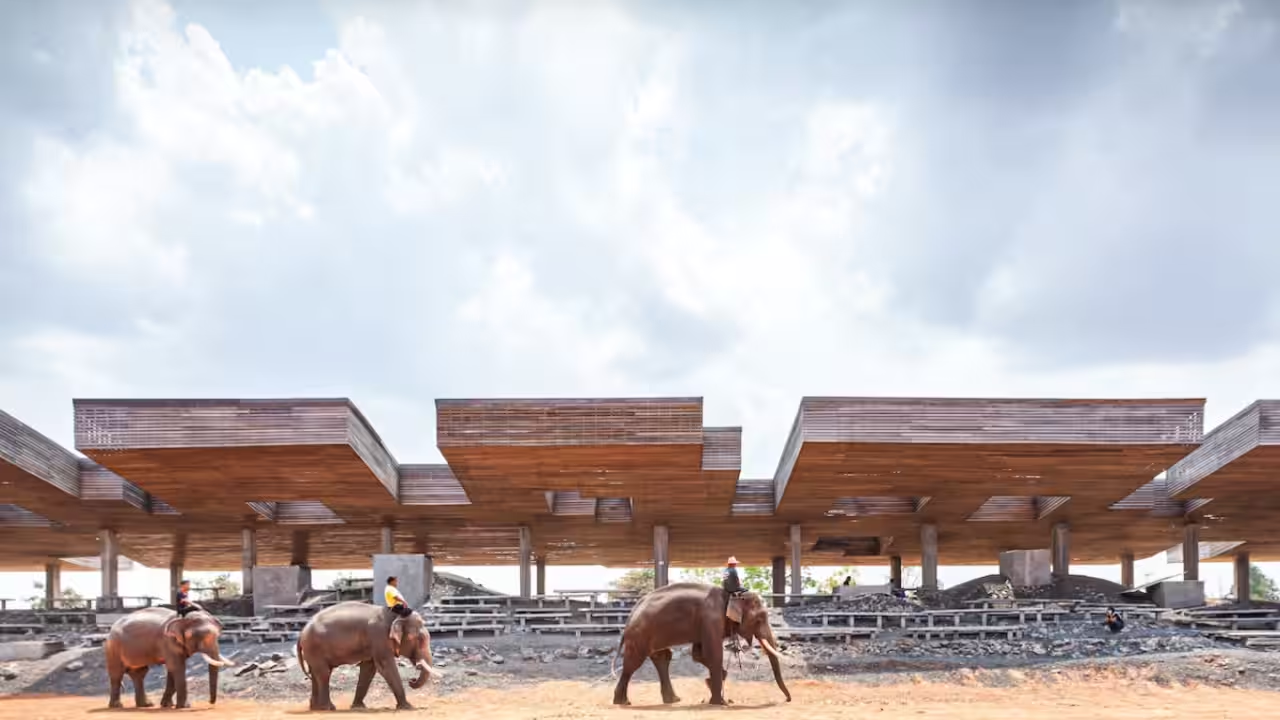
In 2021, once the multi-year Elephant World project in northeastern Thailand was finished, architect Boonserm Premthada kept noticing the same thing on his return visits to the elephant villages, dung everywhere on the roads, outside houses, piled up around town as the local elephant population grew. "My approach to my practice doesn't come from theory; it comes from the soul," Premthada said via Azure, reflecting his instinct to treat the problem as material rather than waste. He began experimenting with the dung as a construction ingredient, mixing it with soil, cement, stucco, tree bark, leaves and plant-based pigments to form bricks. That early test, a single sample from Ta Klang Village, has since grown from small installations into a full building, Goya Tower, a sculptural structure now standing in Phang Nga, southern Thailand, built almost entirely from handmade elephant dung bricks.From roadside waste in elephant villages to a recognised sustainable building materialElephant dung is mostly partly digested grass, leaves and fruit, and it already serves as a raw material for products like paper, fertiliser and insect repellent, but turning it into a structural building component was new territory. Premthada's first public tests came at the Île-de-France Architecture and Landscape Biennial in 2022, and later at London's Academy of Art, where he worked with dung sourced from Colchester Zoo and local volunteers, proof, he found, that the method could travel to a different city and still work, since it depends on the place and scale of each project.He carried the same thinking into the 2025 Venice Architecture Biennale, where he built the Elephant Chapel, an archway formed from elephant dung discs, and into his broader philosophy of material use. Rather than framing the dung as "recycled" or "upcycled," he thinks in terms of a material's whole life cycle rather than only its afterlife, a distinction he treats as the real meaning of scaling up an idea.Building Goya Tower brick by hand-shaped, sun-cured elephant dung brickFor the tower itself, workers shaped the dung into circular bricks 33 centimetres across and 5 centimetres thick, forming each one by hand and curing it with sunlight, human labour and time rather than industrial firing, a deliberately low-tech process that turned a waste stream sitting around the villages into a repeatable, modular building unit. The bricks come in five natural, sunset-inspired colours, arranged in a planned pattern. Builders threaded the individual bricks onto central steel rods and stacked them by colour into cylindrical columns of varying heights, so that the bricks function as both the tower's surface and its structural core. Together, the columns define the tower's curved internal walkways. Visitors can climb through the structure, and as they move upward, light and shadow guide them through changing views of the surrounding roads, gardens, forests and sea.Why the tower is named after an elephant, and where it stands near Phang Nga's Elephant MountainThe tower takes its name, Goya, from a local female elephant, and it stands as a public lookout at the entrance to Matalay, a large resort development in Phang Nga. According to Interesting Engineering, the site sits near Khao Chang, "Elephant Mountain," a limestone formation that resembles a reclining elephant and is tied to local legend. Elephants have shaped the region's forests, settlements and traditions for generations, and the tower, designed by Premthada with his firm Bangkok Project Studio, founded in 2003, is meant to make that relationship between animal, material and place visible.Part of a longer-running elephant-dung design practice, not a one-off architectural stuntGoya Tower isn't an isolated gimmick; it's the latest, most public chapter in a design line Premthada has been developing since 2021 with pieces like the Elephant Theatre Pavilion and his Venice Biennale installations. His broader body of work, including the roughly 480,000-hand-fired-brick Elephant World museum in northeastern Thailand, has long centred on designing with elephants rather than only for the humans who live alongside them, an approach he describes as architecture that isn't human-centric. "I never intended to create something new. I only wanted to create something necessary," Premthada has said, describing his goal as something that lets people, elephants and the local economy keep circulating together. That underlying philosophy is what makes Goya Tower legible, a building material found by paying attention to what a community already has too much of, and a design system built to let visitors physically move through the result.You use AI every day. Now get your AI Quotient. Take the AIQ test.
Topics in this story
- Goya Tower elephant dung bricks
- Boonserm Premthada architecture
- elephant dung sustainable building material
- Elephant World Thailand
- Phang Nga elephant mountain tower
- Venice Architecture Biennale elephant chapel
- Bangkok Project Studio
- sustainable architecture Thailand
- elephant dung construction bricks
- Elephant Theatre Pavilion Premthada
Gathered from external sources. Rights to this text belong to whoever originally published it.