Havana film posters printed during blackouts go on show in London
Rare posters printed through blackouts and shortages go on show in London.
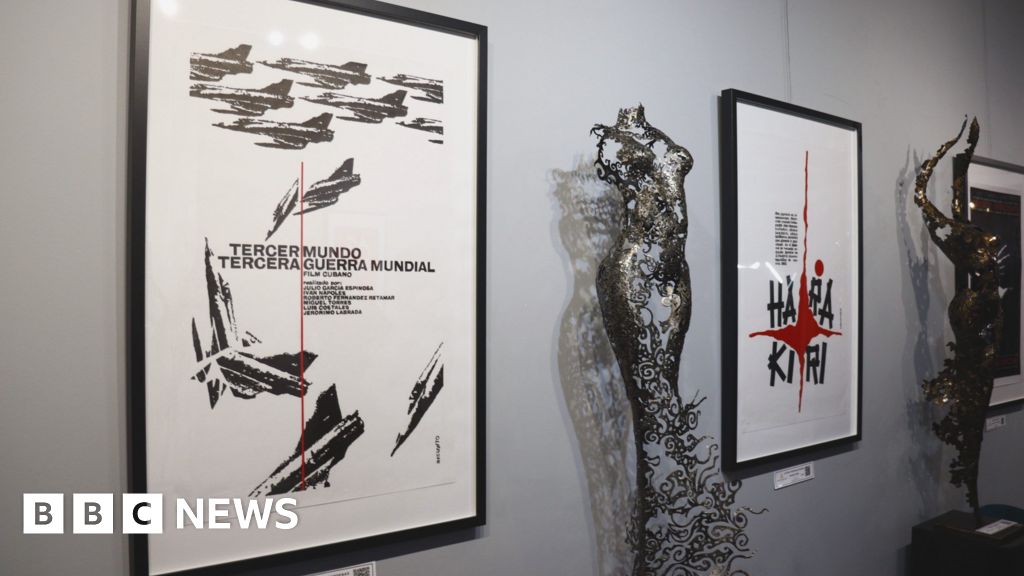
Film posters hand-printed in Havana through months of blackouts have gone on show in London.
The 11 silkscreen prints were made by the poster workshop of ICAIC, Cuba's national film institute, for the recent London Latino Film Festival, which ran in October.
The team had planned 25 designs, but power cuts, water shortages and a lack of materials meant the work dragged on for months and only 11 were finished.
"We can't do anything without power," said master printer Markito Guerra Rojas. "Number one, we can't see. Number two, the materials start to go wrong."
According to the workshop in Havana, they were printed in black, white and red because those were the only inks available, and were sent to London wrapped in a cement bag to protect them on the journey.
Guerra Rojas and his four-person team, who have worked in the same Havana workshop for 20 years, spent much of the year working to the rhythm of the power grid.
"A neighbour would let us know the power had come back, we'd start printing, and the power would go again," he said.
"Sometimes we had to stay, because how were we going to leave in that darkness?"
Cuba has faced severe fuel shortages since January, when the US cut off oil shipments from Venezuela and threatened tariffs on any country supplying the island. Most of its electricity is generated from oil, and the workshop said some neighbourhoods went close to a week without power in the summer.
The UN has said the restrictions are harming ordinary Cubans, while the US State Department has blamed the blackouts on mismanagement by the Cuban government.
For the printers, it also meant hunting for supplies. "There used to be companies that imported them. Now nobody does," Guerra Rojas said.
Silkscreen printing, or serigraphy, is done by hand, with ink pushed through fine mesh on a frame one colour at a time. Each colour needs its own screen, its own hand-mixed ink and its own drying time.
The photographic emulsion that fixes each design to its screen spoils when the electricity goes, and without power the press loses the suction that holds the paper flat.
"Something we might have done in a month, because while one colour was drying we could have been printing the next, we couldn't do," he said. "We'd do one colour and finish it, and then there was no power to prepare the screen for the next colour. It was catastrophic."
ICAIC was set up in 1959, months after the Cuban revolution. Its publicity department, led by Saúl Yelín, decided film posters should be works of design rather than advertising. The method began as a necessity and became a national art form, as central to Cuban cinema as the films themselves.
With no box office to chase, designers made posters for everything from Soviet dramas to Hollywood westerns, each built around a single bold idea in a few flat colours.
Silkscreen suited a country short of industrial presses too, and it is still how the posters are made. Guerra Rojas believes his may be the only workshop in the world still screen-printing posters to promote films.
Some of these posters are now recognised internationally as important cultural heritage, with the 1960–1980 collection inscribed on UNESCO's Memory of the World Register in 2023. It's also the first time the posters have been made for an event abroad.
He does not see the reduced edition as a defeat.
"You depend on one thing, then another, then another to get there," he said. "That's also where the value of serigraphy lies: in the way it's made."
Irinka Cordovi, who heads the workshop, said she hoped visitors who see the exhibition "feel the same admiration we feel for these works of art, because they really are true works of art, and that they value them, admire them and enjoy them".
They are on display in Eclectic Gallery until 9 December.
Listen to the best of BBC Radio London on Sounds and follow BBC London on Facebook , X and Instagram . Send your story ideas to hello.bbclondon@bbc.co.uk
Millions without power as Cuba hit by latest major blackout
Trump is putting pressure on Cuba - why and to what end?
Cubans protest after third nationwide power cut this year
Topics in this story
Gathered from external sources. Rights to this text belong to whoever originally published it.