In 2004, Florida researchers used 36 recycled oyster shells per reef mat, helping restore Mosquito Lagoon reefs to around 1,000 live oysters per square metre
In Florida’s Mosquito Lagoon, the return of oyster reefs began with a relatively simple idea: give young oysters somewhere stable to settle.
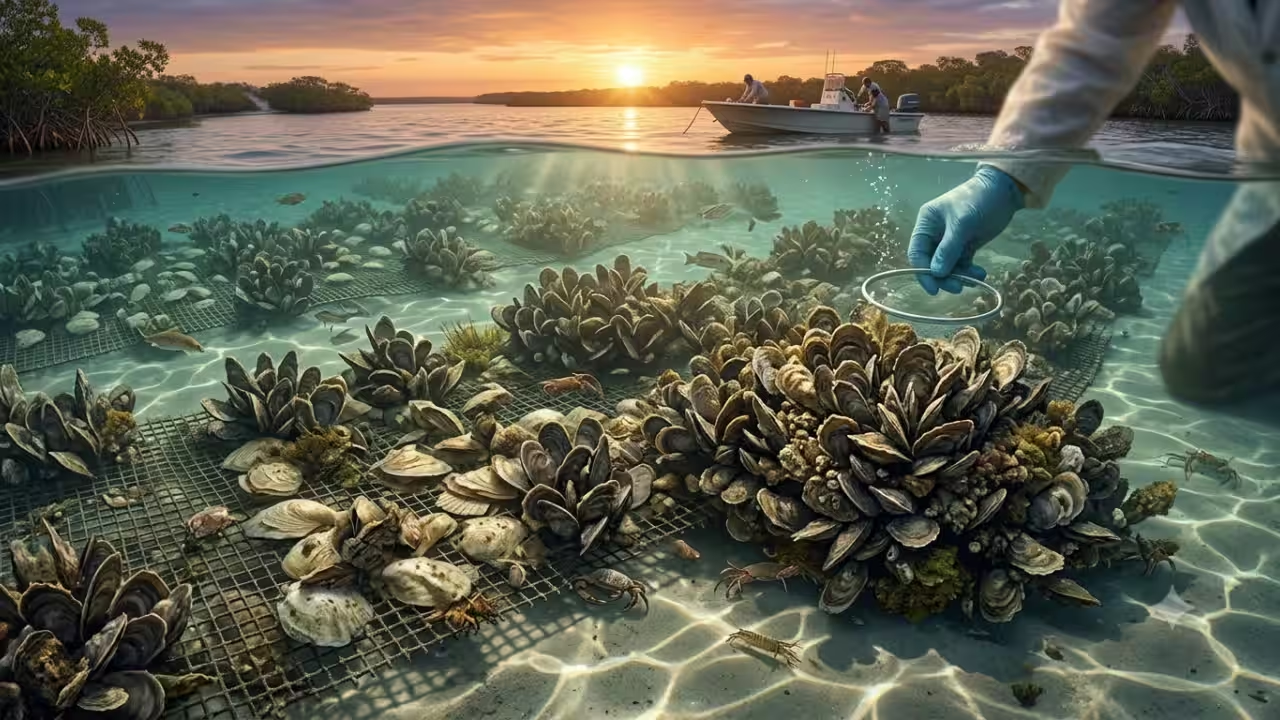
In Florida’s Mosquito Lagoon, the return of oyster reefs began with a relatively simple idea: give young oysters somewhere stable to settle. In 2004, researchers started testing small mats fitted with recycled oyster shells, placing them in areas where boat traffic had damaged existing reefs. Each mat carried 36 shells, held in place by plastic ties and arranged on a mesh base. The approach was designed to recreate the structure of a natural reef in parts of the lagoon where oysters struggled to survive. According to the study published in Sustainability by MDPI titled, ‘The Use of Non-Plastic Materials for Oyster Reef and Shoreline Restoration: Understanding What Is Needed and Where the Field Is Headed’, over the following years, the restored areas developed into productive oyster habitat, with average densities reaching around 1,000 live oysters per square metre. The results also raised questions about the materials used to achieve that recovery.Mosquito Lagoon oyster reef decline and the need for restorationMosquito Lagoon lies along Florida’s east coast, forming the northernmost section of the Indian River Lagoon system. Its shallow waters support coastal habitats that provide shelter for fish and invertebrates, filter water and help protect shorelines from wave action. Oyster reefs are part of that system, but large areas of the lagoon’s oyster habitat had been lost over several decades.Reportedly, between 1943 and 2009, oyster acreage in Mosquito Lagoon declined by more than 40%, according to research cited in the restoration assessment. Several pressures have contributed to oyster declines across the southeastern United States, including disease, harmful algal blooms, changes in freshwater flows and human activity along the coast. In this part of Florida, recreational boating presented a particular problem.Waves generated by passing boats could dislodge oyster clusters and push them beyond the intertidal zone, where conditions became unsuitable for their survival. The damage was especially relevant in the shallow lagoon, where natural oyster recruitment remained strong in areas away from heavily used boating channels.Oyster reef restoration mats use 36 recycled shells to support oyster growthResearchers began developing oyster restoration mats in 2004, using a design intended to resemble the low profile of existing patch reefs. Each unit covered 0.25 square metres and consisted of industrial aquaculture mesh made from extruded polyethylene. Thirty-six recycled oyster shells were attached to each mat using plastic cable ties threaded through holes drilled near the hinge, or umbo, of each shell.The mats were positioned across the historic reef footprint at the appropriate intertidal elevation. Workers connected the individual units in a quilt-like arrangement, using cement rings and cable ties to help keep them in place. Rather than relying on loose shells that could be shifted by waves, the design provided a more stable foundation for oyster larvae to settle on and develop.Mosquito Lagoon oyster reef restoration reaches 1,000 oysters per square metreWithin three to eight years of deployment, the restored reefs averaged about 1,000 live oysters per square metre, according to the research cited in the assessment. Those densities met or exceeded the levels recorded on intact natural reefs in the same local environment.The findings suggested that a relatively low-profile structure could help restore oyster habitat when placed in suitable conditions. The researchers were not attempting to build a completely artificial reef from scratch. Instead, they were providing a stable base in areas where oysters had historically occurred but where disturbance had made it harder for reef structure to persist.Plastic pollution concerns drive a shift in oyster reef restoration materialsThe original mats achieved their intended purpose, but their construction relied on plastic mesh and cable ties. As concern about plastic pollution in marine environments grew, restoration practitioners began looking more closely at the materials being left in coastal waters.Microplastics have been documented across marine environments, including estuaries, and have been detected in many species. Filter-feeding animals such as oysters are of particular interest because they draw water through their bodies while feeding. The research assessment does not establish that the Mosquito Lagoon restoration mats caused increased microplastic pollution, but it describes a wider concern that adding plastic structures to marine environments could contribute to an existing problem.Removing plastic from a restoration project is not as straightforward as replacing one material with another. A substitute needs to provide enough structural support during installation and remain stable while oysters settle and grow. The Mosquito Lagoon team therefore sought to retain the basic mat design while changing the materials used to construct it. The aim was to preserve the conditions that had helped oysters establish themselves without relying on conventional plastic mesh and ties.Biodegradable oyster reef mats support growth while reducing plastic useThe replacement approach used BESE-elements®, a biodegradable lattice made from potato starch, with stainless-steel wire used instead of plastic cable ties. The material was intended to provide a plastic-free alternative to the original mesh-based mats while maintaining a similar restoration method.Monitoring of the new mats in Mosquito Lagoon found that oyster recruitment was not significantly different from recruitment on the earlier plastic mats after one or two years. By the end of the second year, the biodegradable mats supported an average of 676.4 live oysters per square metre. That was a substantial population, although it was a different measure and timeframe from the average density of around 1,000 oysters per square metre recorded on the earlier restored reefs within three to eight years.The assessment also recorded relatively little physical damage. Of 500 mats deployed on reefs, eight were damaged by wave energy where protective shell bags had not been placed beyond the edges. The material did lose some mass during its first year in the water, with estimates suggesting a half-life of 4.4 to 6.7 years. That raised a longer-term question: whether the structures would remain intact long enough to support reef development under different environmental conditions.Florida expands oyster reef restoration with alternatives to plastic materialsThe experience in Mosquito Lagoon forms part of a broader shift in Florida, where restoration teams have been testing alternatives to plastic in oyster reefs and living shorelines. Options include natural fibres, cement-based structures, metal mesh, recycled shell and rock. Each has different practical advantages, and the most suitable choice can depend on the scale of a project and the conditions at the site.A statewide assessment of restoration practitioners found that projects using non-plastic materials were being carried out in a range of settings, from small community efforts to larger shoreline works. Many respondents reported that the materials performed as well as or better than expected, and 86% said they were willing to use non-plastic options again or recommend them to colleagues.You use AI every day. Now get your AI Quotient. Take the AIQ test.
Topics in this story
Gathered from external sources. Rights to this text belong to whoever originally published it.