China suspends flood rescue efforts near its border over ‘real possibility’ of secondary disaster
Hundreds have been killed in Wednesday’s catastrophic flash flooding. More than 1,300 people, including dozens of Americans, remain missing. Follow for live updates.
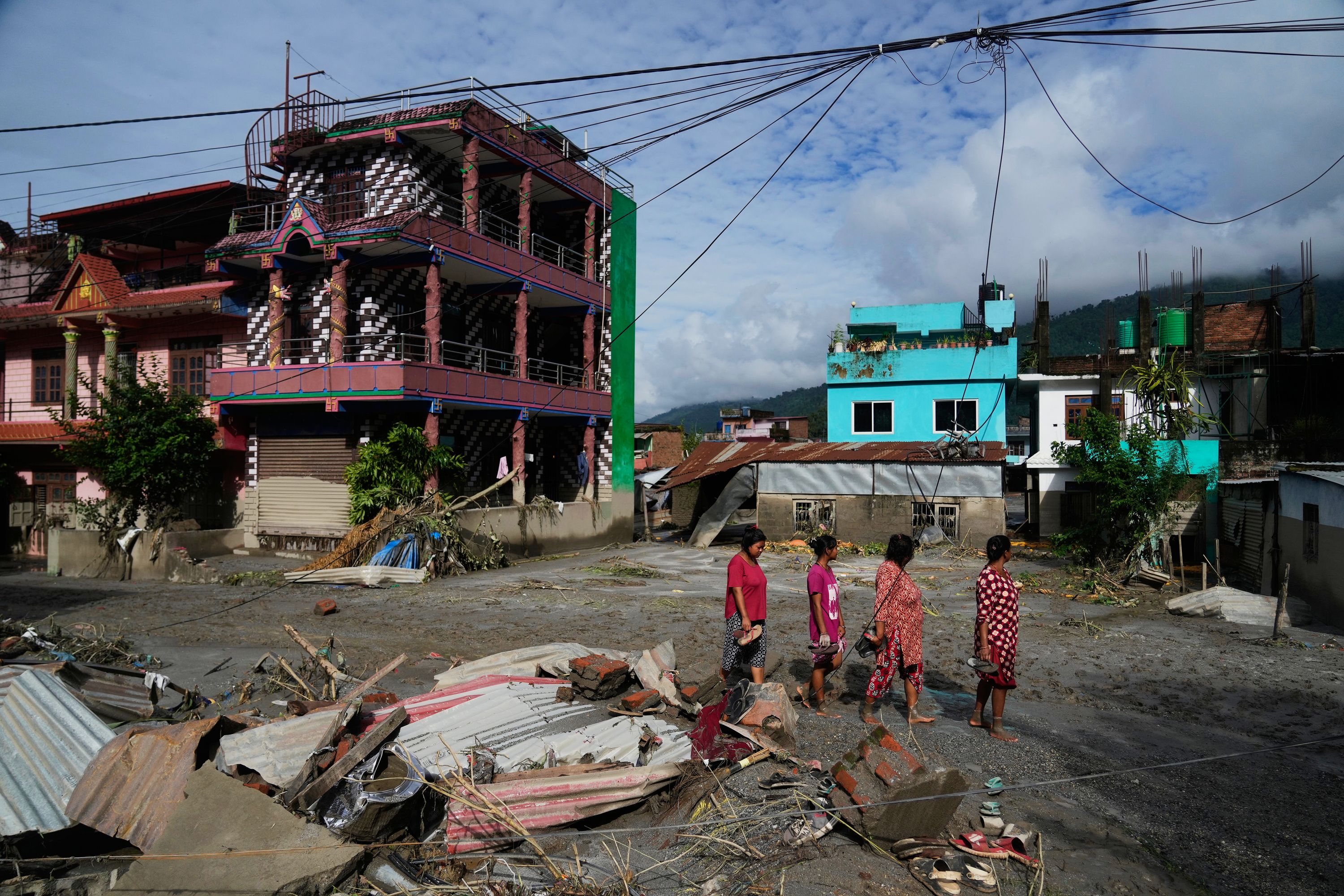
• Rescue suspended: China has suspended rescue efforts along its Nepal border area over fears that a barrier lake created during the initial landslide could trigger another disaster, after Wednesday’s catastrophic flooding in the region.
• Death toll climbs: At least 469 people have been killed in Nepal , according to the police. Dozens of Americans and other foreign nationals are among at least 1,300 people unaccounted for. Some missing foreigners have been rescued.
• On the ground: In Kathmandu , a CNN team witnessed families’ anguish and despair as they learn the worst news of their loved ones from lists and photos on a morgue wall . A separate CNN team closer to the disaster zone is documenting devastated neighborhoods .
• Colossal force: Scientists are still working to determine exactly what caused the disaster. New video showed where a large portion of glacier broke and plunged into the river below, triggering a fast-moving wave of water, pulverized ice and rock.
Officials in Nepal’s Rasuwa district have received a notice saying a lake has broken its banks, Narendra Pariyar, the most senior bureaucrat of the district, said Friday, Reuters news agency reported.
The official said he can see the water level rising.
Nepal has paused rescue operations for the next hour and 30 minutes, an army official said, Reuters reported.
China is suspending rescue efforts near Gyirong land port on the border with Nepal because of fears of another disastrous landslide or flood in the area, state media reports.
A barrier lake formed by Wednesday’s deluge has been rising over the past 48 hours, threatening to unleash another deadly flow of earth or water.
Chinese state broadcaster CCTV reported late Friday morning the newly formed lake has begun overflowing non-stop, posing such a great risk that rescue teams cannot proceed to the hard-hit land port.
“We have no choice but to stop here for the time being,” said a CCTV reporter who is following the rescue efforts.
“Because the lake is continuing to overflow, there is a very real possibility that it could trigger new flash floods or landslides, so it is extremely dangerous to proceed to the areas that have been identified as priorities for search and rescue operations,” it said.
Most of the rescue team gathered at the entrance of Laojiang village in Gyirong Town, said CCTV. Laojiang village is around 4.35 miles from the China-Nepal border.
David Fisher, head of the International Federation of Red Cross for Nepal, told CNN’s Kaitlan Collins about the challenges his teams face amid worries of a secondary flood.
He said teams are currently only “scratching the surface of emergency needs,” emphasizing the sheer magnitude and scale of the disaster.
A video posted on social media showed a large boulder barreling down the Trishuli River in Nepal, illustrating the enormous force of the floodwaters.
Devastating images of flood victims line the walls of a morgue in Kathmandu as families search for missing relatives hoping for closure, CNN’s Will Ripley reported from Nepal’s capital.
Photos of body parts, tattoos, and other identifying features were displayed in a desperate attempt for families to identify their loved ones.
“There are men on the wall, there are women, there are young children… it’s just a terrible situation,” Ripley said.
More than 1,200 people have been registered as missing and just a few dozens are currently being treated in hospital .
All 67 people in a Richa Treks tour group were likely washed away in Wednesday’s flooding disaster on the Nepal-China border, the group’s director Sangay Gurung told a CNN team in Kathmandu.
“It was very unfortunate. They were at the Chinese customs and immigration, queuing up. And suddenly there was this big flash flood, ” Gurung said. “Everything got washed away on the Chinese side. The entire customs and immigration building.”
The group of 67 included 60 Indian nationals, five Americans, and two New Zealanders.
A second group, including eight foreign nationals and two staff, were in a bus and a guide directed them to run up a mountain, Gurung said. They were “very lucky” and are now safe in Nepal’s capital Kathmandu, he added.
Around 700 people were at the customs center when the flood hit, according to Gurung.
“We were totally shocked, we never thought in our wildest dreams that such a big catastrophe could happen.”
It’s Friday morning in the Nepal-China border region, where hundreds are dead and thousands remain missing after a catastrophic flood hit the area. CNN teams on the ground in flood-stricken Rasuwa are speaking with affected communities and rescue crews race to search for survivors.
Video geolocated by CNN showed a glacier breaking off a mountain and plunging into the river below. Scientists are working to establish the exact cause of the disaster.
Rescue efforts : The death toll from the catastrophic flooding rose to at least 469, Nepal police said Friday. A frantic search continues for more than 1,300 missing people, including dozens of Americans among at least 700 foreigners.
Secondary threat: Rain and chilly weather is expected in China’s Gyirong County, where it’s feared a dam created during the initial landslide could breach and cause more flooding.
Missing loved ones : Among those still awaiting news are the children of parents on a 60th birthday bucket-list trip, the brother of a woman and her daughter on a Himalayan adventure and the family of a couple on a once-in-a-lifetime pilgrimage .
Incoming aid: President Donald Trump said the US is ready to send “any help” to Nepal, joining the European Union and India among those announcing plans to provide humanitarian assistance.
CNN’s Alea Motwane, August Phillips, Laura Paddison and Lex Harvey contributed reporting.
CNN journalists are on the ground outside a hospital in Kathmandu, where families are lining up to register the names of their missing loved ones.
More than 1,200 people have been registered as missing in the flooding disaster, according to a local police officer operating the desk outside the Tribhuvan University Teaching Hospital in Nepal’s capital.
Families are also checking paper notices taped to the wall listing 31 injured survivors who are being treated in the hospital.
Nepali filmmaker Tashi Bista has been using thermal drones to help with flood rescue efforts. He speaks to CNN’s Anderson Cooper about the devastating destruction he has seen and the challenges involved in finding survivors.
Video shared by a photographer on Chinese social media and geolocated by CNN captures where a large portion of glacier near Langtang Lirung peak broke along the Nepal-China border, causing a devastating avalanche and landslide.
In his post, the photographer wrote he heard the sound of the falling glacier around 10:30 a.m. local time on August 26, and at first mistook it for a military exercise.
Wednesday’s glacial collapse was so strong that it was initially reported by the US Geological Survey as a magnitude 4.4 earthquake.
Comparing satellite images from before and after the disaster, scientists have established that an enormous chunk of glacier sheared off from high on a mountain.
From there, it plunged to the river below — a roughly 7,000-foot vertical drop, a CNN analysis shows.
Though information on the volume of rock and ice that fell is not available yet, the section of the glacier that fell is approximately 2,000 feet wide, with a similarly sized section of rock next to it falling as well.
The sheared glacier left a 3,000-foot-wide gash in the mountainside, according to CNN analysis of satellite imagery.
The flood wave – a cascade of water, pulverized ice and rock – “descended the first 22 kilometers (13.7 miles) at an average speed of 193 kilometers per hour (120 mph),” said Jeffrey Kargel, a senior scientist at the Planetary Science Institute, a non-profit institute. That means it traveled nearly 14 miles in just 6 minutes and 50 seconds.
Scientists are still unpicking the exact causes of the devastating flooding.
New video posted on Chinese social media captures where a large portion of glacier near Langtang Lirung peak broke along the Nepal-China border, causing a devastating avalanche and landslide.
CNN’s Laura Paddison and Thomas Bordeaux contributed reporting.
The threat of further landslides and flooding along the devastated Nepal-China border is making a difficult search for survivors even more dangerous, the Red Cross told CNN.
“We’re extremely concerned about the possibility of a renewed flood, even as the authorities are working very, very hard to reopen roads that have been blocked for communities that have still not received significant assistance,” said David Fisher, Head of the International Federation of the Red Cross (IFRC) for Nepal.
Two days after the disaster, many people in the flood zone are “still very disoriented,” he said. Rescuers and volunteers are doing their best to distribute flood warnings to people still in shock, Fisher told CNN’s Kaitlan Collins.
“It’s critical that we reach both the existing emergency needs and that we get these warnings out as soon as possible,” he said.
A video posted to social media shows people trapped on the balcony of a building in Bidur, a town on the Trishuli River in Nepal, at the moment the devastating flooding swept through.
Akash and Rashika Sharma, the son and daughter of a New York-based couple missing in Nepal, sat down with Anderson Cooper and shared how a trip she and her brother encouraged their parents to take has now turned their world upside down.
Gyirong County, an area on the China-Nepal border that was severely affected by the landslide, is set to see more rain over the next three days, as authorities warn of future landslides and flooding .
Gyirong County will see frequent precipitation, with rainfall mostly light, Chinese state media CCTV reported, citing the China Meteorological Administration. Temperatures in the area may be as low as 8 degrees Celsius (46 degrees Fahrenheit), “making it feel relatively damp and chilly,” CCTV reported.
China’s Ministry of Resources earlier warned that there is a “high risk” a dam created during the landslide in Nepal could breach and cause more flooding downstream as a lake develops behind it.
This could potentially cause “renewed flooding and damage in downstream areas, including the Gyirong Port,” a major land border crossing between China and Nepal that was wiped out by the landslide, the ministry said in a statement.
It could pose risks to Chinese emergency responders dispatched to the port area for rescue missions.
The lake, known as a “barrier lake,” is forming near where Nepal’s Chhochen Khola river meets the Purepu Tsangpo river, which flows into China, the ministry said.
CNN’s director of international news and video Sugam Pokharel was supposed to visit loved ones in Nepal this December, but since catastrophic flooding swamped a China-Nepal border region he has had trouble getting in touch with some of the friends he is supposed to visit.
“This feels especially personal and difficult for me,” he told CNN on Thursday.
Pokharel was born and raised in Nepal before coming to the United States 20 years ago. He said he has many friends there that are unreachable after the catastrophic flooding.
“This is incredibly heartbreaking and worrying especially not knowing what has happened to them,” Pokharel said of his friends.
He said possible secondary flooding and decomposing carcasses pose a risk to residents.
“They’re saying, well, what do we do now? We don’t have our homes anymore, but do we shelter where we are staying right now? Or do we go to a like a higher altitude, essentially climb a hill and shelter in a forest?” he told CNN.
“There are so many livestock, so many dead animals… they’re going to start rotting soon. And so there’s a concern of an epidemic.”
Pokharel also noted that a major highway connecting Nepal’s capital Kathmandu is closed, potentially cutting off crucial supplies to residents.
“There is a cooking gas shortage in Kathmandu and the cooking gas comes in trucks from India,” he said. “And if the highway blockage continues for longer, the people in Kathmandu and other areas are also going to start feeling the pain soon.”
Additional police teams, some with drones, have been deployed across central Nepal amid frantic ongoing search and rescue efforts after landslide created devastating flooding.
The wave of water , pulverized ice and rocks tore through the steep mountain valleys on the Nepal-China border.
The torrent was loaded with silt, sand, gravel and boulders, which all moved together as a single fluid that Hatim Sharif, an engineering professor at the University of Texas at San Antonio, compared to “liquid cement.”
At the same speed, “this material hits a building with roughly twice the force of water,” Sharif said. The flood wave was able to carry with it “boulders the size of cars,” he added.
Its composition also makes rescue efforts more hazardous. The debris can hold water for a long time, making it “treacherously variable,” Sharif said. While one patch can bear a person’s weight, another can swallow them to their waist.
Depth is another issue. The sediment left behind is likely to be many feet thick in places, he added, meaning searching for people “is done by probing and by hand, and it is very slow.”
A big concern is that fresh rain could set everything moving again. “Downstream communities need to stay off the riverbanks even on days that look calm,” Sharif said.
Thunderstorms are possible for at least the next couple of days in the flood zone, as a notoriously wet seasonal weather pattern continues.
The region is in its monsoon season, so daily chances of rain are the norm. Some places could pick up multiple inches of rain in a few hours, while others see much less or even stay completely dry.
It’s difficult to pinpoint exactly where the most drenching downpours will occur, but the hardest-hit areas could experience them, which could challenge search and recovery efforts.
Nepal’s monsoon typically lasts from June through September. The country sees about 80% of its rainfall during this time .
Here’s what the radar looks like through Saturday, local time:
The flooding along the Chinese-Nepali border on Wednesday hit a popular route for pilgrims and tourists.
Summer often brings hundreds of Hindu, Buddhist, Jain and Bonpo pilgrims to the area around Mount Kailash, a Tibetan mountain revered in each religion. Pilgrims often walk around the distinctive, pyramid-shaped mountain on a roughly 30-mile, high-altitude trail. However, no climber has ever officially summited the mountain. The Chinese government has prohibited ascents due to the peak’s religious significance.
Numerous travel and trekking agencies offer packages guiding people between Nepal’s capital Kathmandu and Mount Kailash, though pilgrim access to the site has been disrupted numerous times in recent years due to the COVID-19 pandemic and political disputes between China and India.
The flooding hit an overland route between Kathmandu and Tibet frequented by many of these tour groups. One Indian guru said in a post on social media that 77 pilgrims guided by his organization were at the Chinese-Nepali border when the disaster began and remain unaccounted for.
President Donald Trump said the US has offered aid and support to Nepal following catastrophic floods that have left dozens of Americans missing.
“Oh, it’s terrible,” Trump said when asked Thursday afternoon about the flood and missing Americans. “We’ve called Nepal and we’ve offered any help that they need. You know, we have a very good relationship with Nepal and that was a brutal.”
“Nobody’s ever seen anything quite like that where very powerful, strong, well-built buildings were wiped out like they were toothpicks,” he added during an Oval Office event.
Trump went on to say that around 50 to 60 Americans are missing but said that he hasn’t received the full list yet.
“Hopefully they’re OK but that looked pretty — that looked like something that people will not be, somebody will be lost, unfortunately,” the president said.
CNN has reported that more than 1,300 people are missing following the floods in Nepal, including at least 700 foreigners from two dozen countries. The death toll in Nepal has climbed to more than 350 people.
Topics in this story
Gathered from external sources. Rights to this text belong to whoever originally published it.