In 2020, BSEE reported 43 retired Gulf platforms had joined Rigs-to-Reefs since 2017, providing habitat where more than 100 fish species live
US News: The Bureau of Safety and Environmental Enforcement (BSEE) reveals that 43 decommissioned platforms in the Gulf of Mexico have been successfully transformed into artificial reefs, fostering a vibrant marine ecosystem and supporting over 100 fish species since 2017.
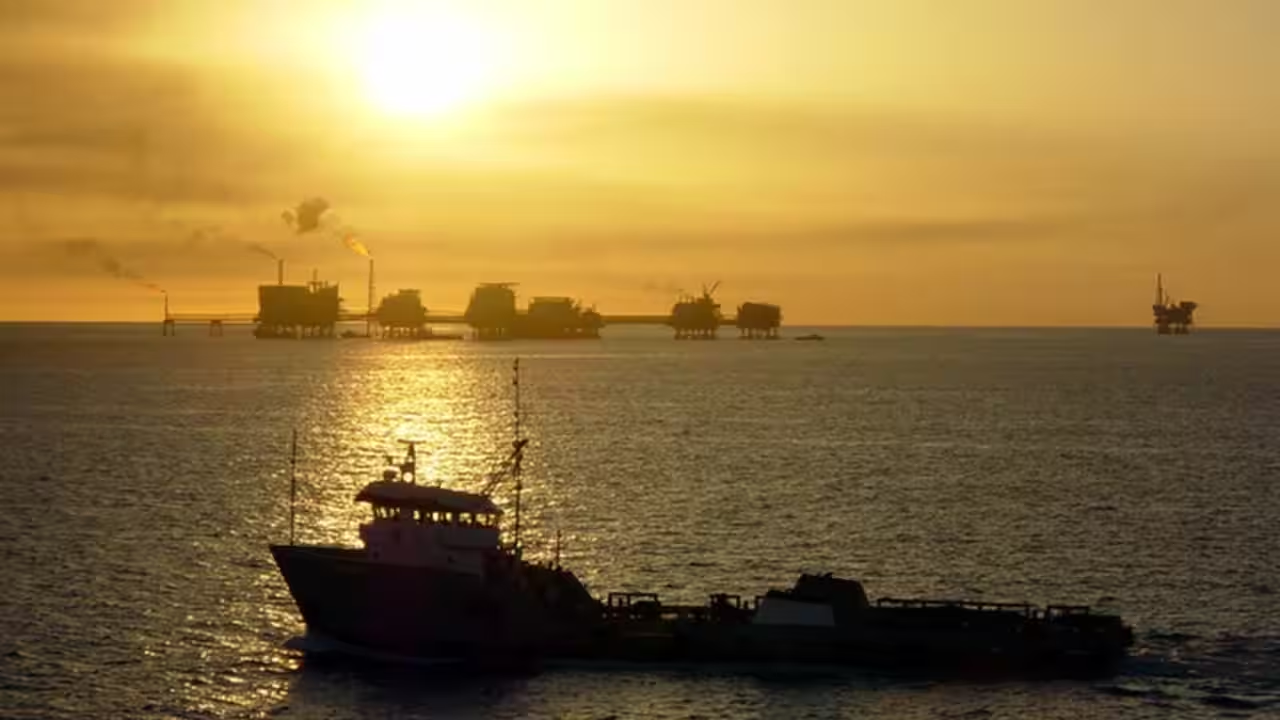
Hundreds of aging oil and gas rigs in the Gulf of Mexico are decommissioned each year. While federal regulations demand that these rigs be dismantled once they are no longer operational, more and more rigs are now being left behind to serve as artificial reefs where sea life can flourish after the drilling process is over. The Bureau of Safety and Environmental Enforcement (BSEE), the federal agency that regulates offshore oil and gas operations, reported that 43 retired platforms had been converted into artificial reefs between 2017 and 2020 through its Rigs-to-Reefs program. That brought the total number of converted structures in the Gulf past 500. These aren't temporary fixes. Once a jacket's drilling days are over, toppling its steel lattice structure in place, or partially submerging it, turns it into a permanent underwater habitat.The statistics presented by BSEE also reveal the reasons why states are always opting for this particular choice instead of the complete removal of the platforms. Over 100 species of fish have been identified around these platforms, and many of these are significant in commercial and recreational angling. These structures provide a surface for algae, sponges, individual coral colonies, and various other invertebrates to thrive on.California research measured record fish production on platform structuresThe reasons behind their effectiveness are not only anecdotal. In a 2014 paper in the Proceedings of the National Academy of Sciences, Jeremy Claisse of Occidental College and colleagues reported that California oil platforms had the highest secondary fish production per unit of seafloor area of any marine habitat studied to date, about an order of magnitude higher than other marine ecosystems, including estuaries, traditionally considered among the most productive on the planet. The researchers analyzed four Southern California platforms using hydroacoustics and trawls over 18 months, then converted the fish biomass they measured into standing stock and annual production per square meter of seafloor. Drawing on separate visual surveys of 16 platforms conducted over as long as 15 years by co-authors Milton Love and Ann Bull, the team estimated that platform fish communities produced roughly ten times more biomass than other marine habitats studied, with the platforms' midwater structure accounting for most of that production; the researchers attributed this largely to rockfish larvae settling and maturing on the platforms' hard vertical surfaces. The same paper found that, compared specifically to nearby natural rocky reefs at similar depths, the platforms produced more than 27 times as much fish biomass.This is significant in terms of the Gulf, because structures in the Gulf are more homogeneous despite being different from the environment in California. An eight-leg structure in the Gulf, for example, may support 12,000 to 14,000 fish at one time, according to the Coastal Marine Institute at Louisiana State University.Louisiana survey found the same pattern at a converted platform reefThis finding inevitably led to a natural inquiry: Is this true for the Gulf of Mexico, which has many more platforms than the California coast? According to the Bulletin of Marine Science, the study conducted by Kevin Boswell et al. investigated Freeport Sulphur Mine Artificial Reef, a platform turned into an artificial reef off the coast of Louisiana, which was the biggest reef structure in the northern Gulf of Mexico at the time. It was determined through the use of mobile acoustic sampling that there was five times less biomass and fish density at 10 metres and 16 times less at 30 metres from the reef structure. The Bulletin of Marine Science research also found that fish concentrated most heavily near the bottom of the water column rather than near the surface, a pattern that has practical implications for how platforms are toppled or partially removed during conversion.In combination, these two studies account for the biological principle behind BSEE's estimate of 43 platforms. As the research above suggests, the platforms' complex structure, not simple attraction, appears to be what drives the high fish production observed around them.Reefing costs less than full platform removalNone of this implies that choosing between removal and reefing is a straightforward task. By keeping the jacket in situ rather than hauling it to shore for disposal, companies reduce their costs, while coastal communities receive diving and fishing opportunities that would vanish following decommissioning of the platform. Yet, from the scientific basis of the project, California production calculations through to acoustic measurements in Louisiana, it becomes apparent that the environmental benefit is not coincidental. Given that fewer than 2,000 platforms are expected to remain for decommissioning in the Gulf over the next few years, the 43 projects registered by BSEE from 2017 to 2020 may represent only a small share of future reefing projects.Catch the latest World News and Live updates. Download the TOI app.
Topics in this story
Gathered from external sources. Rights to this text belong to whoever originally published it.