Melinda French Gates and her daughters backed a $70 million fund; 22 organisations received money to tackle women's health and violence
Melinda French Gates and her daughters, Jennifer Gates Nassar and Phoebe Gates, joined other philanthropists in backing a $70 million initiative to
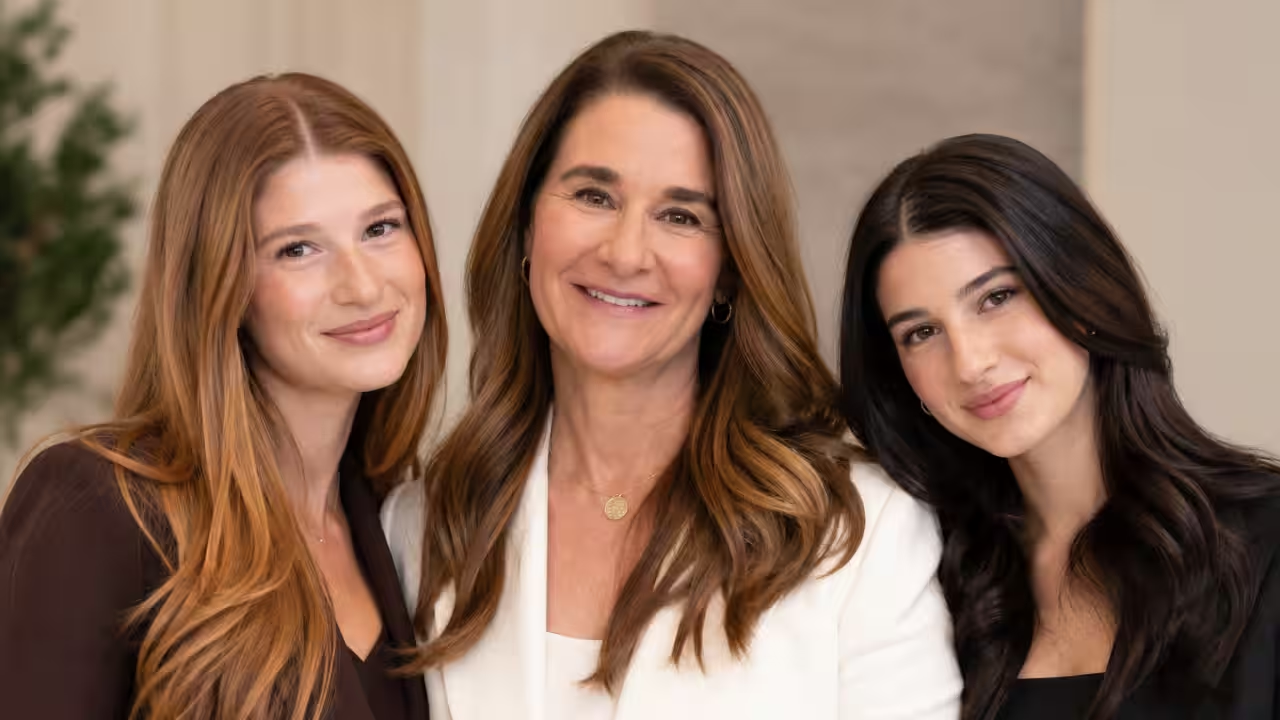
Melinda French Gates and her daughters, Jennifer Gates Nassar and Phoebe Gates, joined other philanthropists in backing a $70 million initiative to improve women's health and address gender-based violence. Launched in September 2025, the Women's Health Co-Lab brought together donors through ICONIQ Impact and Co-Impact to support 22 organisations working on maternal healthcare, sexual and reproductive health and rights, and violence prevention. The initiative aims to mobilise $100 million and provide three years of support through unrestricted grants, allowing recipients to direct resources towards their priorities. Its approach focuses on strengthening organisations and healthcare systems while addressing barriers that prevent women and girls from accessing essential services and living free from violence.How Melinda French Gates and her daughters backed the $70 million fundThe Women's Health Co-Lab was launched on September 29, 2025, by ICONIQ Impact, the philanthropic platform associated with investment firm ICONIQ, in partnership with Co-Impact, a global collaborative philanthropy organisation. The initiative brings together philanthropists to support organisations addressing persistent inequalities in women's health and safety.French Gates and her daughters were among the founding supporters, alongside other philanthropists and families. The initiative's initial commitments exceeded $70 million, with a broader target of raising $100 million. The funding was designed to support 22 selected organisations over three years, giving them resources to expand their programmes and strengthen the systems serving women and girls.Three areas the fund aims to addressThe Women's Health Co-Lab focuses on maternal health, sexual and reproductive health and rights, and gender-based violence. Its grants support organisations providing services, advocating policy changes and addressing barriers that affect women's wellbeing.Maternal healthSix organisations were selected to improve maternal healthcare, strengthen service delivery and help women access appropriate care during pregnancy and childbirth.One recipient is Every Mother Counts, a nonprofit working to make pregnancy and childbirth safer. Its work addresses barriers that prevent women from receiving quality maternal healthcare, including gaps in access, resources and support.Sexual and reproductive health and rightsTen organisations will work to expand access to reproductive healthcare, contraception, reliable information and related services. Their work also includes advocacy to address policies and social barriers that restrict women's ability to make decisions about their health.Among the named recipients are Americans for Contraception and Girl Effect, which works with adolescent girls through media and community programmes.Preventing gender-based violenceSix organisations were selected to strengthen efforts to prevent violence against women and girls, support survivors and challenge harmful social norms. Their work includes community programmes, advocacy and efforts to improve protections for those at risk.Named recipients include Ujamaa Africa, which works to prevent gender-based violence through programmes in African communities, and Serenas, an organisation working in this field.Why the grants are unrestrictedA central feature of the Women's Health Co-Lab is its use of unrestricted funding. Instead of requiring recipients to spend every dollar on a narrowly defined activity, the initiative allows organisations greater flexibility to decide how the money can best support their work.This approach is intended to reduce administrative burdens and help organisations respond to changing circumstances. A group working on maternal health may need to strengthen healthcare delivery, while an organisation focused on violence prevention may prioritise community education, survivor support or policy advocacy.Co-Impact worked with recipients to refine their plans and budgets as part of the grantmaking process. The collaborative approach gives organisations a role in determining how the funding can best advance their objectives.Ujamaa Africa receives $3 millionUjamaa Africa was among the organisations selected for funding, receiving an unrestricted grant of $3 million. The organisation works to prevent gender-based violence through programmes that engage young people and communities.Its executive director, Benjamin Omondi Mboya, said the funding would help the organisation expand its programmes across Kenya, Malawi and Somaliland.The grant illustrates how flexible funding can help organisations adapt their programmes to local needs rather than relying entirely on short-term, tightly restricted project grants.Who else is backing the initiative?The founding donor group included Tricia Black and Patrick Brogan, Marie Dageville, Rachel Markham and Cedric Dageville, Holly Fogle and Jeff Lieberman, Barrie Glabman and Adam Schwartz, Susan Long Hall and C. David Hall, Renee and Alexis Lê-Quôc, Aarti Lohia, Diksha and Divesh Makan, Samantha McManus and David Karp, Andrea Meditch, Rick and Nancy Moskovitz, Susan and Erin Samueli, and the Tullman family.ICONIQ Impact helped bring the donors together, while Co-Impact contributed experience in supporting organisations working to strengthen health, education and economic systems. Their partnership reflects an approach in which multiple donors pool resources around shared priorities.Why women's health and safety are a priorityWomen's health outcomes are influenced by more than access to medical treatment. Maternal care, reproductive health services and protection from violence are also shaped by healthcare infrastructure, public policy, social attitudes and economic circumstances.Organisations working in these areas often require sustained support to train healthcare workers, provide services, advocate for policy changes and reach underserved communities. The Co-Lab's three-year funding model is intended to give recipients greater scope to plan and expand their work.You use AI every day. Now get your AI Quotient. Take the AIQ test.
Topics in this story
Gathered from external sources. Rights to this text belong to whoever originally published it.