The Memo: Canada’s Carney gets under Trump’s skin amid trade dispute
The personal is political, it’s said — and it certainly seems to have become so between President Trump and Canadian Prime Minister Mark Carney. The two men are at odds as a trade war between the two nations ramps up. On Tuesday, Canada announced the imminent imposition of tariffs on around 700 U.S. products. The new…
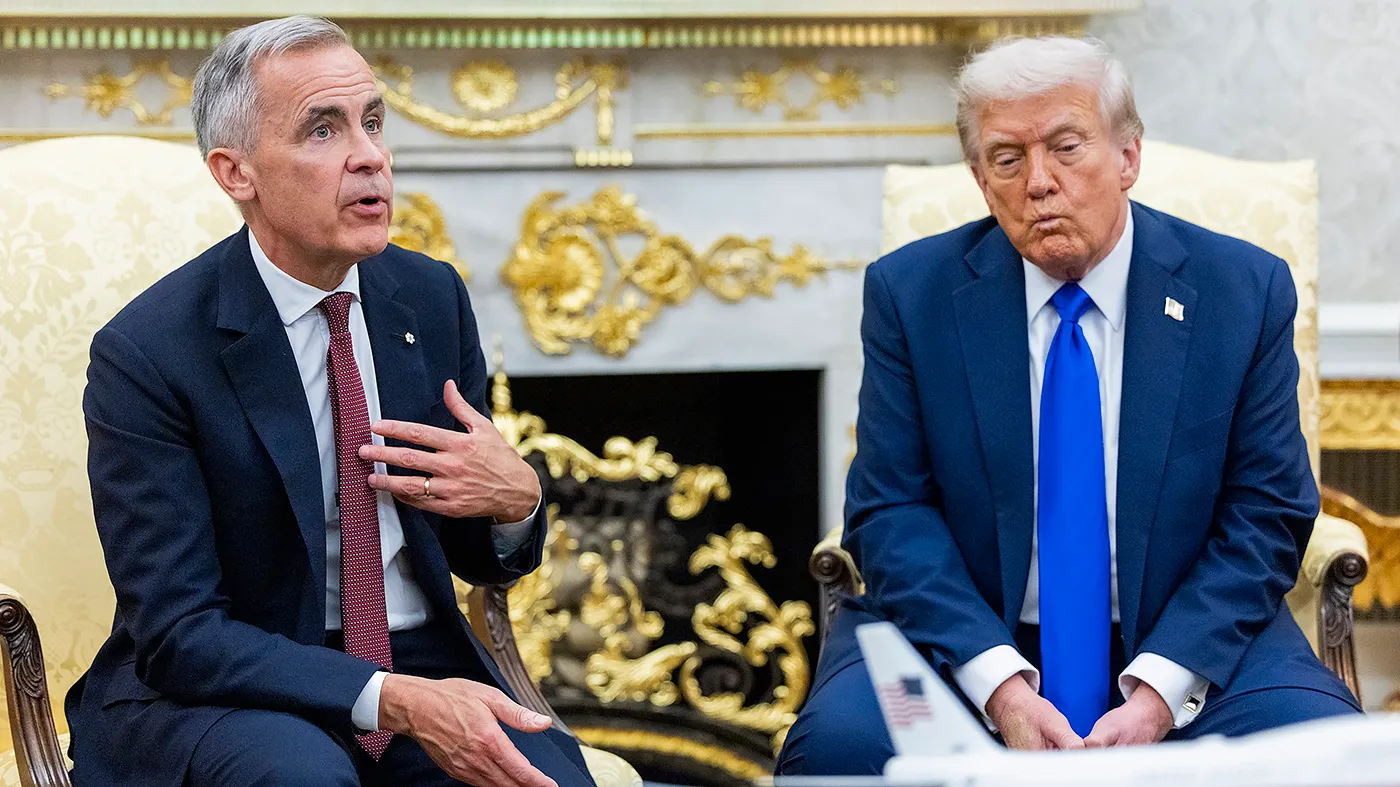
The personal is political, it’s said — and it certainly seems to have become so between President Trump and Canadian Prime Minister Mark Carney.
The two men are at odds as a trade war between the two nations ramps up. On Tuesday, Canada announced the imminent imposition of tariffs on around 700 U.S. products. The new levies, retaliation for fresh U.S. tariffs, are scheduled to kick in Sept. 8.
But there seems to be an element to the struggle between the two leaders that goes beyond the hard numbers and technical minutiae of trade and import duties.
Trump has at times referred to the Canadian prime minister as “Governor Carney” on social media. It’s a none-too-subtle allusion to Trump’s professed desire to make Canada the 51st state of the U.S. But it’s also plainly intended to belittle the Canadian prime minister in a more personal sense.
On Monday, in reference to Carney and Ontario Premier Doug Ford, Trump took to social media to write :
“Without the United States, Canada couldn’t survive — It’s where they get all of their money and, because of their current bad leadership, primarily Governor Carney, and his Flunky, Ford, they will not be allowed to keep taking advantage of the United States — Their key to survival.”
In fact, it appears to be, at least in part, Carney’s willingness to stand up to Washington that enrages Trump.
It was the Canadian leader whose team walked away from trade talks between the two nations late last week. In doing so, he confounded predictions from Trump, just days previously, that an agreement would indeed be arrived at between the two sides.
Carney’s move could have been purloined from Trump’s “The Art of the Deal” — at least in its capacity to leave his counterparts wrong-footed. But Carney’s tone of defiance, applauded by many of his own voters, seems sure to aggravate Trump even further.
At a news conference Saturday, Carney contended that the U.S. wanted to add late terms into the deal, which he said were not merely “uneconomic [and] unfair” but “called into question the reliability of any deal.”
Carney, who has also implied that there was a lack of cohesion among the U.S. negotiating team, asserted that, “They asked too much, and they offered too little.”
The suggestion that the U.S. was both disunited and unreliable is exactly the kind of gambit likely to raise Trump’s ire.
Trump’s pique about Carney’s attitude — and his attempts to regain the upper hand — have included more than mere claims that Canada will suffer the most from any trade war.
It has also included an assertion from Trump on social media Tuesday that “Canada has been ‘Ripping Off’ the U.S.A. for decades” and that “I deal with many countries, and Canada is easily the most difficult and unreasonable.”
The message was Trump’s third referencing Canada before 10 a.m. EDT Tuesday. The previous two had, respectively, accused Carney of being “weak and ineffective” for suggesting Trump was dismissive of French Canadians and suggested that the U.S. was “giving serious consideration to changing the name of Lake Ontario to Lake America in that we don’t expect to be doing much business with Ontario any longer.”
Adding to the trollish tone of the Lake Ontario suggestion, Trump later shared a map of the body of water in question, with its actual name x-ed out and “Lake America” written in its place.
What Carney makes of such tactics is not that hard to guess.
The urbane Canadian prime minister is about as far removed from Trump in terms of tone or demeanor as it is possible to be.
A graduate of Harvard and Oxford, he first came to major public prominence as the governor of the Bank of Canada almost 20 years ago. He followed up his stint at the helm of his central bank with seven years in the equivalent post on the other side of the Atlantic, as governor of the Bank of England.
Carney’s self-assurance — and his ease among power elites — also showed itself at Davos, Switzerland, in January. The Canadian prime minister’s speech at the World Economic Forum caused a massive stir, despite not mentioning Trump by name.
The headline-grabbing phrase was Carney’s contention that the West, at least, was “in the midst of a rupture, not a transition.” Much of the speech seemed premised on the idea that the United States was no longer the reliable ally it had once been. This, in turn, led Carney to implore the world’s “middle powers” to “act together because if we’re not at the table, we’re on the menu.”
The address — and the praise it received — set off a spat between the two leaders.
Trump, in his own remarks to Davos, struck a peeved tone. He asserted that, “Canada gets a lot of freebies from us.” And he added, in a jab directly at Carney: “Canada lives because of the United States. Remember that, Mark, the next time you make your statements.”
Carney, back in Canada, shot back: “Canada doesn’t live because of the United States. Canada thrives because we are Canadian.”
From that point on, it seems, the stage was set for the drama that is currently playing out.
The Memo is a reported column by Niall Stanage.
Topics in this story
Gathered from external sources. Rights to this text belong to whoever originally published it.