Saurichthys fish fossil found in Wales resolves teeth confusion
Fossilised teeth across Europe had been wrongly identified until the latest find in south Wales.
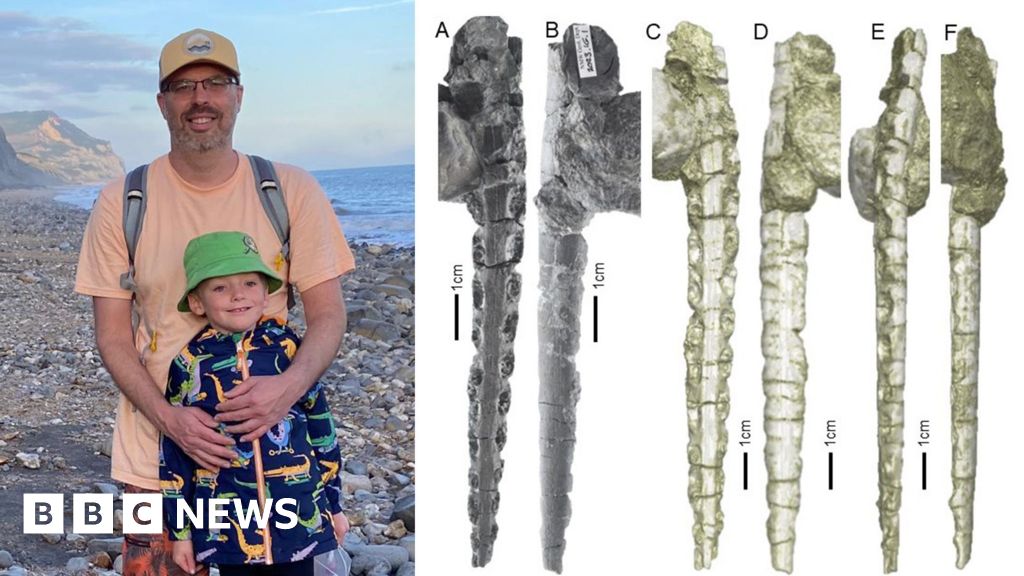
An amateur fossil hunter's discovery of a 200-million-year-old fish jawbone has helped solve two centuries of "confusion" over the origins of fossils across Europe, palaeontologists say.
Fossilised teeth found in rock around the Bristol Channel, along with other examples around Europe, had previously been grouped together as one type of large ancient fish called Severnichthys.
But the bone found on the Welsh side of the channel by Jonathan Bow turned out to be the first found there to belong to a different type.
It has helped experts discover that fossils in museums across the continent had been wrongly grouped and were actually made up of two different species - Saurichthys and Birgeria.
The Saurichthys bone discovered at Lavernock by Bow, and which helped experts make their breakthrough, will go on display at National Museum Cardiff later in 2026.
Bow, from Bridgend, said he had been walking along the beach in the Vale of Glamorgan at low tide in the spring of 2012 when he had spotted "what looked to be a jaw".
He said it "was like nothing I'd ever spotted on the beach before", having been a fossil hunter for about 10 years.
"I was super excited because I thought it was going to be a miniature crocodile, something brand new," he said.
For many years he had no idea what it was as experts were unsure, but in 2022 University of Bristol lead researcher Jacob Quinn came to see Bow's collection and went on to research the jaw.
While a fish jaw was not what Bow had hoped for, he said "it felt good" to have been part of the team that had "contributed to science".
"I've been collecting for quite some time over the years and it was interesting," he said.
Researchers from Amgueddfa Cymru - Museum Wales worked with State Museum of Natural History Stuttgart and the University of Bristol, where the fossil had been sent for detailed inspection.
They discovered it belonged to a Saurichthys - a predator fish that lived in shallow tropical seas during the Late Triassic period.
"Many teeth from Saurichthys were once mistaken for those of an amphibian, and that misunderstanding continued well into the 20th Century," said Museum Wales curator Cindy Howells.
"This lovely little jaw caused great confusion when it was first found as it bore no resemblance to any known species," she said.
Quinn said the fossils found in the Bristol Channel had come from storms that had happened 200 million years ago.
"It is remarkable that such a delicate fossil survived," she said.
"Although British Triassic fossils have been studied for over 200 years, this is the first bone from Saurichthys ever found in these rocks."
The discovery led to the publication of a scientific paper that compared the fossil with those across Europe.
By comparing the new snout with museum specimens from Britain and Europe, it provided clear evidence that fossils originally thought to be Severnichthys were actually a combination of two separate species.
The name Severnichthys had been used for individual teeth and a few small bones that existed in many museum collections. These were even thought to be from amphibians well into the 20th Century, rather than the fish that experts now know they were.
"These predators lived in a shallow tropical sea filled with small limestone islands," paper co-author Dr David Whiteside said of the two species.
"Saurichthys was probably a fast and agile hunter, while Birgeria was larger and more powerful, likely feeding on a wider variety of prey."
Another co-author, Dr Sam Cooper, said: "These fish have a remarkably complicated history.
"It's amazing that a single fossil, found by Jonathan Bow during a spring tide, has helped clear up nearly 200 years of confusion."
Catherine Zeta-Jones bases new role on funny Welsh people she knows
'Cheeky' fees prompts choirs to pull out of Andrea Bocelli gig
Crashed RAF jet steered to 'avoid built-up areas' before pilots ejected
Topics in this story
Gathered from external sources. Rights to this text belong to whoever originally published it.