From 2020 to 2023, Mississippi funded an oyster-shell recycling pilot to capture restaurant waste for cultch and reef-replenishment work along its Gulf Coast
US News: From 2020 to 2023, Mississippi launched a unique oyster-shell recycling pilot under the 'Save Our Shells' initiative, transforming restaurant waste into vital hard substrate for oyster reef restoration along its Gulf Coast. Discover the significance of this project in boosting oyster populations and maintaining marine ecosystems.
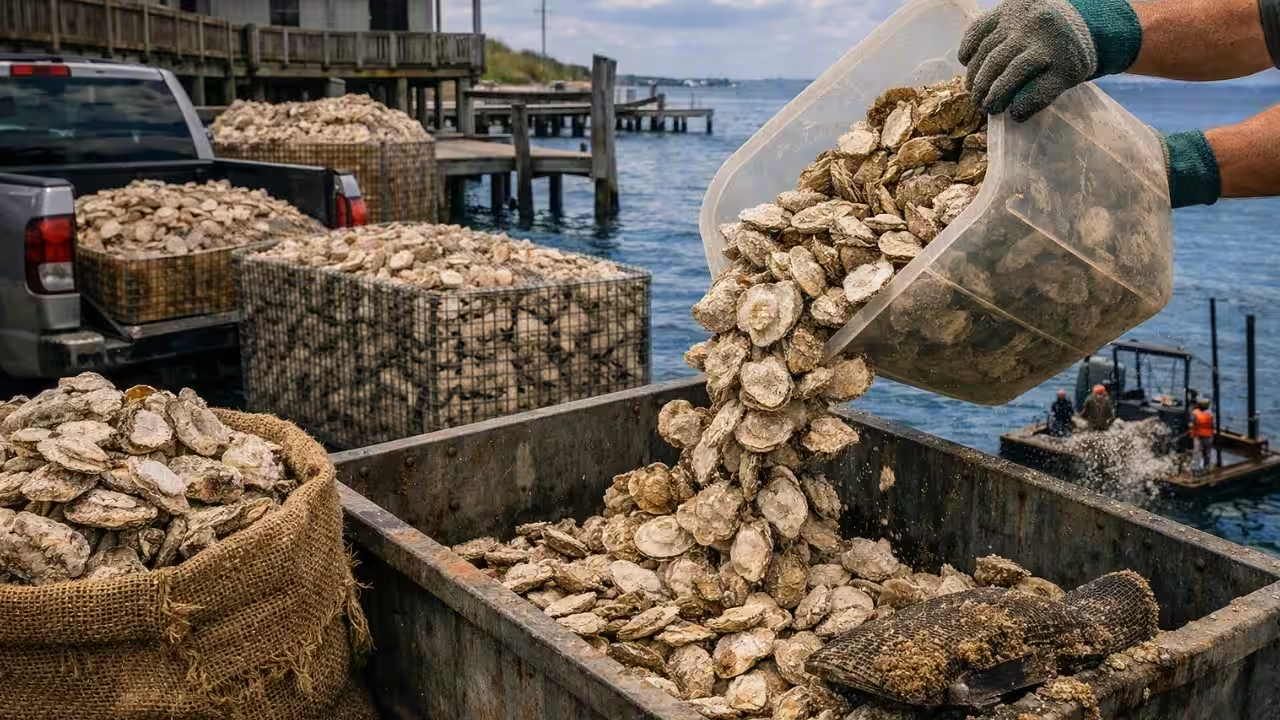
From 2020 through 2023, the state of Mississippi ran a shell collection and recycling pilot program that redirected discarded shells from Gulf Coast restaurants and put them back into the water as cultch, which is the hard material that young oysters use to cling to in order to grow. The pilot program was conducted under the initiative “Save Our Shells,” and helped solve an issue which had gone unnoticed in the Gulf region: as the industry shifted away from centralized shucking toward selling live oysters directly to restaurants, the resulting shells became scattered across many small locations rather than concentrated at a few processing plants, leaving them a largely uncollected resource.How the funding and structure came togetherAccording to MDEQ and RESTORE Council program documentation, the Mississippi Sound Oyster Shell Recycling Program was funded with a RESTORE Act grant of approximately $650,000, drawn from civil penalty funds tied to the 2010 Deepwater Horizon oil spill and designated for Gulf Coast restoration and recovery. The funds were used for Mississippi's Oyster Shell Recycling Pilot Project to recycle oyster shells from restaurants. The department contracted The Nature Conservancy to manage the program, with the first phase spent on planning before the shell collection itself launched in 2023. After the construction process, the restaurants retain the shucked shells for reuse, where contractors come by to transport the shells to a location for exposure to sunlight for many months, thus eliminating all bacteria and organic materials in the shells before placing them in the ocean. Cultch production is then transferred to the Mississippi Department of Marine Resources to use in the replenishment of the oyster reefs in coastal areas within the state.Why shell cultch matters more than most substitutesOysters require something hard to settle on, but shell is often preferred by oysters as cultch over concrete, limestone, and gravel. An article in the Marine Ecology Progress Series researched Louisiana’s Sister Lake and found that oyster biomass from reefs made using shell cultch reached 14.6 kilograms per square meter after three years, with faster shell accretion than reef subsidence. The same Marine Ecology Progress Series also noted that the reef growth trajectory was unique to each site: reefs situated less than 8 kilometres apart grew in different ways, with recruitment and mortality differing greatly across sites. Nonetheless, within just three years, all the reefs harbored high numbers of oysters averaging 728 ± 102 per square meter, and the growth of the shell exceeded the local needs to match the rates of subsidence and shell erosion.Suwannee Sound provides a parallel view from a different perspective. Oyster density was monitored over fourteen years, nine years before and five years after a massive restoration of limestone beds. The number of oysters per square meter at the newly restored sites rose from nearly zero to 91 in six months and to 244 in five years. The study, "Restoration Is a Partial But Not Complete Solution for Long-Term Declines in Oyster Populations: A Case History From the Northeastern Gulf of America," led by W.E. Pine and USGS colleagues and published in Marine and Coastal Fisheries: Dynamics, Management and Ecosystem Science, found that rebuilding hard substrate was an essential step in reef recovery, though the paper's title itself signals that restoration is only a partial, not complete, solution to long-term oyster decline.What sets Mississippi's approach apartThe project carried out in Mississippi has been somewhat different since it used a single grant that has covered its funding throughout several years instead of starting the project step-by-step in restaurants. Such an approach has allowed setting a rather high collection goal; however, it implied spending the first few years not on getting results but on planning and building the collection infrastructure. The project itself is quite consistent with the findings of the research, since the shells, which might otherwise be sent to a landfill, is now used to recreate reefs that will contribute to the process of filtering the water as well as the development of recreational and commercial fisheries.Catch the latest World News and Live updates. Download the TOI app.
Topics in this story
Gathered from external sources. Rights to this text belong to whoever originally published it.