A 5th-century boat burial on Germany’s North Sea coast reveals a man's Danube origins and a rare leprosy pathogen identified through DNA analysis, offering clues to ancient disease spread and human migration
A man buried in a boat grave on Germany’s North Sea coast during the 5th century came from the Danube region and carried an unusual form of leprosy, DNA
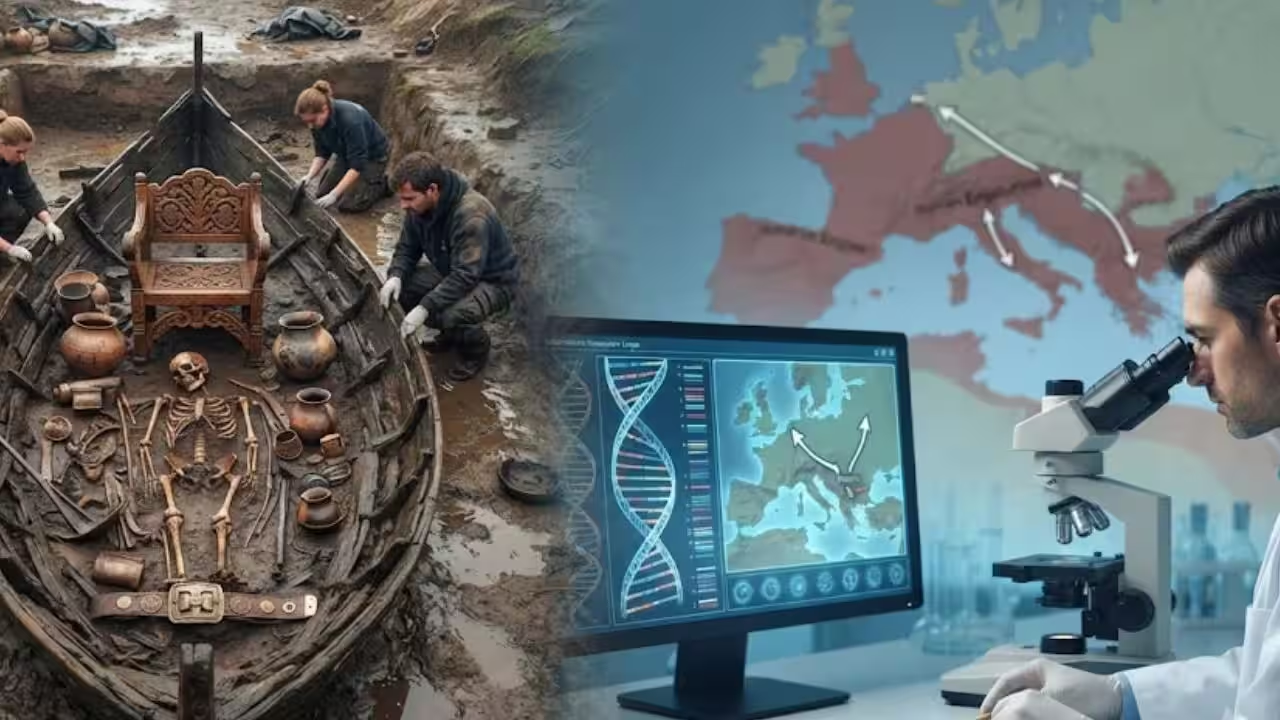
A man buried in a boat grave on Germany’s North Sea coast during the 5th century came from the Danube region and carried an unusual form of leprosy, DNA analysis has found. The discovery came from the Fallward burial site, located in present-day Cuxhaven district.The pathogen belongs to a group whose earliest known representative was identified in ancient Egypt, but which had not previously been detected in Central or Northern Europe.According to Kiel University, the pathogen was identified while analysing bone samples from 11 people. The findings provide evidence of long-distance human movement and the spread of disease in Late Antiquity.How DNA analysis identified a rare leprosy pathogen in an ancient boat burialThe Fallward burial ground is located in the Cuxhaven district, along Germany’s North Sea coast. Archaeologists from the district’s heritage conservation department investigated the site in the 1990s. Damp soil had preserved wooden and textile objects in the graves. Researchers are analysing the finds through a project funded by the German Research Foundation at the NIhK in Wilhelmshaven.Objects recovered in blocks and kept frozen are being examined under laboratory conditions. The Ancient DNA Working Group at Kiel University’s Institute of Clinical Molecular Biology received bone samples from 11 individuals. The team aimed to investigate possible genetic relationships and look for traces of infectious diseases among those buried there.Researchers uncover unusual objects in ancient boat burialProfessor Ben Krause-Kyora, lead researcher at IKMB, said, “Three of the individuals provided sufficient data for a population genetic analysis. The results were particularly striking in the case of one individual.”Reportedly, the man had been buried in a boat along with numerous grave goods made of wood, pottery and metal.Professor Hauke Jöns of the NIhK said, “The grave goods placed in the tomb aroused particular scientific interest; these included a chair, artfully decorated and carved from an alder trunk. Furthermore, the man possessed a late Roman military belt, which suggested that the deceased had had connections across great distances.”The pathogen belongs to a group whose earliest known representative came from Egypt and dates to between the 4th and 2nd centuries BC.DNA analysis traces man's origins to the Danube regionProfessor Almut Nebel from the IKMB said, “Leprosy is a chronic disease. It can take years for clear symptoms to appear. The man had not yet suffered any bone damage. Either he was affected by an asymptomatic form of the disease, or the disease had so far only affected soft tissues. He may have travelled long distances whilst carrying the disease.”Reportedly, the genetic analyses thus confirm the picture of a man who, although buried on the North Sea coast, had his roots in the Danube region and had connections to south-eastern Europe and the Mediterranean. He presumably lived there for a certain period of time.Professor Dr Ben Krause-Kyora said, “He could, for example, have been a mercenary in the Roman army who later settled between the Elbe and the Weser. Or he might have undertaken long journeys as a trader.”What DNA revealed about the man's journey across EuropeThe analyses indicate that the man buried on the North Sea coast had roots in the Danube region and connections to south-eastern Europe and the Mediterranean. Researchers believe he probably lived in that wider region for some time, although his exact origins remain unknown. Professor Ben Krause-Kyora suggested he might have served as a mercenary in the Roman army before settling between the Elbe and Weser rivers.Another possibility is that he travelled long distances as a trader. The researchers said the findings show the complexity of individual lives during Late Antiquity. They also highlight how people and pathogens moved across far-reaching networks in a world connected over considerable distances.You use AI every day. Now get your AI Quotient. Take the AIQ test.
Topics in this story
Gathered from external sources. Rights to this text belong to whoever originally published it.