Spain train crash leaves at least 64 dead in second major collision this year
BARCELONA, Spain — At least 68 people were killed and 68 injured when two high-speed trains collided in central Spain on Wednesday, sending carriages careering off the tracks, in the second major accident on the same line in less than a year.
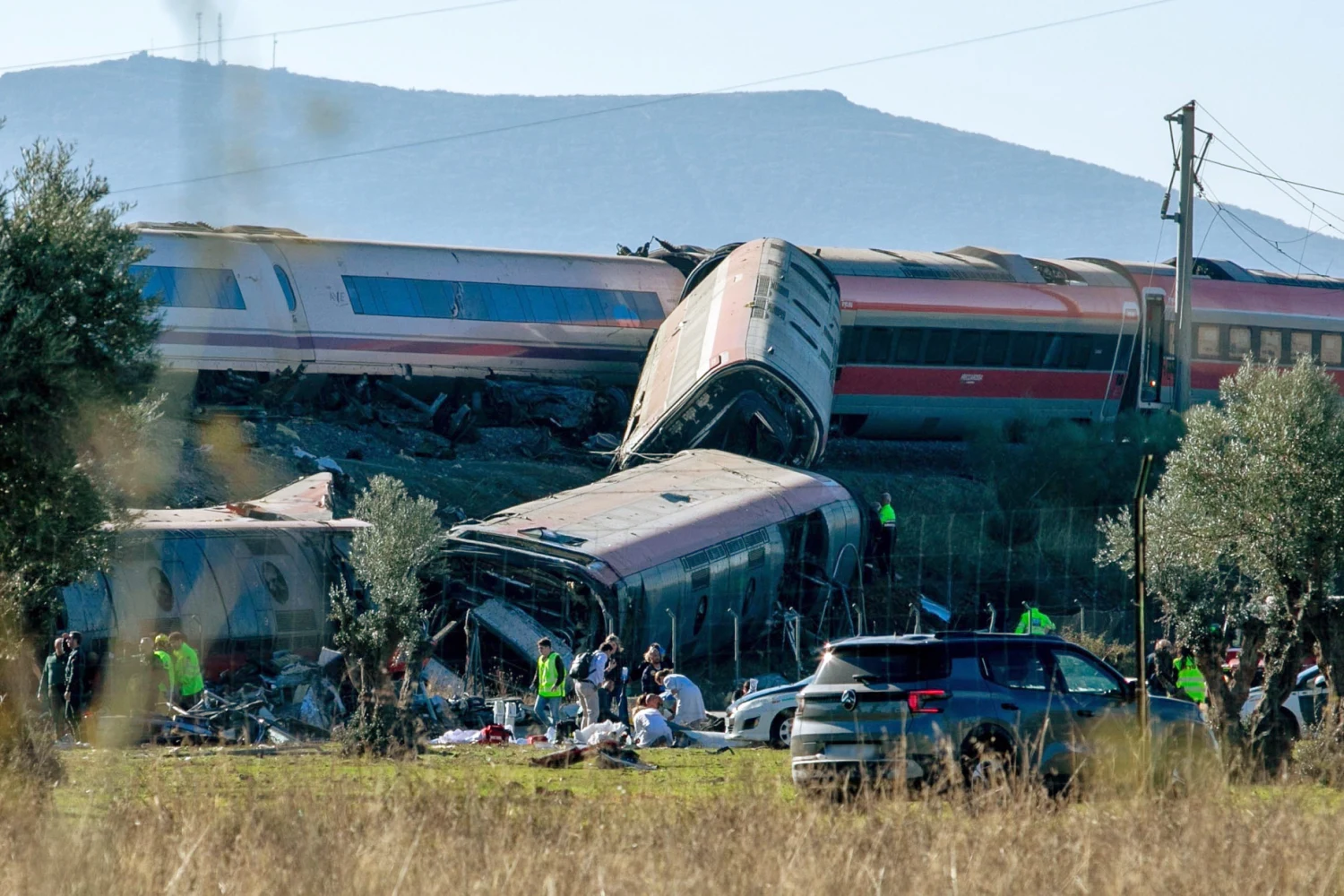
BARCELONA, Spain — At least 68 people were killed and 68 injured when two high-speed trains collided in central Spain on Wednesday, sending carriages careering off the tracks, in the second major accident on the same line in less than a year. “We heard a massive roar, a truly enormous thud that went on for 10 seconds, as if the train were about to derail,” one passenger, Miguel, told Spain’s COPE radio, adding that he was traveling with several colleagues in the rear car of one of the trains. “Through the right-hand window, we could see a wrecked train — I imagine it must have been the other one,” he added. Pictures showed several carriages lying on their sides next to the tracks and others twisted at angles, their wheels sheared off. Debris was strewn around the scene of the accident in the countryside in the province of Toledo. As rescue teams continued to search through the wreckage of the derailed carriages, the Castilla-La Mancha regional government said 68 people had been killed and 68 injured. Together the two trains were carrying more than 500 passengers. “The government of Spain and the whole state are with the victims and also with the families of the victims,” Prime Minister of Spain Pedro Sánchez said at the site of the crash on Wednesday. Sánchez, who is facing a snap election next month, said the government was investigating the cause of the crash and any failures, vowing action “if there has been negligence.” He said that the country must restore confidence in its high-speed rail network, with the crash coming after a separate disaster on the same rail line killed 46 people in January. “It is unacceptable for a country like Spain to have two high-speed accidents in less than a year,” he said. Spain’s transport minister Oscar Puente said Wednesday’s crash occurred after a state-owned Renfe high-speed train was authorized to continue its journey despite an active red signal and a stationary train from private rail company Iryo on the tracks ahead. Addressing reporters in Madrid, Puente said the red signal was issued due to a computer communications failure which automatically stopped traffic. An erroneous decision was made to restart the Renfe train, breaking protocol, he said. Locals rushed to the scene of the accident, which has prompted a major national emergency response and raised questions about the safety and security of Spain’s high-speed rail infrastructure, which had previously been hailed as among the most sophisticated in Europe. Esther Padilla, spokeswoman for the Castilla La Mancha region, told state broadcaster TVE that the trains were heading in the same direction from Madrid to Seville when one ran into the tail of the other, which had stopped on the line. She added that some 397 people had been traveling on the Renfe train and 147 people on the Iryo train. Spain’s royal family who said they shared “in the grief of the families and loved ones of those who lost their lives.” Spanish political parties said Wednesday they would briefly pause campaigning ahead of next month’s general election. Spain’s football federation also said it would postpone some of its Copa del Rey soccer fixtures, following the collision. Juan Manuel Moreno, the president of the Andalusian regional government, said on X that there would be three days of mourning in the region. The full scale of the disaster remains unclear but officials said an emergency phone line had been set up for families of the victims; local blood banks had also made appeals for donations. Manuel Galan, the mayor of the nearby municipality of Urda, said he had been asked by emergency services to prepare a sports hall to accommodate the injured. Eduarda, a passenger on the Iryo train, told Spain’s Cadena SER radio that she felt a strong impact that threw her forward and she initially thought the train had made an emergency stop. After climbing down an embankment to safety, she said she saw part of the train hanging down the slope and a fire in one carriage. “I saw dead people,” she added. Salvador Arriza, a 62-year-old employee of Airbus, was travelling to the rear of the Renfe train. He told the Reuters news agency the carriage ended up “completely wrecked, with seats being ripped out.” “I was lucky because I was in a backward-facing seat, and the impact pushed me into it,” he added. “After the first hit I was disoriented, but the worst thing was that the train then kept moving for quite some time from the inertia and that’s when I thought something would happen to me.” Emergency responders, including a helicopter, police and ambulances, arrived within about 20 minutes, she said. Spain has the largest high-speed rail network in Europe for trains moving more than 155 mph, with more than 1,900 miles of track, according to the European Union.
Topics in this story
Gathered from external sources. Rights to this text belong to whoever originally published it.