In 2009, Todd Bol built a free book box outside his Hudson, Wisconsin, home; 16 years later Little Free Library had placed 200,000 boxes in 128 countries
Todd Bol built the first Little Free Library in 2009 as a small tribute to his mother, a teacher who loved to read.
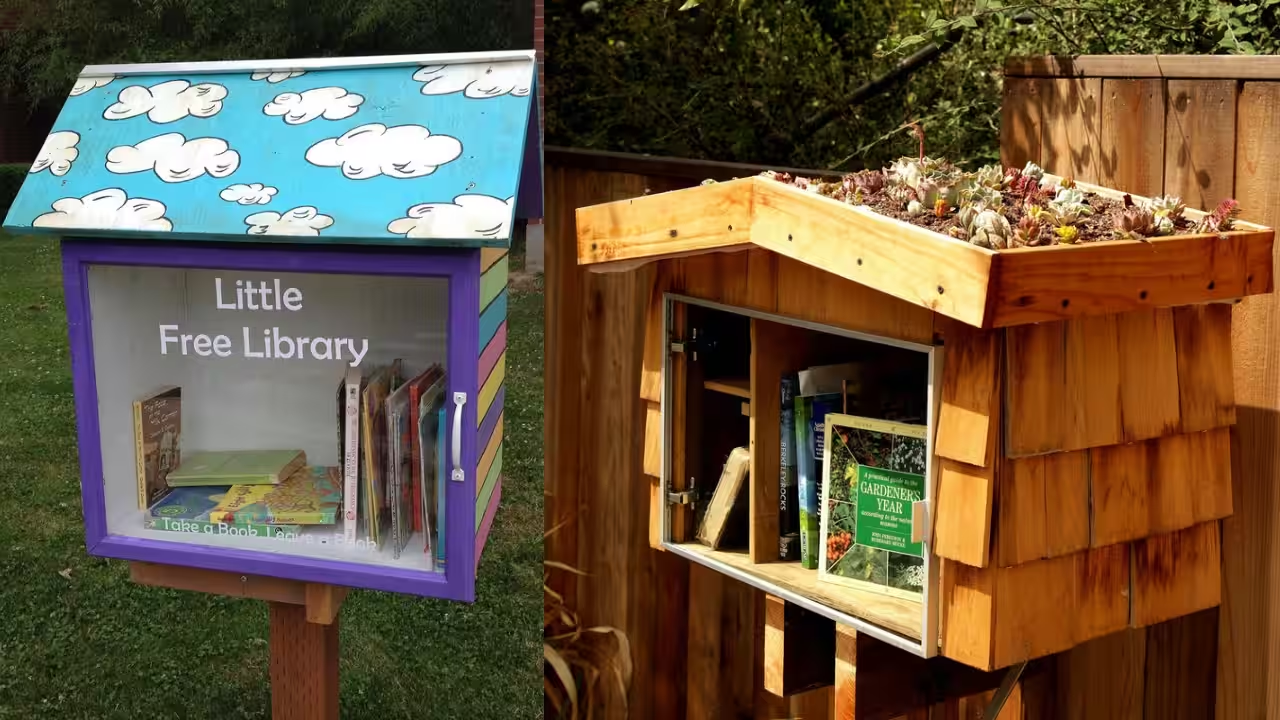
Todd Bol built the first Little Free Library in 2009 as a small tribute to his mother, a teacher who loved to read. He made the box to resemble a one-room schoolhouse, filled it with books and placed it on a post outside his home in Hudson, Wisconsin. Neighbors liked the idea, and Bol began building more boxes and giving them away. It eventually became a nonprofit network that spanned across thousands of communities.The organization’s own history says Bol and Rick Brooks, who was a retired University of Wisconsin-Madison employee, began developing the idea into a larger community project after Brooks saw Bol’s book-sharing box. They were inspired by existing “take a book, leave a book” collections as well as Andrew Carnegie’s efforts that helped expand access to free public libraries. Their first major target was to surpass Carnegie’s historical goal of 2,509 free public libraries, and by August 2012, the 2,510th Little Free Library had been built, according to the organization’s milestone records.From one neighborhood box to a global networkLittle Free Library became an official 501(c)(3) nonprofit in 2012, and the network reached 50,000 registered book-sharing boxes by 2016. The organization’s 2023 milestone record shows another series of jumps: from 100,000 libraries in 2020 to 125,000 in 2021 and 150,000 in 2022. By 2022, the network had reached 120 countries and all seven continents, including Antarctica.Individual stewards, rather than a centralized library system, look after the boxes in their communities. People can leave books, take books or browse what is available without needing a membership card or scheduled opening hours, which allowed the model to spread from residential streets to schools, community spaces, and other locations.The 200,000th box arrived in 2025Little Free Library reached another milestone on March 11, 2025, when it unveiled its 200,000th registered book-sharing box at Benjamin E. Mays IB World School in St. Paul, Minnesota. The box was the first of 200 libraries that the organization planned to give to Title I schools across the country.The network had expanded across all 50 US states, 128 countries, and all seven continents by that point, and Little Free Library said more than 400 million books had been shared through its network at the time of the milestone. The organization’s Impact Library Program provides free book-sharing boxes to communities identified as having limited access to books, while other programs focus on specific communities and reading needs. Bol died in 2018 from complications of pancreatic cancer, but the network continued expanding after his death.The boxes are now targeting communities with fewer booksLittle Free Library’s Impact Library Program was launched in 2016 and provides free book-sharing boxes to qualifying communities in the US and Canada. The organization says that the program has granted more than 3,500 libraries since its launch, with recipients being selected partly on local book access and community need.A 2024 observational study of 768 children in Baltimore County, Maryland, found that 92% reported having greater access to books because of Little Free Library boxes, while 49% said they read more frequently after beginning to use them. Children who visited a box also reported reading an average of 1.1 additional days per week.In 2025, the organization also granted 497 no-cost boxes through the Impact Library Program to communities across the US and Canada, while its Indigenous Library Program provided 100 boxes to Native American and First Nations communities.You use AI every day. Now get your AI Quotient. Take the AIQ test.
Topics in this story
Gathered from external sources. Rights to this text belong to whoever originally published it.