In June 2023, Jessica Vincent paid $3.99 for a colourful vase at a Virginia Goodwill; six months later, a Carlo Scarpa piece sold for $107,100, earning her about $83,500
In an astounding tale, Jessica Vincent discovered a Carlo Scarpa vase at a Virginia Goodwill for just $3.99. After expert authentication, the vase sold for $107,100 at auction, revealing the hidden treasures that thrift shopping can uncover.
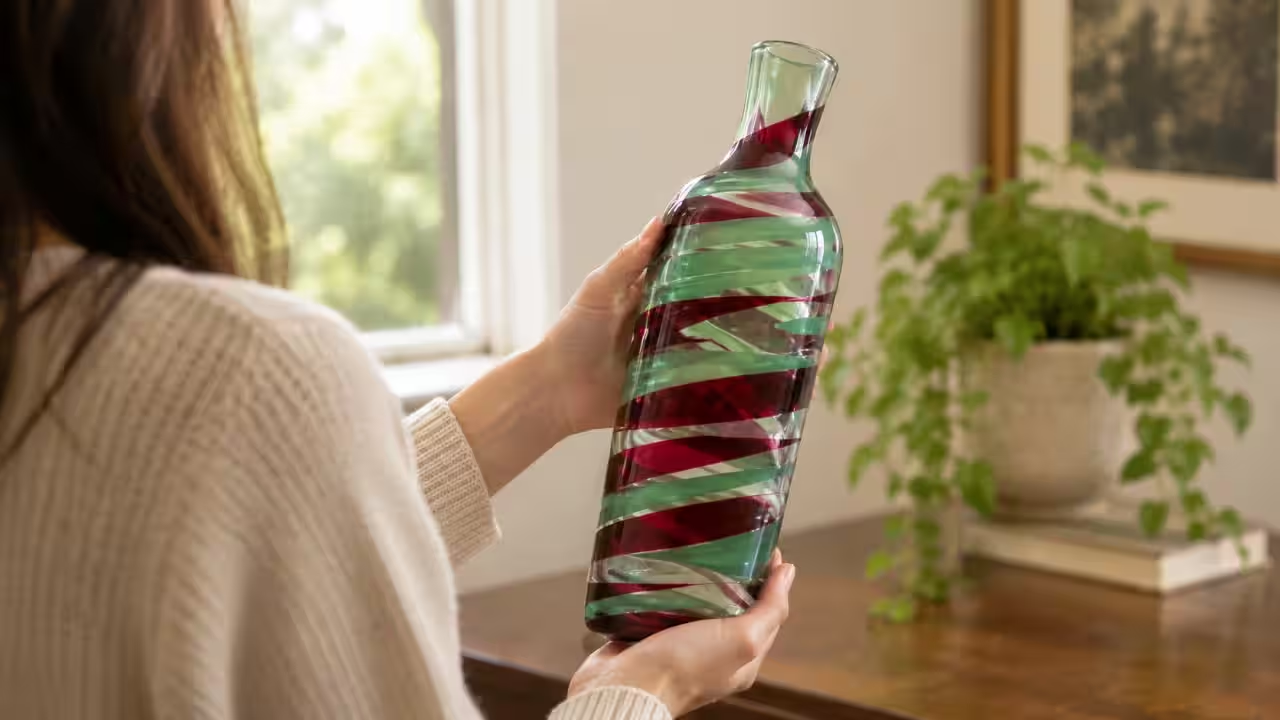
A routine shopping excursion through a secondhand retail store led to the authentication of an old masterpiece. A small mark on the base sent Jessica Vincent looking beyond the price tag. The bottle-shaped glass vessel had no price displayed when she found it at a Goodwill shop in Hanover County, Virginia. According to The New York Times, she had set herself a ceiling of about $8.99, but the cashier said $3.99. She assumed the vase would’ve been worth around $1,000 or $2,000, but had not identified its maker.Vincent, at the time 43 years of age, visited the shop in June after training horses. The vase stood among the household goods. Amethyst and aqua bands appeared to move through its glass. What caught her attention was the letter “M” written on its base, which she took as a possible reference to Murano.She had years of experience searching for items in second-hand shops, having gone thrifting with her mother since childhood, as per the Associated Press report in 2023. Vincent was an avid Antiques Roadshow fan and researched purchases. Her earlier finds included a Balinese woodcarving and lithographs by Burt Groedel, which she believed were worth a few thousand dollars each. Along with her partner, Acosta, she visited thrift shops several times a week. They trained polo, sport and trail horses for work.Authenticating the vase, from its purchase to attributionExperience gave her an edge, but she needed proof of what she had found. Vincent, in order to be sure from her home, posted photographs of the vase in online glass-identification groups on Facebook. The responses from members suggested the design resembled work by Carlo Scarpa and advised her to go to Wright Auction House. This prompted her to contact the auction house for an expert assessment.Richard Wright, president of the auction house, recognised the design from her photograph and arranged for the vase’s examination. Wright sent two Italian glass specialists to Virginia to check out its authenticity. Vincent brought the vase out wrapped in bubble wrap and a tablecloth. She recalled their excitement when they first saw it: “It was incredible to have experts who handle very important pieces of glass who were very excited for my little thrift-store vase.”After examination, the vase was linked to Scarpa’s Pennellate series, made for an Italian glass company called Venini in 1942. Pennellate, in Italian, translates to brushstrokes. Following Wright’s account, the process involved applying coloured opaque glass to a vessel as it was blown, leaving marks that gave the impression of paint strokes. The glassblower had to keep rotating the vase while the colours were added. Scarpa’s drawings had to be translated into a physical object by the person working on the glass.The process was pedantic; as a result, only a small number of pieces were known to have been made. Wright said the auction house was cognizant of one other vase with the same shape and colour combination, which was held in a private collection. Vincent’s vase had no chips or cracks. This was an important highlight because even a chip, no matter how small it was, could drag the value below $10,000.The auction and what ensued after Initially, the Wright Auction House estimated the vase would sell for $30,000 to $50,000, according to the New York Times. It went under the hammer on 13 December 2023 and sold for $107,100. The buyer was a private collector and, following their request, remained anonymous. Vincent received about $83,500, with approximately $23,600 going to the auction house.Vincent decided not to keep the vase after finding out its rarity and value. Her reasoning was rather simple: keeping such a valuable item in the house meant exposing it to break-ins. She said to The New York Times that she wanted the piece restored to the art world because its existence had been unrecognised, and she hoped it would eventually be placed in a museum.The money was kept aside for a farmhouse Vincent had bought in January. The farmhouse was built in 1930 and required major renovation; at the time it was being heated with two space heaters. Her plans then included the installation of a heating and air-conditioning system, alongside a dishwasher and fencing.How the vase ended up at Goodwill remains unknown. Laura Faison, a spokeswoman for the Goodwill of Central and Coastal Virginia, said the organisation oversaw more than 2 million donations a year, making it impossible to identify the donor. As per the account of the Associated Press, the vase might have been on the shelf for a couple of days, given the volume of stock moving through stores. Faison said the vase might have come from someone clearing out a relative’s home.You use AI every day. Now get your AI Quotient. Take the AIQ test.
Topics in this story
Gathered from external sources. Rights to this text belong to whoever originally published it.