From 2014 to 2021, Wisconsin tracked three permeable pavements through seven winters; concrete pavers froze less often and thawed faster below ground
A seven-year study by the USGS shows interlocking concrete pavers have fewer below-freezing days and thaw faster than pervious concrete and porous asphalt, suggesting they may help improve drainage and reduce road salt use in winter conditions.
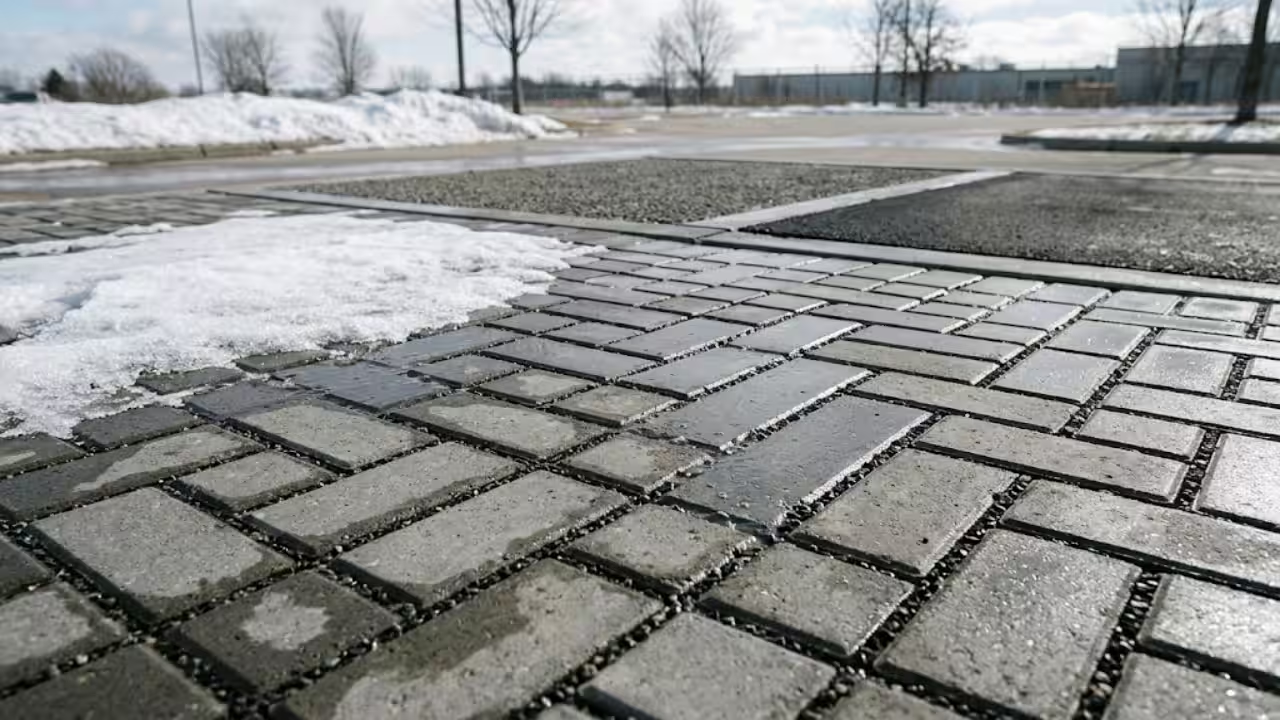
Winter is tough on highways in ways most drivers never notice. Water enters tiny cracks, freezes and expands, pushing the surface apart. The process can repeat when temperatures drop again. Cities using permeable surfaces to reduce flooding and pollution face another question: how do these pavements behave underground when temperatures remain below freezing?Seven winters of temperature data from Madison, Wisconsin, helped researchers examine how permeable pavements respond to cold weather. The US Geological Survey studied three types of permeable pavement: interlocking concrete pavers, pervious concrete and porous asphalt. The pavers had fewer days below freezing, higher temperatures during snowmelt, slower freezing and faster thawing than the other two surfaces. The findings were published in the journal Water in 2021.This is important, since ground that remains unfrozen is able to keep absorbing meltwater, rather than letting it pool on the surface and refreeze. That might ultimately mean less road salt; however, the researchers are quick to remind us that salt has its own set of concerns. The details of the experiment explain how the team came to that conclusion and where its boundaries are.How the test was set upIn summer 2014, researchers established three test plots at a research site in Madison, Wisconsin, next to an overflow parking area. The plots represented interlocking concrete pavers, pervious concrete and porous asphalt. Each plot covered about 500 square feet, or 46.5 square metres, and had an aggregate base about 21 inches, or 53 centimetres, deep beneath the pavement. An impermeable liner and concrete walls separated the plots from the surrounding ground and from one another. The adjacent conventional parking area was not one of the three pavement types in the temperature comparison.Temperature monitoring ran from 21 August 2014 to 6 July 2021, with sensors recording readings every minute. Each plot had 27 thermocouples arranged at three depths: immediately below the pavement and 15 and 30 centimetres below the aggregate base. No vehicles drove on the test plots, and no salt or sand was applied to them. Snow deeper than 5 centimetres was removed with a hand-operated snow thrower, while the adjacent parking area was ploughed and treated with sand and salt. The main comparison used 303 winter days when sensors in all three plots were working at the same time.What the temperature data showedThe main comparison covered 303 winter days with simultaneous readings from all three pavement types. The daily average air temperature was below freezing on 182 of those days. During those days, temperatures in the top, middle and bottom layers beneath the pavers remained above freezing on 42%, 68% and 81% of days, respectively. The corresponding figures were 20%, 38% and 74% for pervious concrete, and 25%, 45% and 74% for porous asphalt. These percentages are rounded summaries of the study data.Another measure counted days when the daily minimum air temperature stayed above freezing throughout the day. This occurred on only 39 of the 303 days. The bottom layer beneath the pavers stayed above freezing throughout the day on 263 days, compared with 214 days beneath pervious concrete and 212 days beneath porous asphalt.During the 120 days when the daily maximum air temperature remained below freezing, the top, middle and bottom layers beneath the pavers were also below freezing all day on 65, 35 and 14 days, respectively. The corresponding figures were 101, 82 and 35 days for pervious concrete, and 61, 58 and 28 days for porous asphalt. The porous asphalt top layer therefore had a similar number of frozen days to the pavers, but its lower layers froze more often.Researchers also examined three extended cold periods: the winter from late December 2014 to early March 2015 and two shorter periods in the winter of 2019 and 2020. During these periods, all depths beneath the pavers froze completely only once, while pervious concrete and porous asphalt froze completely during all three periods. Across the three pavement types, the top layer took an average of about 13 hours to freeze after air temperatures fell below zero. The middle layer took about one day and 15 hours, while the bottom layer took about three days and 22 hours. Thawing generally occurred faster than freezing, although the time varied by pavement type and depth.The researchers suggested that differences in construction may help explain the results. The gaps between the pavers occupy about 10% of the surface, while pores in pervious concrete and porous asphalt extend across their surfaces. The researchers proposed that the arrangement of the pavers, the movement of air and water through the gaps and aggregate base, and the thermal mass of the concrete blocks may affect heat transfer. These are possible explanations offered by the authors, rather than mechanisms independently established by the experiment. The darker, porous asphalt surface may also absorb more sunlight, helping explain why it stayed warmer near the surface than the previous concrete.What it means for road saltThese temperature differences matter during snowmelt. When the layers below a pavement remain above freezing, meltwater is more likely to infiltrate instead of pooling on the surface and refreezing. Researchers identified 137 melt days from meteorological records. Temperature data were available for 103 of those days for the pavers, 47 for pervious concrete and 89 for porous asphalt. On days with available data, the daily maximum temperature across all measured depths stayed above freezing on 96% of paver observations, 93% of porous asphalt observations and 83% of pervious concrete observations.The authors cited earlier studies reporting that permeable pavements could reduce road salt use. One study in Toronto reported about half as much salt use at a site with interlocking concrete pavers, while research in New Hampshire found that porous asphalt could maintain comparable or better surface conditions with 64% to 77% less salt than conventional asphalt.These findings do not mean that salt can be used without environmental consequences. Dissolved chloride can pass through permeable pavement and reach groundwater, even when the surface reduces runoff or the need for deicing. The researchers therefore recommended minimising salt use where possible and avoiding it when conditions permit.There are some boundaries to remember. The study was at a single site in one city, the plots were small, and nobody drove on them, so the findings reflect temperature behaviour rather than how well each surface handles traffic. The work was funded by various donors, including a foundation for teaching and research on interlocking concrete pavements, as well as Wisconsin agencies, the City of Madison and the USGS. The authors say the funders played no role in the findings. The findings suggest that all three permeable surfaces can retain temperature conditions that allow water to infiltrate during winter melt events, with interlocking pavers performing best in the temperature comparisons.You use AI every day. Now get your AI Quotient. Take the AIQ test.
Topics in this story
Gathered from external sources. Rights to this text belong to whoever originally published it.