Harmanpreet Kaur: India's trailblazing women's cricket captain steps down
The skipper who led India to the historic 2025 World Cup win has stepped down from her role in all three formats.
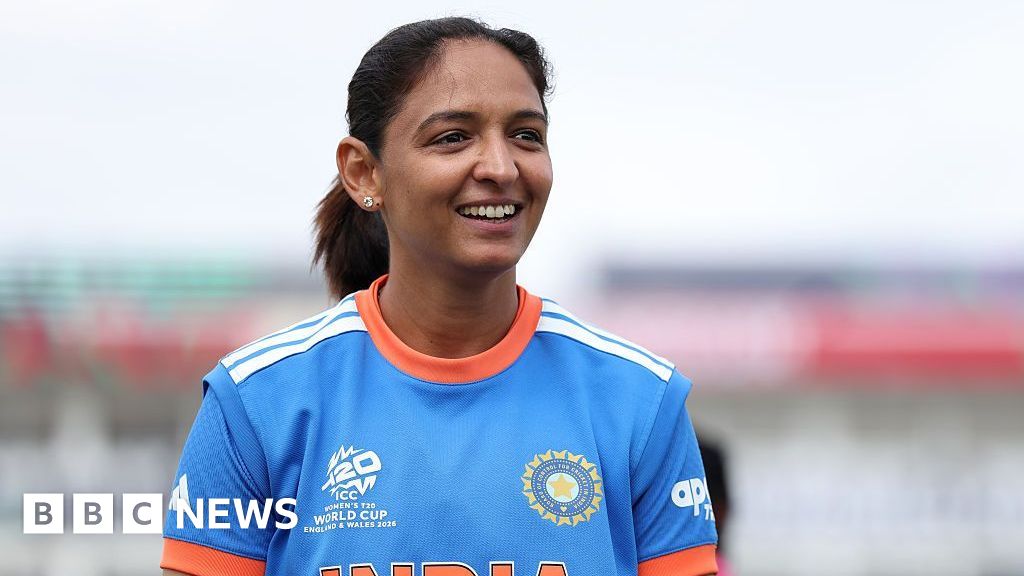
When Harmanpreet Kaur scored that unforgettable World Cup century against Australia in the 2017 semi-final, she not only changed the course of a match but the trajectory of women's cricket in India.
India went on to lose the final to England that year but women's cricket no longer remained a passing pursuit for the average Indian fan.
That dogged zeal to win she infused into the team helped them lift India's first women's World Cup trophy - the same feat that had eluded them in 2017 - in emphatic fashion eight years later.
Less than a year on, and within weeks of victories in the Asia Cup and the Asian Games, she has relinquished the captaincy, ending an era in which she became the team's most influential leader and one of the most recognisable figures in the sport.
Star opener Smriti Mandhana, her long-time deputy, has been appointed captain across all formats.
Board of Control for Cricket in India (BCCI) secretary Devajit Saikia, coach Amol Muzumdar, Harmanpreet and Mandhana attended the review meeting at which the leadership change was ratified. The transition, however, was not entirely seamless.
Reports suggest the 37-year-old Harmanpreet was willing to relinquish the T20 captaincy immediately, but was keen to continue leading the side in One-Day Internationals and Tests so that younger players could benefit from her experience.
The BCCI, however, was intent on a younger person at the helm and opted for the 30-year-old Mandhana.
In some ways, the move mirrors the BCCI's decision to replace Suryakumar Yadav as captain of the men's T20 side shortly after India won the World Cup earlier this year, with the captaincy passing to Shreyas Iyer.
Harmanpreet's future as captain had become a subject of intense debate in cricketing circles after India's below-par performance at the T20 World Cup in England a few months ago.
Her own poor form with the bat amplified concerns and prompted the BCCI to consider changes that could help the team meet the growing challenges of a women's game that continues to expand rapidly around the world.
Approaching her 38th birthday, and after almost a decade at the helm, Harmanpreet found herself under increasing scrutiny as her form dipped.
Opinion on whether she should continue as captain was sharply divided among former women players and captains.
Former cricketer Diana Edulji, among the most respected names in the game, felt Harmanpreet had done everything that could reasonably have been expected of her and that it was time for a younger captain to take over. Former captain Anjum Chopra, meanwhile, argued that Harmanpreet's experience remained invaluable and that she should stay on.
Sensing that the BCCI was strongly inclined towards a change, Harmanpreet opted to step down during the review meeting. She later announced her decision in an emotional Instagram post.
"I feel I have done my duty. I gave this team everything I had," she wrote.
"Now, it is time for me to turn the page… Blood. Sweat. Sacrifice. Pride. I gave it all. Now, I'm ready to play for the love of the game again.
"Captaincy ends, the journey continues."
Harmanpreet's intention to continue playing now leaves the BCCI with another decision to make about her future.
In Suryakumar Yadav's case, he not only lost the captaincy but also his place in India's T20 side. Given the depth of talent available in the men's game, it was easier for Ajit Agarkar and his fellow selectors to take what was always likely to be a contentious decision.
The situation in the women's game is different. Despite Harmanpreet's modest recent form, replacing a player of her experience and stature may not be straightforward, as the talent pipeline is not yet as deep as it is in men's cricket.
Whatever the future holds, Harmanpreet has scripted among the more memorable careers in women's cricket. Spanning more than two decades, it is a journey marked by significant achievements and milestones.
Born into a family of modest means in Punjab's Moga city, Harmanpreet developed a passion for cricket at an early age.
Her family's support was vital in the early years, but her rise to national recognition came after she joined the Railways - a transition facilitated by Diana Edulji - and moved to Mumbai.
The superior facilities and greater professionalism associated with Mumbai's sporting culture helped accelerate her development.
She made her India debut in 2009 at the age of 20 and has remained an integral part of the national side across formats ever since.
An all-rounder for the better part of her first decade in cricket, she made herself indispensable to the side with her explosive middle-order batting, crafty off-spin and sharp fielding skills.
Her blistering century against Australia in the semi-final of the 2017 Women's ODI World Cup remains one of the defining knocks in the history of the women's game. India went on to lose to England in the final, but beating Australia was a monumental hurdle overcome.
That century also helped spark wider interest in women's cricket in India, and transformed Harmanpreet into a household name.
The second decade of her career showcased her prowess both as batter and captain. Having succeeded Mithali Raj as T20 captain in 2016, Harmanpreet assumed charge across all formats in 2022 and went on to guide India to some of the greatest successes in its history.
Her leadership was marked by an aggressive pursuit of victory. That fearless approach instilled confidence and ambition in her teammates, helping the team overcome even the previously unbeatable Australians, most memorably in the semi-final of the 2025 ODI World Cup.
Unlike in 2017, Harmanpreet couldn't get a hundred on that occasion, but her innings of 89 as was a stellar effort as captain. Combined with Jemimah Rodrigues's century, it helped India secure a famous victory over their arch rivals.
India then defeated South Africa in the final to reach what many regard as the pinnacle of achievement in the history of Indian women's cricket.
With multiple titles and trophies won under her leadership, Harmanpreet leaves behind a formidable legacy for her successor, Smriti Mandhana, to emulate.
Topics in this story
Gathered from external sources. Rights to this text belong to whoever originally published it.