Nepal-China flood disaster: What’s the latest toll, how many are missing?
Over 3,000 people remain missing days after a glacier collapse triggered devastating floods near China-Nepal border.
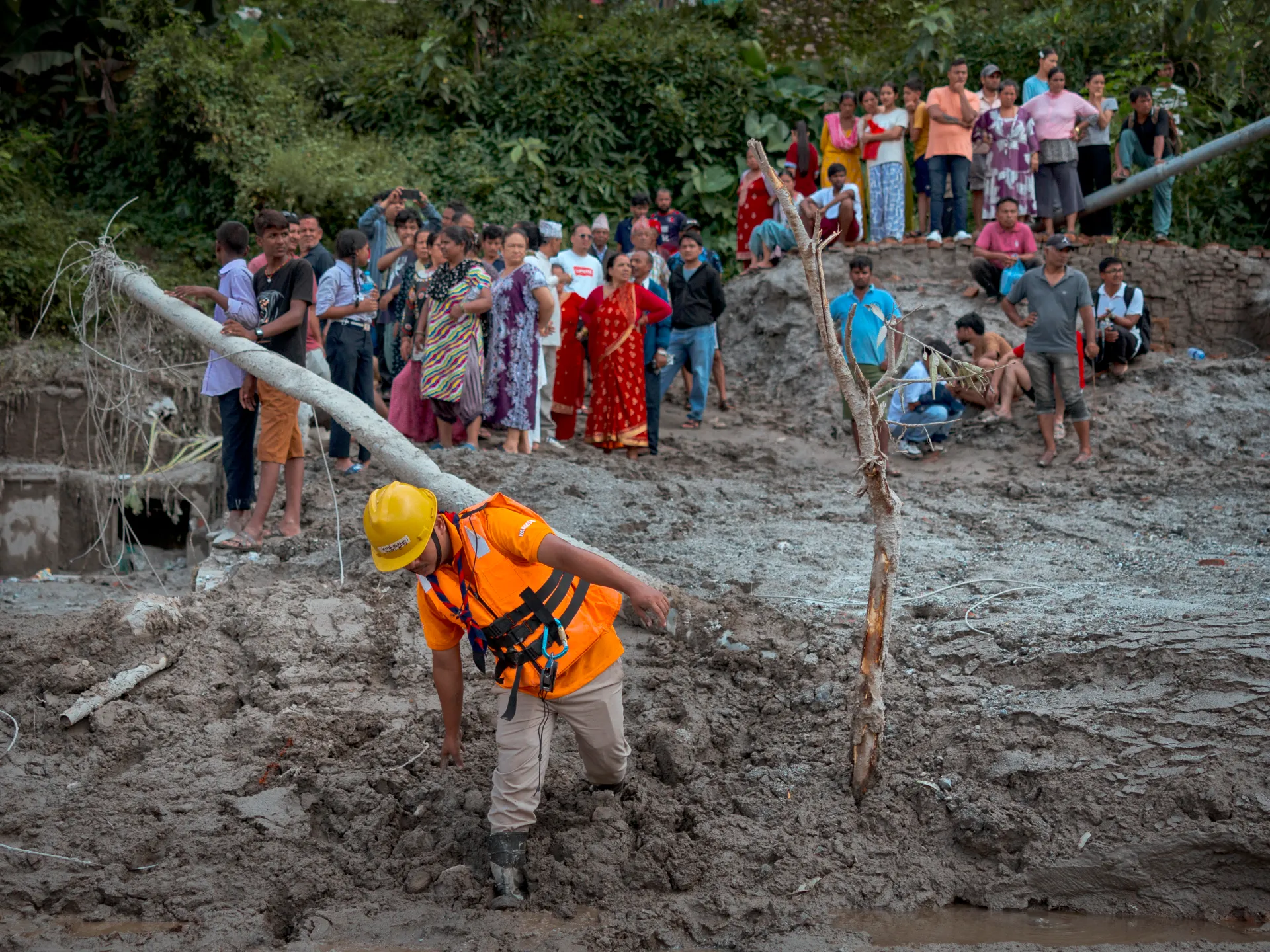
The death toll from devastating floods near the border between Nepal and China has risen to nearly 800, with thousands missing following Wednesday’s disaster.
Rescue efforts are under way to locate more than 900 missing workers at hydropower projects in central Nepal.
Authorities from Nepal and the Tibet region of China have put the total number of missing at just over 3,000, with some bodies washing up in neighbouring India.
A glacier collapse high in the Himalaya mountains in Nepal near the border with Tibet triggered Wednesday’s catastrophic flooding and landslides, which buried villages and towns along the Trishuli and Bhotekoshi river systems.
On Friday, rising water levels in a new lake formed by the build-up of debris prompted a temporary halt to search efforts amid fears of a second flood. Rescue operations resumed after the lake threat was deemed manageable.
Al Jazeera’s Katrina Yu, reporting from Beijing, said that Chinese authorities say the risk seems to have been reduced, but it has not disappeared.
“They are closely monitoring the barrier lake, located one km upstream at the port of Gyirong and the border area. They are closely monitoring using satellites, radars, and drones,” she said, adding that “authorities are confident that if the situation around the barrier lake should deteriorate, they will be able to give notice of about 30 minutes to rescuers below”.
Here’s what we know about the latest rescue efforts and the victims:
As of Sunday morning, around 933 people are missing or unaccounted for, according to the country’s Independent Power Producers’ Association. They were working at 11 hydropower project sites and tunnels in Nepal’s Rasuwa and Nuwakot districts, which are among the worst-hit areas.
The workers include citizens of Nepal, India, South Korea and China. How many are trapped or missing at each individual hydropower site remains unclear.
“After complaints emerged that people were trapped inside the tunnel, the government prioritised the deployment of a rescue team and has been advancing the work to clear the entrance by removing debris and rubble,” Nepal’s prime minister’s office said late on Saturday.
“To expedite the digging of the tunnel entrance and the search operations, a joint team of 82 personnel – including 62 from the Nepali Army and 20 from the Armed Police Force Nepal and Nepal Police – has been continuously deployed since last night. However, with adverse weather conditions persisting in the area, the rescue efforts have become quite challenging,” the statement added.
Nepal’s Foreign Secretary Amrit Bahadur Rai said that 19,000 security personnel and 16 helicopters have been mobilised in the search and rescue operations.
Videos on social media show Nepali soldiers wading through mud trying to rescue workers trapped at the 216-megawatt Upper Trishuli-1 hydropower project. The army has rescued 254 workers there.
But rescue efforts have also proved challenging at other hydropower sites, such as the 22MW Chilime Hydropower project in Rasuwa district, 133 km (82 miles) north of the capital, Kathmandu.
“We have not been able to carry out a rescue. The tunnel is filled with mud and it is impossible to enter,” Baburaj Maharjan, executive director of Chilime Hydropower Company, told the Kathmandu Post. “We are working to mobilise a rock-climbing rescue team,” he added.
India has sent teams to help rescue trapped workers.
According to Indian media reports, an 11-member team of medical personnel and tunnel-rescue specialists reached Nepal on Saturday to begin aerial assessments in the Chilime and Langtang regions.
What else do we know about the victims and the missing?
According to Nepal’s National Disaster Risk Reduction and Management Authority, the death toll from the floods has risen to 781.
The Kathmandu Post reported that bodies are turning up far downstream and local morgues are running out of space to store others until they are identified.
Rojita Adhikari, a freelance journalist and filmmaker from Nepal, told Al Jazeera that authorities are facing a challenge.
“Yesterday [Saturday] I was at a press conference with Nepal’s foreign minister and he said the country is struggling to store and identify dead bodies – whose numbers are mounting. He said Nepal does not have enough refrigerators to store the dead bodies and identify and test their DNA,” she said.
Unidentified bodies have been sent to 21 hospitals in different districts for preservation and identification, says the Kathmandu Post.
Chinese authorities in Tibet told reporters that 16 people had died in Gyirong County, as of Saturday evening.
As of Sunday morning, 2,498 people remain missing in Nepal. They include 589 foreigners and 127 Nepali citizens travelling with them, 45 personnel from Nepal’s army, 27 from Nepal’s police and 13 from the armed police force.
Reporting from Nepal, Al Jazeera’s Samer Allawi said Nepal’s disaster management authorities have evacuated thousands of people, including foreign nationals, with the help of the army and police.
In China’s Tibet region, authorities said on Sunday that 261 foreign nationals from 23 countries are missing. They include 104 from Nepal, 49 from neighbouring India, as well as 33 Latvians, 18 Americans, 15 Britons, six from Canada, six from Australia, three each from Russia, Malaysia and Germany, 10 from the Netherlands, New Zealand, Estonia, France and Ireland and one each from Finland, Lithuania, Portugal, Ukraine, Spain, Hungary and Kazakhstan.
Al Jazeera’s Yu said that getting a picture of the full scale of the devastation on the Chinese side of the border is difficult because foreign journalists are not allowed to enter the area. “We are completely reliant on the government and state media,” she said.
“The government says teams have desperately been searching the worst-hit area of the port of Gyirong since teams arrived there late on Friday after days of trekking through the mountains,” she said, adding that they have “searched at least 90,000 square metres using life monitoring equipment, search dogs and drones”.
Chinese authorities say that a team of hundreds of technical operators are using heavy machinery to slowly repair roads as access to the port of Gyirong is blocked following the flooding and landslides.
Nepal and China are working together to identify missing citizens and foreign nationals.
But the efforts have proven to be challenging, with roads and bridges destroyed.
On Sunday morning, water levels in the Trishuli River rose after more rain, prompting residents and rescue workers to seek higher ground, a Nepalese police official said.
Al Jazeera’s Allawi said authorities “have not yet moved to the second phase of relief operations, which includes humanitarian assistance and reopening roads”, because of “the rugged terrain and the lack of sufficient resources”.
He added that Nepal’s finance minister [Swarnim Wagle] estimated losses from the disaster at “more than $4bn”, while warnings remain in force for potential flooding along rivers in northern Nepal.
“Local relief efforts are also very limited because of the difficulty of reaching the affected areas,” he said, adding that “dozens of kilometres of roads have been destroyed, as well as bridges over rivers”.
Al Jazeera’s Minelle Fernandez, reporting from the Nepalese capital, said the government has requested specialist help from India and China to “fill gaps” in its rescue operations.
“The reason the [Nepalese] foreign ministry spokesman said that this decision has been taken is because lives are at stake and that it is very, very urgent,” she said.
“The reason that initially Nepal had said they didn’t want assistance is they didn’t want the chaos which comes with huge teams being fanned out in different areas.”
Nepali journalist Adhikari accused world leaders of not prioritising the threats posed by the climate crisis. “This catastrophe is not Nepal’s fault. The country is paying the price for how world leaders have been dealing with climate change.”
“Nepal has had floods and disasters like earthquakes before, but I have never seen anything like what happened on Wednesday. Entire families have been swept away. People are devastated and have lost everything – their property, their security, their lifelines. They have no homes to return to in the flood-affected areas.”
China has mobilised 2,100 rescue workers and allocated at least 220 million yuan ($32.7m) to support relief efforts, according to CCTV news. Beijing is also using heavy-lift drones and helicopters to airdrop equipment and supplies to frontline rescuers near the border crossing.
International aid has arrived from the United Nations, the Red Cross Federation, Australia, India, South Korea and the United States.
The US and Canada said they would provide $3.6m each in humanitarian aid. The United Kingdom has offered $6.8m in aid, while the UN released $2.5m in emergency funding.
On Friday, the European Union pledged $2.3m and the International Federation of Red Cross and Red Crescent Societies (IFRC) said it had allocated more than $1m and launched an emergency appeal for $31m.
Topics in this story
Gathered from external sources. Rights to this text belong to whoever originally published it.