They said he couldn’t travel due to his disability. Today, he’s visited all seven continents
With his mom by his side, Cory Lee has explored 56 countries by wheelchair. Now he’s helping others discover how far they can go.
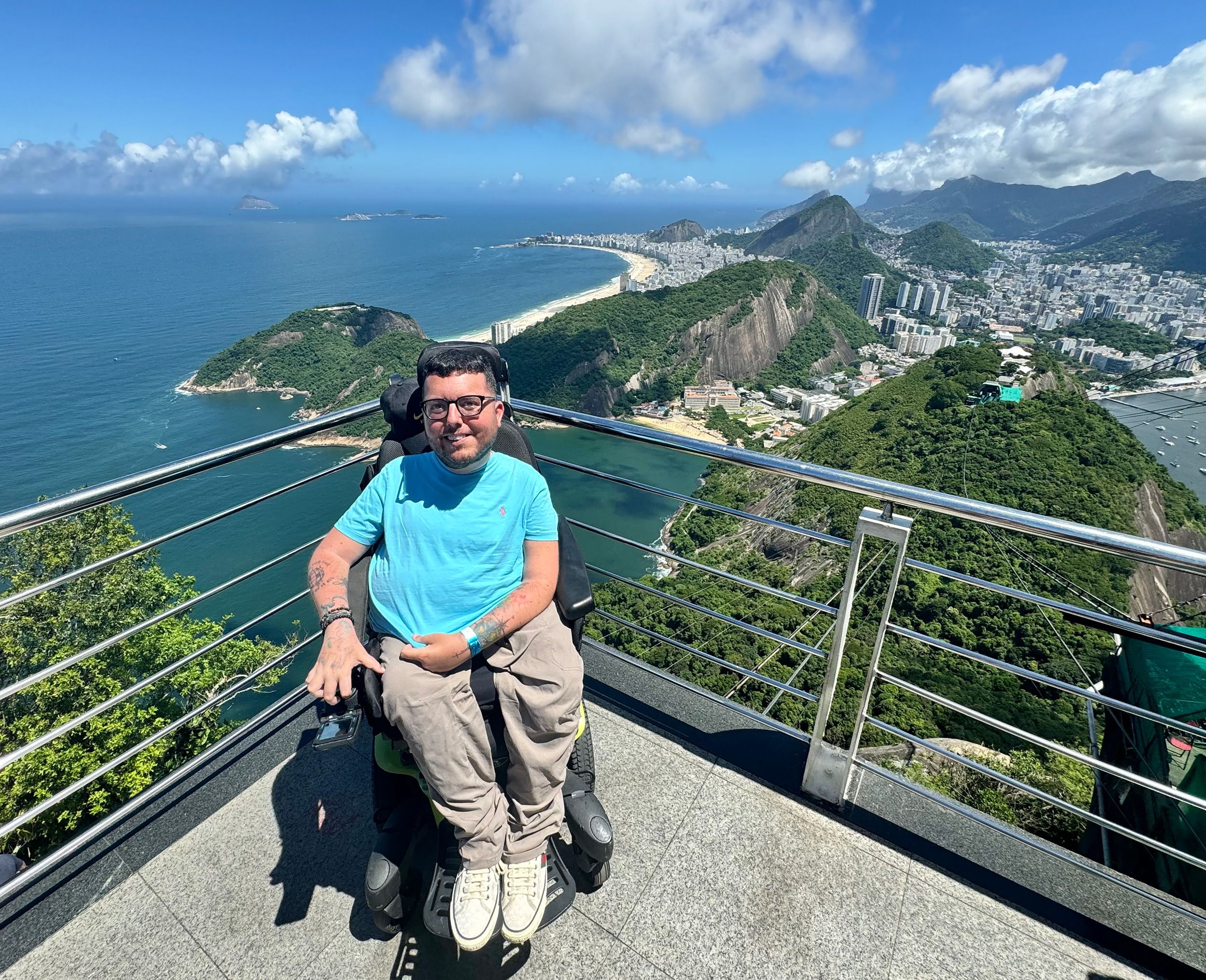
At 36, Cory Lee has a travel record few can match: 56 countries and all seven continents (yes, even Antartica). Remarkably, he’s accomplished this feat while using a 400-pound power wheelchair — navigating not just the globe but formidable accessibility barriers. “I cannot physically use the restroom on a plane, so I’m usually dehydrating and starving myself for a couple days before the flight,” Cory told CNN. “On the day of the flight, I have to physically be lifted out of my wheelchair and put onto the plane and into my seat. On several occasions I’ve been dropped. “I’m constantly worried if my power wheelchair is going to be damaged in the cargo hold because frequently it’s not tied down,” he added. “That happens all the time — I arrived in Barcelona a couple years ago and the front wheel caster was snapped in half. In Atlanta, the joystick was missing, and I couldn’t leave the airport.” The effort it takes for Cory to travel is “insane, so much more than I have to do,” said Cory’s friend Kelly Narowski, a disability rights advocate who uses a manual wheelchair after losing the use of her legs in a car accident. “His level of grit and perseverance is inspiring to me and many others, and I do not use the word ‘inspiring’ lightly,” said Kelly, who has traveled with Cory to Chile, Spain, Greece, Mexico, the Dominican Republic and the Bahamas. Cory shares his adventures and provides accessibility advice on his popular travel blog, “Curb Free with Cory Lee,” which reaches an international audience of wheelchair users and their caregivers who are searching for ways to enrich their lives. “Someone recognized him in a small town in Chile and again in Spain,” Kelly said. “He teaches young people with disabilities that they can still travel. It just is so heartwarming — he really changes lives.” ‘The wheelchair is their freedom’ Cory’s been on so many adventures since he started his blog in 2013 that it’s hard for him to choose his favorites. A safari in Africa stands out: “I was able to touch a hippo — the whole trip really was such an incredible experience.” Thailand, said Cory, “blew my mind — I was able to feed elephants and get a tattoo from a monk at a monastery in Thailand, which was really something! “I’ve gone paragliding in the Swiss Alps. I’ve gone ziplining. I’ve gone snow skiing,” he said. “Travel really pushes me to break out of my comfort zone and embrace the world.” Arriving in Antarctica, Cory recalled crying. “It was such an emotional moment for me, because I had worked so long and so hard to get to that point,” he said to CNN in a 2020 profile. One of his most unusual experiences was a camel ride in 2018 in Morocco – the first of many annual “Curb Free” group tours that Cory organizes for wheelchair users. “A company in Morocco actually invented the world’s first adapted camel saddle,” he said. “I will never forget being on that camel and looking out at the dunes of the Sahara Desert, pinching myself and thinking, ‘Is this even real?’ I never knew that I could have an experience like that as a wheelchair user.” Cory’s mom, 57-year-old Sandy Gilbreath, is his constant travel partner, wrangling most everything — luggage, wheelchair repair, bathrooms, meals, showers and bedtime. “He’s changed my life completely and my outlook on others with disabilities,” Sandy told CNN. “Someone in a wheelchair — I now see them as a person first. “The wheelchair is not what disables them — the wheelchair is their freedom. It’s their independence,” she added. “It’s society and the limitations that are in the world for people with disabilities that is the problem.” ‘You’re an overprotective mom’ When 1-year-old Cory’s knees buckled as he tried to walk, Sandy knew something was terribly wrong. “His legs would just give out, and his head would actually smack the floor before I could rush over and stop him,” she said. “I had taken him to pediatricians and tried to find out, ‘Is this normal? What’s going on?’ They kept saying, ‘Oh, you’re an overprotective mom.’ Finally, at that 2-year mark, I was like, ‘We’ve got to do something,’ and so they did a muscle biopsy on him.” Cory was diagnosed with spinal muscular atrophy type 2, or SMA, a progressive genetic disorder caused by the loss of motor neurons in the spinal cord. After cystic fibrosis, SMA is the second most common severe hereditary disease in childhood. As the disease progresses, muscles deteriorate, limiting the ability to hold one’s head upright, sit without support, raise arms or even breathe. Traditionally, some 70% of people with SMA live to the age of 25; some make it into their 30s. “It was devastating, absolutely devastating,” Sandy said. “I called my parents, and I was like, ‘He’s got a muscle-wasting disease that there’s no cure for, and it’s just going to get worse over time.’ “My dad answered the phone that day, and he’s always been my rock, my go-to,” she said. “He never even skipped a beat. He said, ‘There’s a lot of things that people have wrong with them, but it’s how you deal with those challenges that make the difference.’ From that day on, I thought, ‘This is it. This is life. We’re going to make the best of it, and we move forward from there.’” The disease progressed quickly. By age 4, Cory relied on a power wheelchair that required an accessible van. Sandy, now a single mom, had no money for a proper ramp or the equipment that could make caring for him easier. “When I say we were poor, I’m not even kidding,” she said. “I struggled to buy groceries, to have gas to take him to therapy — swimming therapy, because in the water he was weightless, so he could move his arms, move his legs. It was 45 minutes from our house, and we had to go three days a week, and I didn’t have the gas money to take him.” ‘If you can’t stand up, stand out’ Despite the family’s challenges, Cory thrived. Carolyn Huggins, his daily caregiver throughout elementary and high school in his small, rural town in Georgia, remembers Cory as an extremely smart child who was “very sensitive to people’s feelings.” “The young ladies at school, they just loved Cory,” Carolyn said. “They always wanted to help him during the school day — carry his book bag, his lunch tray, whatever. I think it was because Cory was such a sweet young man, and he just loved people.” Cory pursued every opportunity that came his way. He was student council vice president twice and a member of the German Club, Beta Club and Drama Club. He also performed outside of school, starring in several plays across northwest Georgia. “I jokingly tell people I’ve always felt like Cory didn’t even know he was disabled,” Sandy said. “Mentally, yes, he knows his limitations, but he never acted like he was disabled. He wanted to be in the spotlight, never shy or embarrassed or hiding his wheelchair. I don’t know where it came from, but I’m glad he had it.” Cory credits his family, and especially his mom, for his positive attitude toward life. “My mom, when I was growing up, she always told me: ‘If you can’t stand up, stand out.’ That’s been a motto I’ve lived with,” Cory said. “I’ve also not really known life outside of a wheelchair, so I don’t necessarily see myself as disabled. “Society sees me that way, but I don’t see me that way. I was just taught to always stand out and rise above any situation that society wants to throw on me.” The rejection that changed everything As he headed towards graduation with a bachelor’s degree in marketing, Cory started job hunting, with little luck. Then a breakthrough: An advertising firm wanted him to fly to Pennsylvania for an interview. “I was super excited. I flew to Pittsburgh the next day,” Cory said. “As soon as I rolled into the hiring manager’s office, he looked me up and down and I could sense he really only saw the wheelchair and didn’t see me as a person.” Before the interview began, it was over. “It wasn’t even five minutes,” said Sandy, who was waiting in the lobby. “Cory was right back out, tears rolling down his face. He told me the hiring manager looked at him and said, ‘This job is going to require a lot of travel, and you’re definitely not the best fit for this.’ And then the man walked back out of the room. “Now, it’s unbelievable that Cory’s career is travel. But flying home from that job interview, we’re crying on the plane and I’m thinking, ‘What is his life going to be like? What will he do now? Nobody’s seeing past the chair.” Ironically, before the interview Cory had been dreaming of a graduation trip to Australia. His internet searches for accessible travel information came up short, exposing yet another obstacle for people with disabilities. “I thought, I’ll launch an accessible travel blog as a hobby — I never expected it to take over my life in the way that it has. Yet, it’s been the best thing that could have ever happened to me,” Cory said. “I can finally communicate with other people that actually understand what it’s like to live and travel with a disability. It’s been the best experience in the world.” A booming business As Cory’s online audience grew, he was invited to give speeches and attend business conferences on accessible travel, broadening his reach. “Travel destinations started reaching out to him and saying, ‘If you’ll come here and show what we’re offering, we’ll pay for it. We’ll pay you.’ It’s just grown into something unbelievable for me and for Cory,” Sandy said. As the company blossomed, Sandy was able to quit her job as a Medicaid specialist and become a full-time employee, documenting their travels with videos and photographs and assisting with social media. She also co-authors children’s books with Cory and serves on the board of The Curb Free Foundation, a nonprofit they launched in 2022 to provide travel grants to wheelchair users. “They offered me the opportunity to make a dream a reality,” said Maylan Chavez, a Florida-based Francophile who won a grant to visit Paris after years of French lessons. “When I was at the opera and the Louvre, I would just cry a little bit, and say, ‘Wow, I can’t believe I’m here! I can’t believe I made it!’” said Maylan, who also has spinal muscular atrophy type 2. “Many of us with SMA, we can’t even do a three-hour road trip because we don’t have the means, or we don’t have an accessible car or caregivers to take us,” she said. “I know a lot of us are homebound, so being able to see Cory go to Indonesia and all over the world and then being able to do a trip myself was incredible.” As his health has worsened in recent years, Cory has been determined to visit as many places as possible before travel becomes too difficult. He and his mom took 24 trips over six months in 2025 and, so far in 2026, have taken 17 trips over four months. Next year’s plans include Beijing, Hong Kong and four group trips to Italy, with more to come. Sandy worries about her health as well. Despite doing daily core exercises for years — 200 crunches before bed and 50 squats while brushing her teeth in the morning — she fears the physical strain of lifting Cory in and out of planes, taxis, trains and trams could take a toll. “I’m not only stressed about his health and his equipment getting damaged, but I’m also worried about me. What if I got sick and we’re on a trip? Who’s going to help him?” she said. “I try to be positive, I really do. I’m always looking at the glass half full. But on the inside, it hurts to see your child struggle just to raise his arms to eat. I see those declines happening,” Sandy said. “But I just live for today. We’re going to do it as long as I’m able and as long as he’s willing to let me.” For Cory, too, the desire to keep traveling outweighs the difficulties. Travel makes him feel alive — and he hopes to spend years doing what he loves while challenging society’s narrow expectations of people with disabilities. “I have the best job in the world,” Cory said. “I hope my legacy shows able-bodied people just what people with disabilities are capable of, and that we can do so much and have so many incredible experiences. The more information and visibility we can get out into the world, the better.”
Topics in this story
Gathered from external sources. Rights to this text belong to whoever originally published it.