Pictured: Winning entries for Wildlife Photographer of the Year 2025
South African photographer Wim van den Heever takes the main prize for his shot
A brown hyena standing beside the ruins of an abandoned diamond mining settlement has earned wildlife photographer Wim van den Heever the title of Wildlife Photographer of the Year.
He set up his camera trap after spotting fresh hyena tracks in the ghost town of Kolmanskop, Namibia. It took him ten years to get the shot, he said.
The brown hyena, the rarest of all hyena species, is primarily nocturnal and tends to live a solitary life. For years, Mr van den Heever searched the deserted town, finding only traces of the elusive animal.
"I knew they were there, but actually photographing one was just never going to happen," he says he thought.
He was awarded the prize at London's Natural History Museum.
The annual exhibition dedicated to the competition opens at the Natural History Museum on 17 October.
Keep scrolling to explore the full collection of award-winning images.
Category: Junior Grand Prize and 15- to 17-year-old winner
Location: Lepini Mountains, Lazio, Italy
While exploring the Lepini Mountains in central Italy, an area once logged for its old-growth beech trees, Andrea spotted a beetle resting on a cut log beside abandoned machinery.
"This photo shows the story and challenge faced by many animal species: habitat loss," he says. "In this case, it's a beetle that loses the tree and the wood it needs to lay its eggs."
Location: D'Arros Island, Amirante, Seychelles
After weeks of patience, last year's winner , Shane Gross, captured peppered moray eels scavenging for carrion at low tide.
He spent hours enduring the sun, heat, and flies, waiting where dead fish had washed up. Eventually, three eels appeared.
On a cold September morning, Jamie Smart discovered an orb-weaver spider curled up inside its silken hideaway.
"It's also quite special for me because I get to show something that people are usually afraid of," she says.
Photographer: Sebastian Frölich, Germany
Sebastian Frölich visited Austria's Platzertal moorlands, a fragile wetland, to highlight its vital role as a carbon sink and a habitat for diverse wildlife, at a time when Austria has lost 90% of its peat bogs.
Location: Col de la Colombière, Haute-Savoie, France
During an early ascent, Lubin Godin found an Alpine ibex resting above a sea of clouds. He retraced his steps as the sun broke through and captured the scene before the mist returned.
Battling strong currents, Ralph Pace captured this image of a swell shark egg case, revealing a glowing embryo, complete with gill slits and a yolk sac.
Swell sharks depend on kelp to lay their leathery eggs, making them vulnerable to kelp forest loss. Researchers believe Monterey Bay's kelp has declined by more than 95 per cent in the past 34 years.
Philipp Egger observed this eagle owl's nest from afar for more than four years.
Among the world's largest owls, eagle owls are about twice the weight of buzzards. These nocturnal hunters nest on cliffs or in crevices and often return to the same site for many years.
Location: Yundang Lake, Fujian Province, China
Qingrong Yang captured a ladyfish snatching prey just beneath a little egret's beak.
He often visits the lake to document these frenzied feeding moments.
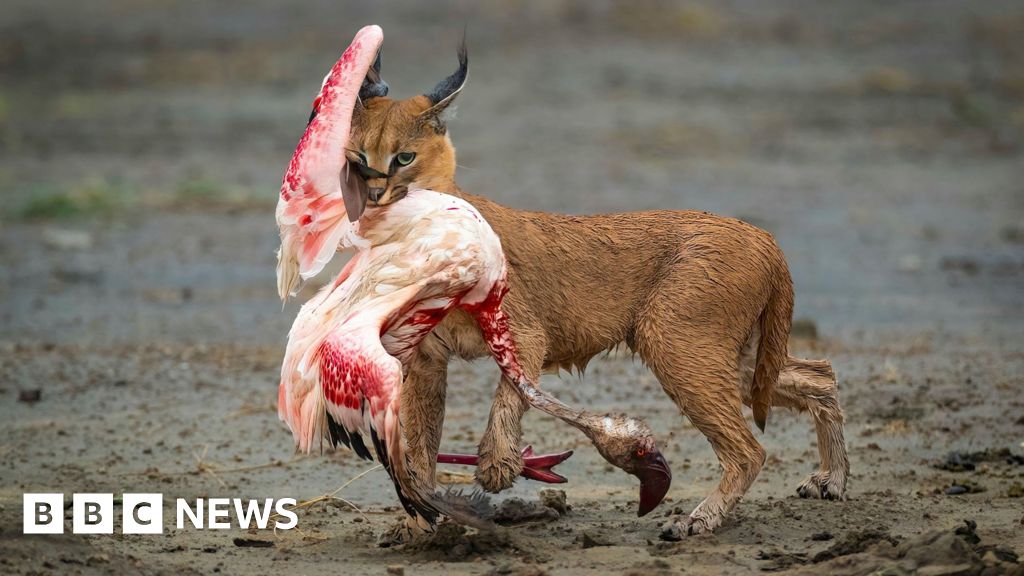
Location: Ndutu Lake, Serengeti National Park, Tanzania
Caracals are known for their acrobatic leaps to catch birds, but sightings of them hunting flamingos are rare.
Location: Ol Pejeta, Nanyuki, Laikipia County, Kenya
After years following the BioRescue Project, Jon A. Juárez witnessed a breakthrough in rhino conservation, the first successful transfer of a rhino embryo to a surrogate mother.
Though the foetus of the southern white rhino, pictured here, did not survive due to infection, the milestone proved that IVF could work for rhinos, bringing scientists closer to saving the critically endangered northern white rhino.
The BBC covered this incredible story and you can read about it here.
Category: Behaviour: Amphibians and Reptiles
Photographer: Quentin Martinez, French Guiana
In heavy rain, Quentin Martinez followed a flooded path to a pool in a forest clearing and captured the metallic sheen of lesser tree frogs gathering to breed.
Photographer: Javier Aznar González de Rueda, Spain
Across the US, Javier Aznar González de Rueda explored society's conflicted views of rattlesnakes from deep respect to fear and persecution.
Photographer: Georgina Steytler, Australia
Location: Torndirrup National Park, Western Australia
Georgina Steytler showcased the gum-leaf skeletoniser caterpillar's strange tower of discarded head capsules. Each moult leaves a capsule behind, forming a stack thought to confuse predators.
Location: Kvænangen Fjord, Skjervøy, Norway
During a polar night in Norway, Audun Rikardsen photographed gulls swarming around a fishing vessel, trying to catch fish trapped in nets.
He aims to highlight the conflict between seabirds and the fishing industry. Many birds drown in purse seine nets each year.
Location: Kuching, Sarawak, Borneo, Malaysia
Some carnivorous pitcher plants reflect UV light as part of their display, using colour, scent and nectar to lure prey. To illustrate this, Chien Lee used a long exposure and UV torch.
While Luca Lorenz was photographing mute swans on an urban lake, a coypu photobombed his frame.
Photographer: Simone Baumeister, Germany
Location: Ibbenbüren, North Rhine-Westphalia, Germany
On a city bridge, Simone Baumeister photographed an orb-weaver spider silhouetted against traffic lights. By reversing one of the six glass elements in her lens, she created the kaleidoscopic effect, framing the spider.
Category: Impact Award Winner 2025 & Highly Commended, Photojournalism
Location: CETAS (Centro de Triagem de Animais Silvestres), Belo Horizonte, Brazil
At a rehabilitation centre in Brazil, Fernando Faciole photographed an orphaned giant anteater pup trailing its caregiver.
His aim is to show the consequences of road collisions, a major threat to these animals.
Photographer: Alexey Kharitonov, Israel/Russia
A recently frozen lake in Svetlyachkovskoye Swamp reveals snow-dusted dark circles etched with crack-like veins.
Using a drone, Alexey Kharitonov captures the rapid transition from summer to winter across taiga forests and Arctic tundra.
Wildlife Photographer of the Year 2025 – the best pictures so far
Tadpoles steal show in wildlife photography contest
Badger admiring Banksy-style image wins hearts in wildlife photo competition
Topics in this story
Gathered from external sources. Rights to this text belong to whoever originally published it.