Millions are watching Ash Dykes travel through the Congo Basin. Why do we love watching other people put themselves through extreme adventures?
From morbid curiosity to emotional investment, psychologists explain why we become hooked on watching strangers take extraordinary risks.
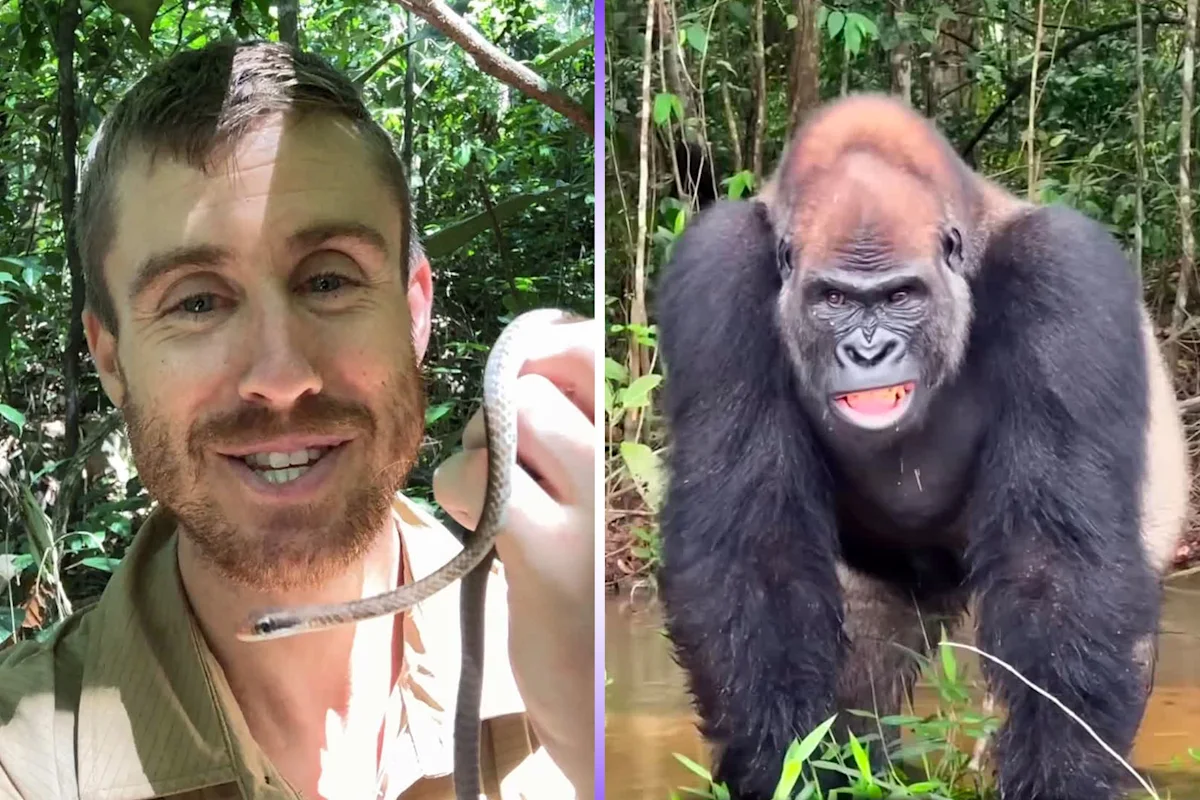
Millions of people are following extreme adventurer Ash Dykes on social media as he attempts to kayak 434 miles through the Congo Basin, which is considered one of the most hazardous and remote environments in the world.
Starting this week, the 35-year-old will travel in an inflatable kayak through waters inhabited by crocodiles and hippos, potentially encountering gorillas and elephants along the way. Consisting of 500 million acres of land and the second-largest river basin in the world, the Congo Basin is a hotspot for tropical diseases and is classed as unsafe to travel due to health, crime, unrest, terrorism and kidnapping risks, according to the State Department .
In a social media post outlining the challenge , Dykes warned he could be "days away from proper medical help" at some of the most remote points of the journey.
With more than 4.5 million followers across social media, Dykes has built a reputation for undertaking increasingly extreme adventures, including becoming the first person to trek across Mongolia solo and unsupported, and the first person on record to walk the entire length of the Yangtze River in China. His adventures have attracted huge audiences, including followers genuinely concerned for his welfare.
Dykes is documenting his Congo Basin journey online as it unfolds, turning an extreme expedition into episodic social entertainment with no guaranteed outcome.
While some social media users seem to be watching the footage through their fingers, others appear torn between excitement and anxiety.
"I hate that we all have to do this," one TikTok user commented on the adventurer's arrival video. "I'm stuck between wanting to experience this and blocking you because I don't want stress," another added.
As audiences follow these extraordinary missions in real time, why do we become so invested in watching a stranger take on a potentially dangerous challenge — and why does finding out whether they make it begin to feel so personal?
For those watching Dykes navigate the Congo Basin from the comfort of their homes, the appeal of such a dangerous expedition may go beyond simple entertainment.
Our fascination with watching others face danger is rooted partly in what psychologists call "morbid curiosity," an interest in threatening or potentially dangerous situations that allows us to learn about risks without experiencing them ourselves.
"There is no better way to safely learn about something dangerous than to witness it," Coltan Scrivner, an author and psychologist at Arizona State University, told Yahoo. "Our mind treats these opportunities for high-consequence learning as particularly valuable, which draws us to stories of danger."
But curiosity is only part of the appeal. Pamela Rutledge, director of the Media Psychology Research Center in Boston, said watching someone voluntarily undertake an extreme challenge also offers the excitement of danger without the physical consequences.
"Watching from a safe distance lets us experience the excitement of danger without facing the consequences ourselves," she said.
For some viewers, particularly those drawn to sensation-seeking, that can make following a risky adventure especially rewarding. Yet it doesn't entirely explain why audiences continue watching when the experience makes them anxious.
Mary Beth Oliver, a professor of media studies at Penn State University, points to a media theory known as "excitation transfer," which suggests that the heightened arousal created by suspense can intensify our emotional response to what happens next.
"Ultimately, I don't think people want to experience anxiety, but that anxiety can heighten our feelings of elation when the character wins or avoids danger," she said.
Oliver compared it to watching a close sporting match. While a win usually feels good, a last-minute victory can feel far more satisfying than an easy victory because of the way the tension builds until the final moment.
Dykes' followers will be left in suspense as they await the next update. As the expedition unfolds, each new social media post offers a snapshot of his progress while leaving the outcome of the wider journey unresolved.
"Each post is a mini-cliffhanger that encourages continued engagement," Rutledge said.
The serialized format is not unique to Dykes and has a long history in entertainment. Victorian novelists published their stories in installments, keeping readers coming back for the next chapter while creating a lucrative publishing model.
More recently, adventure creators such as British YouTuber Ed Pratt, who documented his journey around the world on a unicycle , and British YouTuber GeoWizard, known for attempting to cross countries in a straight line , have built audiences around ambitious, self-imposed challenges.
For Rutledge, the episodic nature of these adventures is part of their appeal.
"Each post is one installment of the journey and becomes a piece of a puzzle leading to the next post," she said.
While the creators' missions differ, each has a clearly defined goal and obstacles to overcome. Dykes has taken this a step further by releasing social media clips documenting his adventure in real time.
When spectators become emotionally invested
As viewers become familiar with Dykes' personality, decisions and setbacks through repeated updates, their curiosity about the adventure can develop into genuine concern for his welfare.
"The question moves from being outcome-oriented: Can this guy kayak 434 miles through the Congo Basin? to a more relational perspective as we get to know Dykes as a person and become more sensitive to the risks he faces," Rutledge said.
This can be explained in part by parasocial relationships , the one-sided connections audiences develop with people they repeatedly encounter through the media.
"The uncertainty and danger threaten someone the viewers feel they know," she said.
But that emotional investment is not necessarily unhealthy.
"Parasocial relationships are, for the most part, beneficial; they can create feelings of belonging and decrease loneliness," the academic said.
While the relationship with Dykes may be one-sided, sharing his journey on social media allows those interested in the adventure to connect and share their anticipation.
"The journey becomes both a vicarious experience and a shared social event," Rutledge said.
For the millions following Dykes' journey, the adventure is far from over. Until the next update arrives, they'll have to keep waiting to find out.
Topics in this story
Gathered from external sources. Rights to this text belong to whoever originally published it.