Newfoundland: The Canadian province with the Irish accent
A new Netflix series features characters with an Irish accent in somewhere you might not expect to find it.
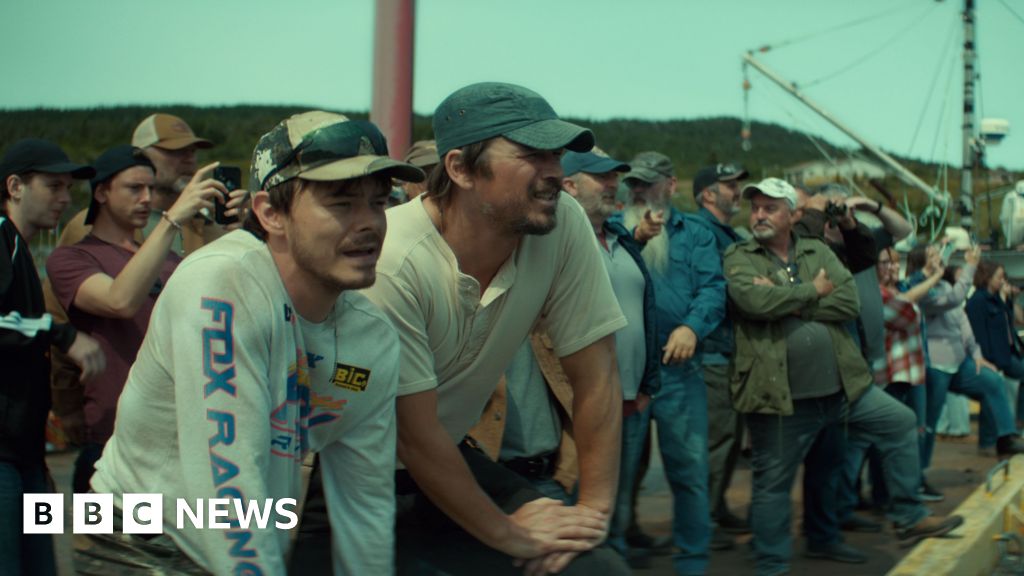
Watch 10 minutes of Netflix's horror mini-series Below and you'll likely be asking yourself: 'Why are they talking with Irish accents when it's in Canada?'
The series is set in a remote coastal fishing town in Newfoundland, Canada's most easterly province.
It follows fisherman Calvin Penney, played by Josh Hartnett, as a mysterious sea creature begins terrorising the community.
And while the main characters' "Irish" accents may seem out of place, Newfoundland has always been a place apart from the rest of Canada.
Fishing, specifically for cod, was what first brought the Irish - mainly from counties Waterford, Wexford, Kilkenny, Tipperary and Cork - to Newfoundland, as Willeen Keough of the Newfoundland Historical Society explains.
The Irish came in boats owned by people from the West Country of England who had established a fishery in Newfoundland and settled there.
"[The West Country fishermen] started to go to the south-east and south shore of Ireland to look for cheaper provisions and for labour for the fishery and that's how the Irish ended up coming out," Keough says.
"They started coming in the late 1600s, primarily though in the 1700s and up to the 1830s. They increasingly replaced English fishers."
She says the immigration "wasn't that kind of mad desperation that drove the later famine migrations".
"They were fishing servants, they were indentured servants coming out. They were paid but they were of that class and status."
While much of the original migration was seasonal, Keough says the Irish eventually settled in areas like the Avalon Peninsula.
"You've got from the Cape Shore around St Mary's Bay; the Southern Shore - a very, very Irish part of Newfoundland; St John's; and then moving into Conception Bay more mixed populations - but the Irish are also there as well.
"You can see that isolation and separation is part of the story there in terms of why Irish people didn't lose their language."
She adds: "Right at the moment I would say what you have is sort of a mélange or mix of West Country [English] and Irish but there are still very distinctive Irish undertones in certain areas.
"We have the d instead of the th - dis, dat and dose.
"The silent h in the thr combination - so instead of three people we'll say 'tree', or 'true' instead of through.
"The people who grew up on the shores, they have such a distinctively Irish sound.
"When they go to Ireland - because people do that these days - people won't believe that they're not Irish, it's that close."
Prof Raymond Hickey is a linguistics expert at the University of Limerick.
He says Newfoundland is an outlier. In the US, Australia and New Zealand, the Irish accent disappeared within a generation.
"The fact that they were isolated for such a long time, far away from the centre of Canada, meant they preserved whatever input they had both from south-west England and also south-east Ireland," he says.
While it became more diluted after Newfoundland became part of Canada in 1949, the Irish accent persists in parts of the province, says Hickey.
"Certainly still to this day in places like Tilting, or on what's called the southern shore, places near the Burin Peninsula - basically away from St John's, the capital, there would be considerable retention of Irish accents.
"I went up to Tilting once and I could have been in County Waterford the way people were talking.
"They use 'do be' which is very common: 'They do be out fishing.'
"Also the use of s on other parts of the present tense apart from the third person singular so: 'I gets up early in the morning', that sort of thing. Or: 'Lots of people does be there.'
Keough says there has been "a sort of cultural renaissance" in Newfoundland.
In the 1960s, '70s into the '80s, students recorded older people, capturing the distinctive accent.
"It reinforced the notion that this is not something to be ashamed of," says Keough.
"So we didn't get sucked into the combination accent of the mainland, we did remain kind of separate."
She says in the 1990s the Irish government and the Newfoundland government signed a memorandum of understanding
"Then there were all these moments of getting together for economic reasons, but also educational and academic and cultural moments.
"That really encouraged Irish [Newfoundland] people with an Irish dialect to keep it up.
"People genuinely wanted to hold on to it but it was reinforced by that and reinforced by tourism - that sort of sold the idea of the Irishness of Newfoundland.
"When people come over here from Ireland they are amazed. I think they feel a great deal of emotional attachment."
When Keough lived in British Columbia for a time, people would ask her if she was Irish.
"I would say no, but I am an Irish Newfoundlander and I would identify as that," she says.
"I think it's becoming a little more fashionable again."
Topics in this story
Gathered from external sources. Rights to this text belong to whoever originally published it.