In Portugal, radar and observers shut turbines down during migration; over five autumns, no soaring birds died, though 5,000 crossed the wind farm each year
Discover how radar-assisted shutdown systems in Portugal's Barão de São João wind farm protect soaring birds during migration seasons without halting energy production.
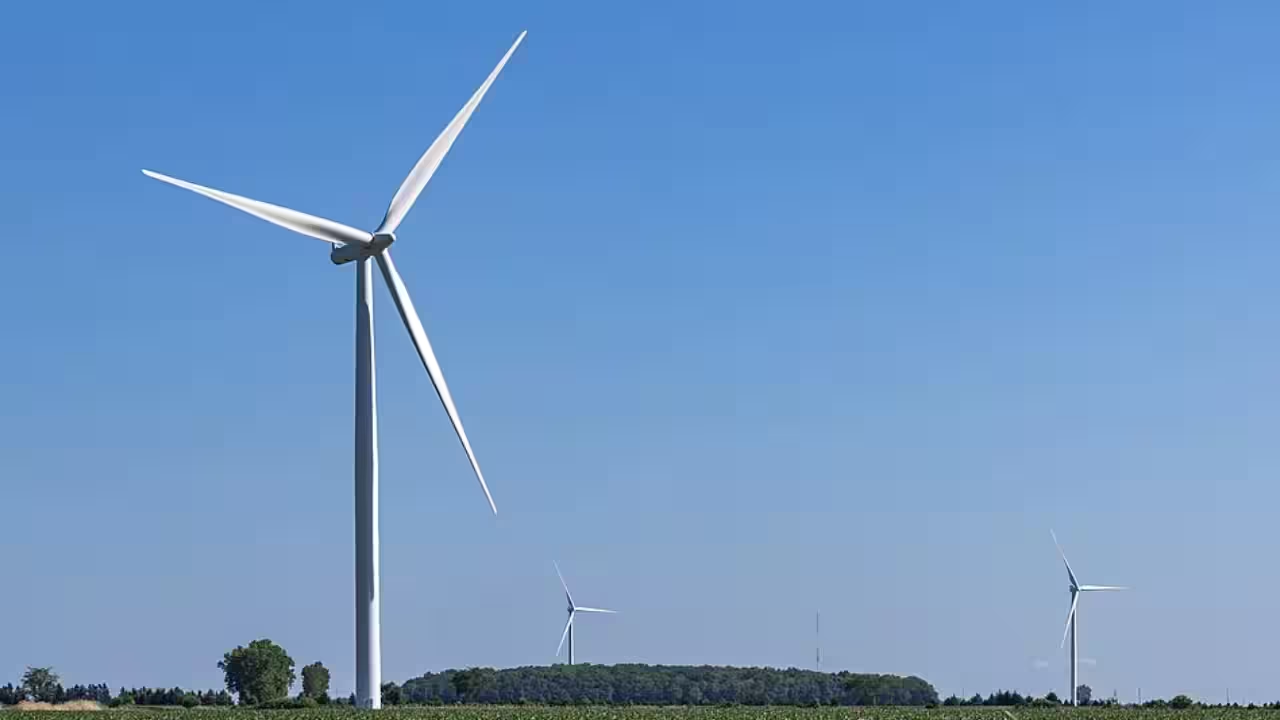
The Barão de São João wind farm in the Algarve, in southwestern Portugal, sits on a migratory flyway crossed by soaring birds, including birds of prey, every autumn. Its licence required rigorous mitigation procedures, including a protocol that uses radar and observers to detect approaching birds and shut turbines down when needed. According to a 2017 book chapter by Tomé and colleagues, no soaring birds died from collisions at the wind farm during five consecutive autumn migrations while the protocol was in use.Radar and observers monitored migrating birds.The research team examined the Barão de São João wind farm in the Algarve, in southwestern Portugal. Their findings appeared in the 2017 book chapter Radar Assisted Shutdown on Demand Ensures Zero Soaring Bird Mortality at a Wind Farm Located in a Migratory Flyway, available through Tethys and written by Ricardo Tomé, Filipe Canário, Alexandre Hespanhol Leitão, Nadine Pires and Miguel Repas. The chapter reports that about 5,000 individuals of 30 soaring bird species cross the wind farm every autumn, and that 55% of the soaring birds crossing were recorded at altitudes associated with a high collision risk.To reduce this risk, the wind farm’s licence required a Radar Assisted Shutdown on Demand (RASOD) protocol. Bird migration was observed near the wind farm using radar. Wind turbines were shut down when certain criteria were fulfilled, such as high activity of migration or flying of the threatened bird species. Initially, the shutdown of the wind farm was made at the request of the observation team, but then the team acquired access to the supervisory control and data acquisition (SCADA) system.Shutdown periods fell from 105 hours to 15 hours.The monitoring program showed that targeted shutdowns could protect soaring birds while keeping interruptions to the wind farm small. According to the chapter, the shutdown period corresponded to 0.2% to 1.2% of the equivalent hours in a year’s wind farm activity. The annual shutdown averaged about 105 hours in the first year and fell to about 15 hours once the monitoring team gained direct access to the turbine control system, which matches the top and bottom of that range. The decrease reflected better coordination and the monitoring team’s growing experience in deciding when shutdowns were necessary.No soaring birds died from collisions during five consecutive autumn migrations. Many of the birds crossed at altitudes that posed a collision risk, which makes that result significant. The procedure targeted soaring birds, so its results do not cover other birds that may pass the turbines. There were also collisions of other types of birds, which were not the primary target of the procedure.Selective shutdowns at 20 Cádiz wind farms cut soaring bird mortality by 61.7%Ferrer and colleagues published a significant decline in Griffon Vulture collision mortality in wind farms during 13-year of a selective turbine stopping protocol in Global Ecology and Conservation in 2022. They analysed 15 years of records for 20 wind farms with 269 turbines in the Cádiz area of southern Spain, from two years before the protocol began in 2008 through 2020. After it began, mortality of soaring birds, mainly raptors and storks, fell by 61.7% and Griffon Vulture mortality fell by 92.8%, with an estimated energy production loss of less than 0.51%. That study covers a different location and operating programme, so its results are not a direct prediction for every wind farm.Targeted shutdowns can support bird conservation.The shorter shutdown times suggest the response became more efficient. Direct access to the turbine controls allowed faster action, and the team’s experience improved its decisions about shutdowns. Radar-guided shutdowns do not eliminate all collision risks, and their effectiveness may depend on bird species, local migration patterns, and the speed of monitoring.You use AI every day. Now get your AI Quotient. Take the AIQ test.
Topics in this story
Gathered from external sources. Rights to this text belong to whoever originally published it.