After Utah removed invasive brown trout from a mountain stream for 4 years, native Bonneville cutthroat trout recovered to near-carrying capacity within 6 years
A groundbreaking study reveals how Utah's Right Hand Fork stream successfully restored populations of native Bonneville cutthroat trout after eliminating invasive brown trout, demonstrating rapid ecosystem recovery and the importance of habitat management.
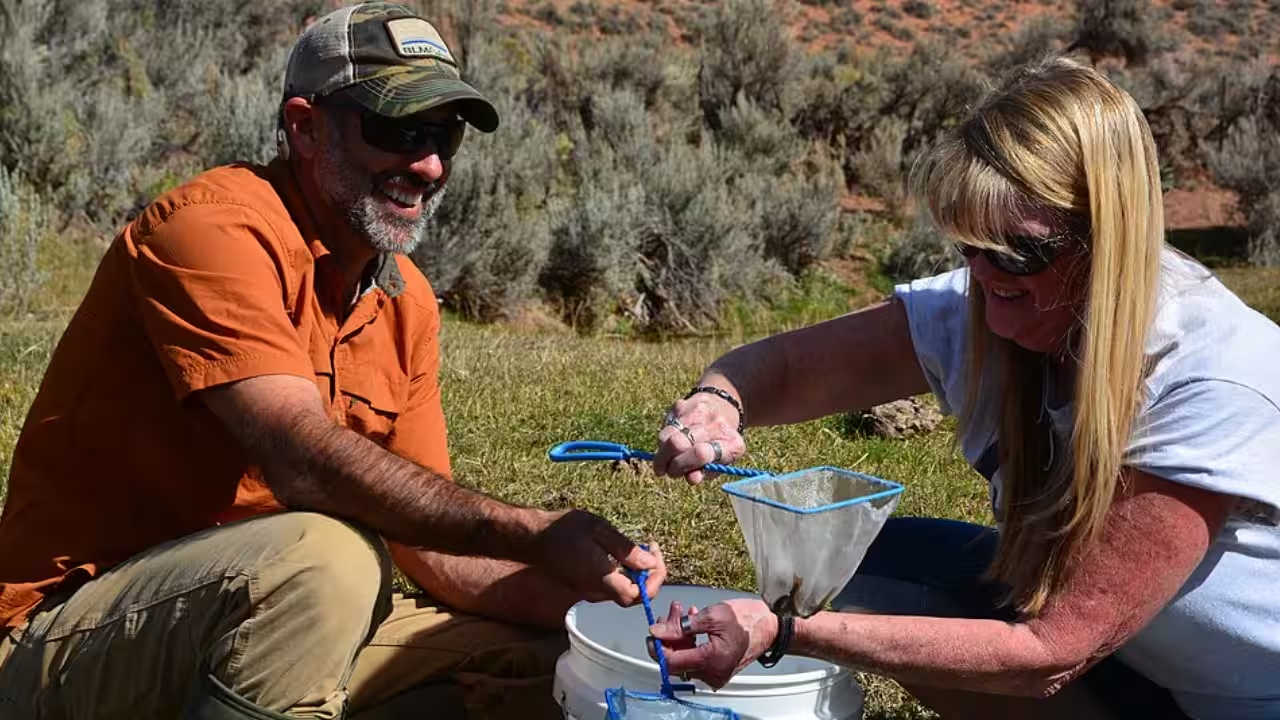
Removing an established fish population from a mountain stream is not a simple task. Even after the unwanted fish are gone, there is no guarantee that native species will return in large numbers. In a tributary of Utah's Logan River, however, researchers found that native Bonneville cutthroat trout could recover surprisingly quickly after non-native brown trout were removed.According to the US Geological Survey (USGS), the long-running experiment took place in Right Hand Fork, a tributary where non-native brown trout had become established alongside the native Bonneville cutthroat trout. Researchers had monitored the fish community for a decade before beginning the removal programme. The four-year effort included two years of mechanical removal followed by two years of chemical treatment. After the brown trout were eradicated, the researchers introduced relatively small numbers of cutthroat trout eggs and young fish. Within six years of the eradication, the native population had recovered to close to the stream's estimated carrying capacity.Removing the fish that had taken overAccording to Conservation Science and Practice, the Right Hand Fork is part of the Logan River watershed in northern Utah and provides habitat for Bonneville cutthroat trout. Brown trout had become established in the tributary by the late 1990s, and before the restoration work, the stream was dominated by the non-native species rather than supporting a resident population of cutthroat trout. Researchers identified competition from brown trout as one of the pressures affecting native cutthroat trout in the wider Logan River system. The researchers first spent 10 years collecting information on the stream's fish populations. This gave them a baseline against which they could measure what happened after the brown trout were removed.The first step involved the use of mechanical removal techniques such as electro-fishing. After this came the second stage, which involved two years of chemical application, aiming at eliminating all the brown trout. This four-year process was not simply one of removing all the fish once and then letting the stream take care of itself. It took repeated efforts since brown trout would live or come back to a part of a stream system. Past experience in the Logan River had proved how hard it was to get rid of brown trout. Through two years of mechanical removal, 15,000 brown trout were removed from 5.6 kilometers of Right Hand Fork.Native trout get another chanceAfter the removal of brown trout from the ecosystem, however, the scientists did not leave the recovery process to chance. They introduced a small number of eggs and young fish of cutthroat trout into the ecosystem. In this way, the experiment evaluated the influence of both factors – elimination of the competitor and the introduction of a new source population for the native fish. Results came fast. Scientists calculated the growth rate and the carrying capacity of the population based on monitoring results during several years. After six years of eradication and seeding of brown trout population reached the carrying capacity of the stream. At least four age classes existed, including adult fish suitable for anglers.The recovery was also consistent with earlier research showing that brown trout can affect the performance of native Bonneville cutthroat trout. A field experiment published in Transactions of the American Fisheries Society examined brown trout's effects on native cutthroat trout at both individual and population levels, providing evidence that interactions between the two species can influence the native fish population. The result was therefore not simply a case of fish numbers rising after a stocking exercise. The restoration removed a competing non-native population and then allowed the native fish to establish themselves in habitat that had previously been occupied by brown trout.What the recovery tells researchersThe modelling of the cutthroat population by the researchers gave an optimistic long-term outlook. This is because the model showed that there was a 95% chance that the cutthroat trout population would have attained at least 90% of its carrying capacity after 10 years of brown trout eradication. This does not mean all the streams will show a similar trend. The study location had healthy habitat, and the researchers stated that removal of invader species could be influenced by the size and status of the ecosystem, among other factors.However, they also noted that such small tributaries as the Right Hand Fork were constrained by size. Any larger benefits might result from their ability to serve as source populations that enable native trout to thrive in the downstream reaches of a river system. The research provided an informative illustration of how the native fish might fare in conditions when they have the opportunity for restoration. Four years of brown trout elimination and six years of monitoring resulted in the population of Bonneville cutthroat trout being on par with the maximum capacity of the stream to support them. The restoration did not take several decades but was fast.You use AI every day. Now get your AI Quotient. Take the AIQ test.
Topics in this story
Gathered from external sources. Rights to this text belong to whoever originally published it.