Saudi Arabia reports 110 million tonnes of ore containing uranium and heavy rare earths in Madinah, boosting its nuclear and mining ambitions
Middle East News: A large mineral resource reported in western Saudi Arabia has added another piece to the kingdom’s expanding plans for critical minerals and nuclear e.
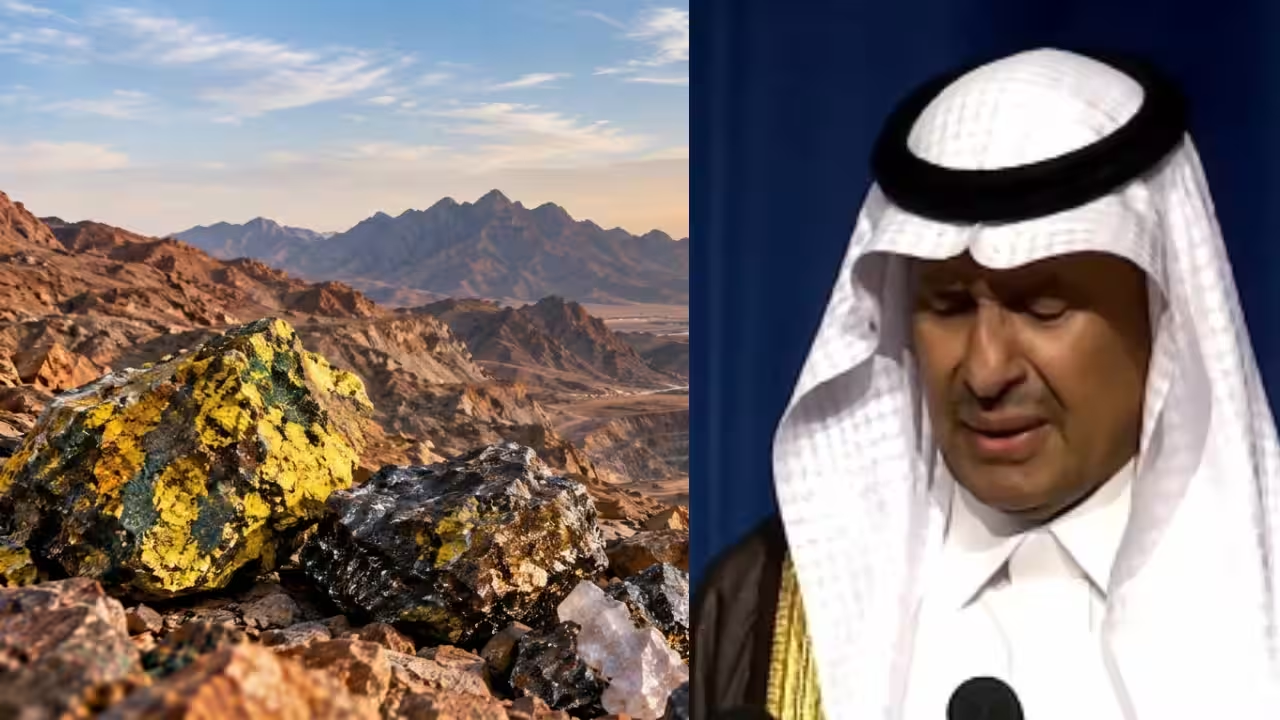
A large mineral resource reported in western Saudi Arabia has added another piece to the kingdom’s expanding plans for critical minerals and nuclear energy. Exploration at Jabal Sayid in the Madinah region has identified an estimated 110 million tonnes of ore containing high concentrations of rare earth elements, particularly heavier varieties, as well as uranium, according to Energy Minister Prince Abdulaziz bin Salman, according to the X post (Formerly Twitter). The announcement was made at the International Atomic Energy Agency’s General Conference in Vienna on September 14. The figure refers to the estimated ore resource, rather than 110 million tonnes of rare earths or uranium themselves.What lies inside Saudi Arabia’s 110 million tonne mineral resourceThe reported discovery comes from exploration and geological work carried out around Jabal Sayid, an area already attracting attention for its mineral potential. The newly disclosed estimate covers about 110 million tonnes of ore in which rare earth elements occur alongside uranium.The rare earth component is particularly significant because the deposit contains heavier rare earth elements. These include minerals such as dysprosium and terbium, which are used in specialised technologies and high-performance magnets. Lighter elements including neodymium and praseodymium are also associated with the wider resource.The ministry’s announcement did not mean that all 110 million tonnes could be extracted as commercially usable rare earth material. The number describes the estimated quantity of ore identified through exploration, while the concentrations of the individual elements determine what could ultimately be recovered.Saudi Arabia’s Jabal Sayid holds large rare earth and uranium resourcesJabal Sayid is not a new name in Saudi Arabia’s mining plans. The site, about 350 kilometres north-east of Jeddah, has previously been identified as one of the country’s important rare earth prospects.An analysis from the Center for Strategic and International Studies, drawing on estimates from Saudi Arabia’s Ministry of Industry and Mineral Resources and state mining company Maaden, put the site’s heavy rare earth resources at around 552,000 tonnes. A further 355,000 tonnes were estimated to consist of lighter rare earth elements.Those figures place the deposit among the larger known rare earth resources globally, according to the analysis. Heavy rare earths such as dysprosium and terbium are of particular interest because supplies are concentrated in relatively few parts of the world.The site also has a uranium component. The same analysis estimated a co-located uranium resource of about 31,000 tonnes. That combination gives Jabal Sayid a different significance from a conventional rare earth project. It potentially links mineral extraction with Saudi Arabia’s longer-term interest in producing nuclear fuel.Saudi Arabia explores a domestic route to nuclear fuelSaudi Arabia has been developing plans for a civilian nuclear programme while seeking greater control over the resources and industrial capacity needed to support it. The latest announcement comes less than two months after Washington and Riyadh formalised a civil nuclear cooperation agreement. US Energy Secretary Chris Wright and Prince Abdulaziz signed the deal on July 22, establishing a framework for long-term cooperation in civilian nuclear energy, according to the US Department of Energy.The US Department of Energy described the agreements as providing a legal basis for a multibillion-dollar partnership lasting decades. They are also intended to give US companies greater access to Saudi Arabia’s civilian nuclear programme.Against that background, a domestic uranium resource has an obvious relevance. A resource inside the kingdom could form part of efforts to develop a local nuclear fuel supply chain, although the existence of an identified resource does not by itself mean that commercial uranium production is ready to begin.There are still technical, economic and regulatory stages between geological identification and actual mining.Rare earth ambitions grew after the 2025 US visitThe mineral announcement also fits into a broader push that has accelerated since Crown Prince Mohammed bin Salman’s visit to the United States in November 2025. During that period, Saudi Arabia and the US expanded cooperation around critical minerals, metals and supply chains. Maaden, Saudi Arabia’s state-backed mining company, also entered into a partnership with US-based MP Materials, the company behind the United States’ only rare earth mine and processing operation. A Strategic Framework for Cooperation followed, covering critical minerals and uranium among other areas.Under the arrangement, the US Department of Defense agreed to finance 49% of a planned rare earth processing plant in Saudi Arabia. Maaden is expected to hold the remaining 51% alongside MP Materials, as reported by The Arab News. The arrangement reflects a wider attempt to develop mineral processing capacity closer to the countries seeking to secure supplies of materials considered strategically important.For Saudi Arabia, the objective is not limited to identifying deposits. Processing and refining are equally important because extracting ore is only one part of turning a geological resource into a usable industrial material.Saudi Arabia says its rare earth resources are growingThe Jabal Sayid announcement follows other large resource estimates reported by Saudi authorities. The Saudi Press Agency reported in November 2025 that the value attributed to the kingdom’s rare earth discoveries had reached $100 billion. It described that figure as a 90% increase compared with 2018.Separate work by the Saudi Geological Survey has identified two advanced exploration areas containing an estimated 644 million tonnes of resources. These numbers form part of Saudi Arabia’s attempt to expand mining beyond its historically important commodities and make greater use of the geological resources spread across the kingdom.Rare earth elements are particularly relevant because they are used across industries ranging from electronics and renewable energy equipment to electric motors and defence-related technologies. Their supply chains have also become an important area of international competition.Catch the latest World News and Live updates. Download the TOI app.
Topics in this story
Gathered from external sources. Rights to this text belong to whoever originally published it.